“All the world’s a stage”: Shakespeare on screen
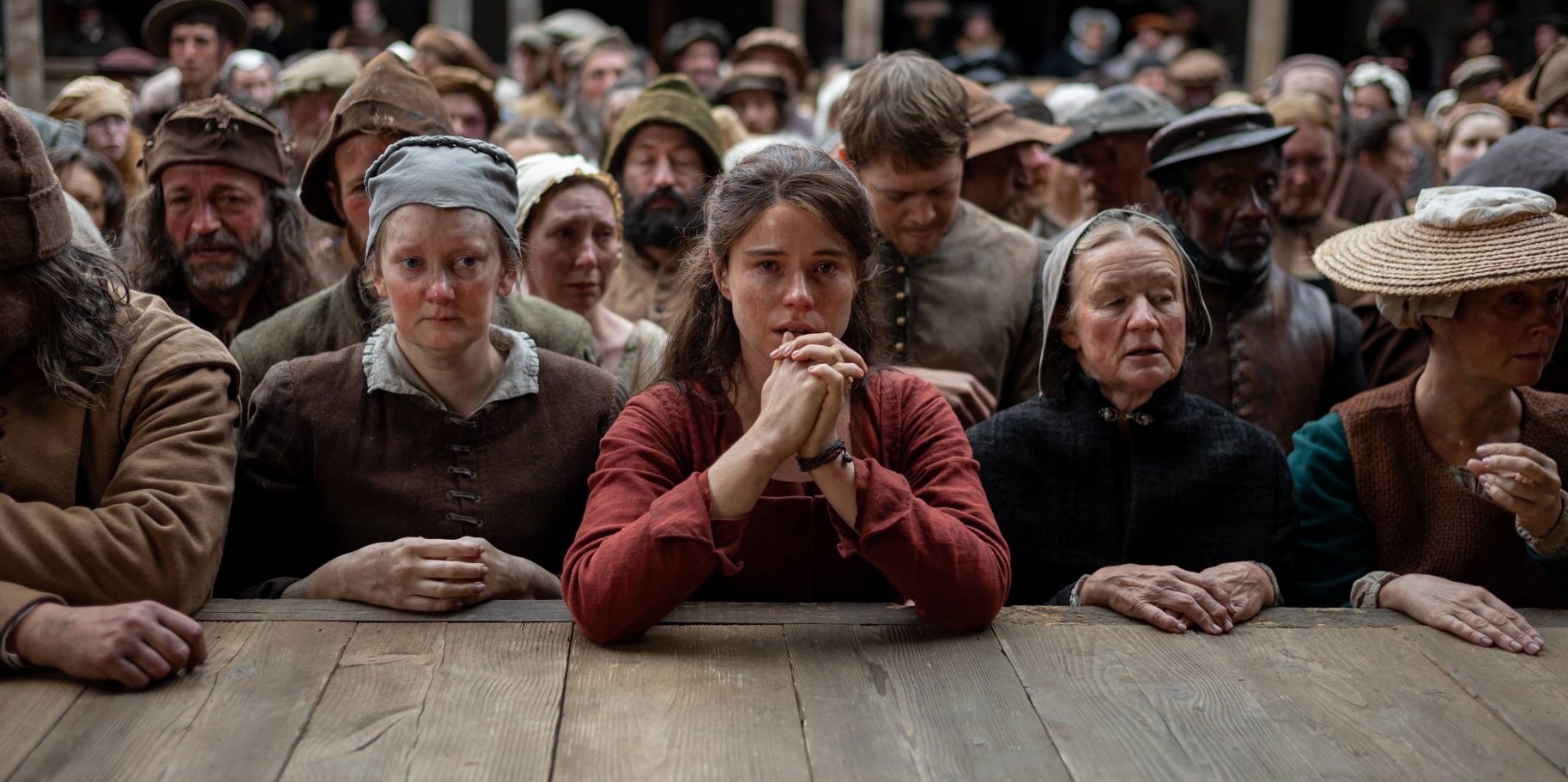
After watching Hamnet, I left the cinema in shock, and I’m sure I wasn’t alone. The tears started when Hamnet was born and I don’t think they stopped until the credits rolled. Not a dry eye in the house.
Director Chloé Zhao’s adaptation of Maggie O’Farrell’s 2020 novel Hamnet presents the story of William Shakespeare and his wife Agnes. Zhao has provided parts of reality in her portrayal of this paragon of English Literature, as People magazine’s Francesca Gariano explains: “there are elements of the story that have been adapted from history”.
Jessie Buckley, Paul Mescal, and Jacobi Jupe’s performances are heartbreakingly beautiful, inevitably leading to Buckley winning Best Actress at the 2026 Oscars, and the culmination of the narrative with Noah Jupe’s performance of Hamlet at a reconstructed Globe theatre brought many a tear to the audience’s eyes – and mine.
How can the “two hours traffic” of the Elizabethan stage address a twenty-first century audience?
Zhao’s presentation of the playwright himself led me to explore how contemporary filmmakers are interacting, engaging with, and subverting his works for the modern world. New York Times writer Drew Lichtenberg describes Hamnet as “a generational gateway for a reanimated obsession with the Bard”. Considering this, how can the “two hours traffic” of the Elizabethan stage address a twenty-first century audience?
With innumerable adaptations of Shakespeare’s works, from Baz Luhrmann’s iconic 1996 adaptation of Romeo + Juliet to Disney’s The Lion King, arguably inspired by Hamlet, his plays have been repeatedly adapted and readapted for the big screen. Which poses the question – are some adaptations better than others?
Hamlet, Romeo and Juliet, and Macbeth are the most popular plays for adaptation, with numerous traditional adaptations, most notedly Franco Zeffirelli’s 1968 adaptation of Romeo and Juliet, Kenneth Branagh’s 1993 adaptation of Much Ado About Nothing, (casting himself as Benedict and starring Emma Thompson as Beatrice), Kenneth Branagh’s 1996 adaptation of Hamlet, Richard Loncraine’s 1995 adaptation of Richard III (with Ian McKellen playing Richard), and Julie Taymor’s 2010 adaptation of The Tempest, starring Helen Mirren as ‘Prospera’, a female interpretation of the sorcerer Prospero. These traditional adaptations stay true to their texts, keeping Shakespeare’s original lines in their scripts.
Modern film adaptations of Shakespeare’s works have provided a much more accessible format for the modern audience. Inevitably, his “star-crossed lovers” are repeatedly presented in many different adaptations of the play. Baz Luhrmann’s fast-paced Romeo + Juliet (1996) starring Leonardo DiCaprio and Claire Danes utilises the direct language of the text with modern alternatives for props and setting, such as using guns instead of swords in fight scenes. The 2011 animation Gnomeo and Juliet reimagines the lovers as garden gnomes, in neighbouring gardens, with an Elton John soundtrack… One of the few Shakespeare plays adapted into a children’s film, alongside The Lion King, Gnomeo and Juliet stands out as one of the strangest adaptations of Shakespeare’s plays. I do wonder how a Gnomeo and Juliet equivalent of The Tempest would play out – would the gnomes be stranded on a beach?
A musical take on Shakespeare is West Side Story. Adapted first in 1961 and more recently in 2021, it presents Romeo and Juliet – or rather Tony and Maria – as the canonical star-crossed lovers in 1950s New York. Divided by tensions over control of the neighbourhood between white Americans and Puerto Rican immigrants, this tragic love story is soundtracked by musical numbers which provide a symphonic accompaniment to this Romeo and Juliet adaptation.
Now for a more modern take on Shakespeare’s other works…
Gil Junger’s 10 Things I Hate About You is a 1999 adaptation of Shakespeare’s comedy The Taming of The Shrew, depicting Julia Stiles as Kat and Heath Ledger as Patrick, a modern depiction of Katherina and Petruchio from the play. The film uses a modern script, although it does sneak in Lucentio’s line “I burn, I pine, I perish” through Joseph Gordon-Levitt’s lovestruck character Cameron. With famous scenes like Patrick singing ‘Can’t Take My Eyes Off You’ down the stairs, or Kat reading her poem: “I hate the way you talk to me, and the way you cut your hair…”, 10 Things I Hate About You is full of quotable moments.
10 Things I Hate About You presents a contemporary romantic relationship that disregards these “outdated Elizabethan values”
This adaptation presents a more naturally developing relationship between Kat and Patrick, compared to the forced marriage of Katherina and Petruchio in the play. Collider writer Taryn Tyler argues The Taming of The Shrew “is the story of a strong woman being shown her ‘place’ in the world as a subservient wife”, therefore 10 Things I Hate About You presents a contemporary romantic relationship that disregards these “outdated Elizabethan values”.
2006 classic She’s The Man is an adaptation of Twelfth Night, another of Shakespeare’s comedies. An early 2000s approach, She’s The Man is an entertaining romcom which follows Viola (Amanda Bynes) deceiving Duke (Channing Tatum) as she attempts to impersonate her brother Sebastian in order to play football for a professional college team. There is a quintessential makeover montage, a messy love triangle, and plenty of iconic one-liners.
However, audiences have commented on Viola and Olivia having chemistry, but ending up in their respective heterosexual relationships, as in Shakespeare’s text. CBR writer Ashley Vivian argues that “She’s The Man fails at acknowledging any of the inherent queerness that takes place throughout”. This begs the question, should modern adaptations of Shakespeare’s plays be faithful adaptations of the original text, or instead lean into the possibilities of queer storylines?
A more recent Shakespeare film adaptation is Anyone But You, a 2023 romcom directed by Will Gluck, starring Sydney Sweeney as Bea and Glen Powell as Ben. Inspired by Much Ado About Nothing (Bea, as in Beatrice and Ben, as in Benedict), this adaptation utilises the ‘fake dating’ trope and the backdrop of a beautiful wedding in Australia to convey to a modern audience what Variety writer Owen Gleiberman describes as “sitcom Shakespeare”. The method of using typical romcom conventions to present Shakespeare to a modern audience is a clever one, but it could be argued that the line delivery and the ‘hate’ between Bea and Ben was slightly forced.
Both traditional and modern film adaptations of Shakespeare’s plays have subverted his work for the big screen, with varying degrees of success. There is definite potential for more adaptations of Shakespeare’s plays in the future, and for more experimental modern interpretations of his work. I for one would love to see a modern adaptation of A Midsummer Night’s Dream, or an adaptation of The Tempest directed by Baz Luhrmann.
Only time will tell, and in the end, “all the world’s a stage”.
Comments