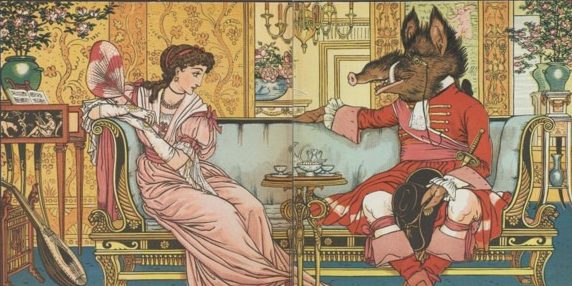
Why are women always the beauty and never the beast?
You would think that the idea of falling in love with someone purely for who they are and not for what they look like is incredibly progressive, propelling feminism forward as we try to fight inane beauty standards for both men and women. However, it seems someone can only ever fall in love with your personality if you are a man, and the person looking past appearances seems to always be a woman. So, if anything, this classic phenomena in film might be perpetuating gender biases.
If you were asked to name even one film where there is a beast-like female protagonist who isn’t a villain or the centre of a horror plot, I imagine you would struggle. I certainly do. But if asked to name films where the male lead finds true love in his ugliest form, the list is almost endless. Beyond the obvious Beauty and the Beast and its 38 adaptations, there’s Shrek, Guillermo del Toro’s The Shape of Water, Hellboy, The Toxic Avenger, even Teen Wolf just to name a few.
The Beast is quite literally toxic masculinity personified (or ‘beastified’) and it falls to Belle, as the woman, to look past his harsh exterior
In the case of Beauty and the Beast, the Beast is not only physically ‘hideous’ but his spoilt, pretentious, and rage-fuelled personality also leaves a lot to be desired. It’s then up to Belle, our ‘beauty’, to patiently nurture and transform him, becoming attracted to him in the process. There may of course be the workings of Stockholm Syndrome interwoven here, but that is a whole different discussion. The point here is that the Beast is quite literally toxic masculinity personified (or ‘beastified’) and it falls to Belle, as the woman, to look past his harsh exterior and invoke the traditional female nature of being kind, caring, and emotionally mature.
Even looking at more lovable characters like Shrek or Megamind, it will always only be the beautiful woman who is able to throw looks to the side and really connect with someone for who they are as a person. Honestly, it’s quite a good parody of real life: we’ve all had a female friend preface showing you a photo of her latest romantic affair with “I promise he’s got a great personality”.
A YouGov study spanning 20 countries even found that women are more likely than men to prioritise personality over looks in a partner. From an evolutionary context, since women have traditionally relied upon men, they are drawn to traits of stability and reliability, whereas men traditionally tend to emphasise fertility cues which of course manifest through appearance.
Why are we still entrenching the archaic expectation that men prioritise looks while only women are encouraged to look past to personality?
Now in this age, where these traditional structures hold increasingly less significance as people are having children later in life and women can be entirely self-sufficient, why are we still entrenching the archaic expectation that men prioritise looks while only women are encouraged to look past to personality?
It comes back to the age old gender bias that should a woman be even conventionally unattractive, that is her defining characteristic. As New Feminist Writer Lucy Dunnet says: “A non-male beast wouldn’t make sense, because only men are afforded the luxury of not being judged by their appearance.”
Naturally the argument could be made that having a female beast would also mean that the main conflict point in the film would ironically centre on her physicality, but what kind of message does it send if we never see a female beast being loved for who she is despite what she looks like?
The only attempt, and what I would deem quite a pathetic one, was the 2006 rom-com Penelope where a wealthy girl with a pig snout needs to find true love to break her curse. Is a rich woman getting a nose job even a curse or just a pretty standard occurrence?
If anything, this just makes the problem worse, as it seems that the most ‘beast-like’ a woman is ever allowed to get is to have slightly larger nose, something which also very harmfully stirs existing insecurities. The cherry on the cake is that, even though Penelope is wildly attractive with her sole ‘flaw’ (if you can even call it that) being the pig snout, her male love interests are unable to move past this and so she breaks the curse with self-love and acceptance.
All I’m saying is: is it really too much to ask to be loved as a woman for who you are, and not what you look like? That would arguably be the most feminist thing we could do.
Comments