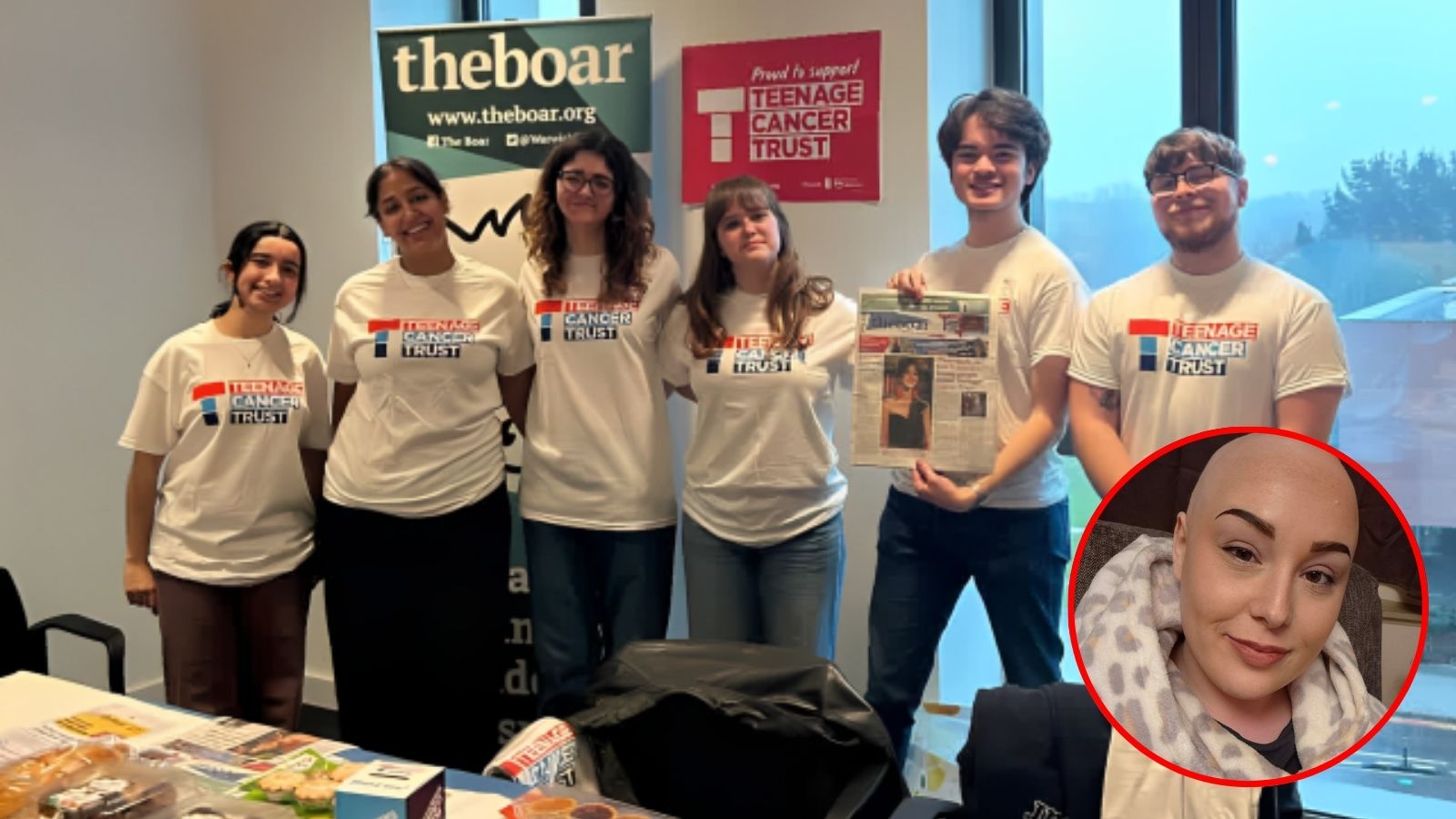
Cancer care, made for young people: The Boar fundraises for the Teenage Cancer Trust
For our February print edition, The Boar is proud to be supporting the Teenage Cancer Trust, the only UK charity providing specialised nursing case and support for young people with cancer. You can support The Boar‘s fundraising by donating here.
Cancer care, made for young people by Martin Day
A sobering thought to start – all of us will be touched by cancer during our lives. Today, nearly one in two people will develop some form of the disease during their lifetime: the product of, ironically, a far healthier society, where people live longer lives and are therefore at greater risk. If it isn’t you (and I do hope it isn’t), it might be a loved one, or a friend, or a neighbour.
Generally speaking, though, you can expect to live a long, cheerful life before you need to be bothered by this fact. The overwhelming majority of cancer diagnoses (nine in 10) happen past the age of fifty, and the disease is most prevalent with those aged 85 to 89 years old. As University students, your focus should be far more conventional – buying circling tickets for Pop, weighing up the pros and cons of a Co-op sweet treat, even attending a lecture once in a while.
There are thousands of students every year who find themselves forced to confront this issue far earlier than anyone should ever have to
Yet there are thousands of students every year who find themselves forced to confront this issue far earlier than anyone should ever have to. A cancer diagnosis in what should be the greatest years of your life is unquestionably devastating – support during this time is invaluable, and that’s why The Boar is proud to be fundraising for the Teenage Cancer Trust – the UK’s only charity dedicated to young people with cancer, providing specialised nursing care and support for those aged 13–24, and their loved ones too.
Julie Wood, Senior Relationship Manager at the Trust, told The Boar: “We exist because cancer care wasn’t made for young people. Without us, a young person diagnosed with cancer today would find themselves lumped together with small children or much older adults – taking away their dignity, independence, and identity.
“You only get one chance at being young, and those years shape the person you become. Friendships, mental health, body image, studies, work, relationships, and choices about the future are hard enough to navigate – before a cancer diagnosis shatters everything.”
We couldn’t do any of this without donations from the public, so your support is vital in making sure we can still be there for every young person who needs us
Julie Wood, Senior Relationship Manager, Teenage Cancer Trust
“We’re here so no young person faces cancer alone. Our units don’t feel like hospital – they’re bright, contemporary spaces where young people can welcome family and friends and be treated alongside others their own age.”
“And our expert nurses and youth workers are specially trained to help young people navigate everything cancer throws at them, from diagnosis, through treatment and beyond. We provide the sensitive, individual care and support young people need at the toughest and scariest time they’ve ever faced – so they can get through cancer, rebuild their life, and shape their own future.”
She added: “We couldn’t do any of this without donations from the public, so your support is vital in making sure we can still be there for every young person who needs us.”
Kelly’s story: ‘When I was diagnosed, I thought that I was the only 24-year-old with cancer’ by Sanjana Iyer
Kelly Underwood, from Birmingham, was just 24 when she was diagnosed with Hodgkin’s Lymphoma in September 2025. After first discovering a lump in her neck in May 2025, Kelly went to the doctors six times before finally getting a diagnosis, initially being dismissed that she just had raised lymph nodes.
As her symptoms persisted, it was only after one doctor noticed that her blood levels hadn’t been right for five years that she was sent in for an ultrasound, biopsy, and CT scan which led to her diagnosis.
“I went along with my partner Olivia just thinking that I was going to be given antibiotics for a possible infection, so we were shocked when I was told I had cancer,” recounts Kelly. Yet, not only did Kelly suddenly face a life-changing diagnosis, she had to wait ten further days to discover what type of cancer it was, which she only uncovered after her partner chased the doctors up.
“We were not given notice that this appointment would be so life changing and I was young, so ideally, I’d have liked to have been able to bring my parents,” she continues.
When she was diagnosed, Kelly thought ‘[she] was the only 24-year-old with cancer’
Feeling ignored and disregarded, Kelly naturally lost trust in her doctors. It was only once she was transferred to the Teenage Cancer Trust unit at Queen Elizabeth Hospital in Birmingham, where she underwent treatment, that she finally felt listened to, and she says she “had every trust in them”.
Beginning chemotherapy at the end of September 2025, Kelly highlights how the Teenager Cancer Trust unit was “so unlike other hospital spaces.” Instead of the expected bleak “white-walled room with no conversation”, she found the unit to be a “bright space with lots of people chatting.”
When she was diagnosed, Kelly thought “[she] was the only 24-year-old with cancer”. At 24 years old, those around you are usually getting engaged, graduating, moving cities, and more. But this is exactly why being treated around other young people in the Teenage Cancer Trust unit was so valuable, as she was able to connect with other young people going through the same thing.
“I am on a similar cycle to the two girls I met, so it helps to have someone going through the same sort of side effects,” Kelly emphasises.
However, Kelly isn’t letting cancer stop her from getting everything she wants out of life. Having wanted to propose to her partner anyway, she didn’t want to wait until she lost her hair or “didn’t look or feel like [herself]”. With the ring already ready to go, Kelly’s original plan of proposing at Kenilworth Castle lit up at night was replaced by a spontaneous Costa drive-through engagement the night before she was admitted and “everything changed.”
Beyond battling the disease itself, a cancer diagnosis comes with a plethora of other concerns that someone also may have never expected to deal with, especially not at 24
“It’s not how I imagined doing it, but I didn’t want to go into the hospital without having done it,” she says. Olivia then returned Kelly’s proposal at the Sutton Park light trail, and Kelly emphasises, “Cancer doesn’t define us – we still had the most beautiful engagement and cannot wait to properly celebrate it.”
Beyond battling the disease itself, a cancer diagnosis comes with a plethora of other concerns that someone also may have never expected to deal with, especially not at 24. Suddenly being told she was unable to work, Kelly faced a lot of stress surrounding her finances, but the Teenage Cancer Trust team were there to help guide her through the process to get grants.
An even more paradigm-shifting reality she had to face was being unable to wait for fertility preservation treatment, since they initially thought her cancer was stage four.
“I’d always thought my partner would carry our children, but after I was told that I couldn’t wait for fertility treatment it did hit me,” she recounts. “We weren’t thinking of having kids just yet, but we suddenly had to think about these things. We were also seeing people around us having children at the time, and it all seemed to hurt.
Naturally, a diagnosis and treatment process as trialling as this takes a toll on your mental health, especially coupled with everything else you have to consider on top of focusing on getting better.
“I feel like it’s a grieving process,” Kelly describes. “To start with I was angry at everything and felt: ‘Why me?’”. She continues, “I lost my hair quite quickly, so I’d look back at pictures and not feel like myself. I couldn’t shower without help, so I felt like I’d had my independence taken from me.” Recounting how she couldn’t stop crying during her second cycle of treatment, a nurse then reassured her: “It’s really normal, look at what you’re going through.”
I then tried to become more positive and that helped. My partner and parents especially were a great help, always making sure I had good company and giving me something to laugh about or focus on
Kelly Underwood
Not even knowing whether cancer was curable when she was first diagnosed, Kelly was writing goodbye letters to her family thinking she was going to die. It was Cathy, Teenage Cancer Trust’s Youth Support Coordinator who was able to distract her by teaching her a new card game.
Being there for Kelly to discuss what was on her mind, and even helping her to laugh when she was down, Kelly highlights: “When your whole life is turned upside down and put on pause suddenly right in the middle of building all of your happiness, the Teenage Cancer Trust team were exactly what I needed.”
Kelly then realised that fixating on her side effects wasn’t helping her: “I then tried to become more positive and that helped. My partner and parents especially were a great help, always making sure I had good company and giving me something to laugh about or focus on.”
By prioritising making time for the things they enjoy, from walks to garden centre visits to Christmas light walks with coffees in hand, Kelly found that the key to getting through was giving herself lists of things she wanted to do, and “letting [herself] feel ‘small achievements’”.
Now having finished her last round of chemotherapy on January 14 and hoping for an all-clear at her appointment in March, Kelly emphasises that through everything she’s experienced she is “not taking anything for granted and appreciating all the little bits of life so much more.”
“I feel I’ve more love to give, and I want to raise as much money and help as many people who are affected by cancer as possible. I want to get married, buy a property and start a family with my fiancée with no more hold ups.”
Comments