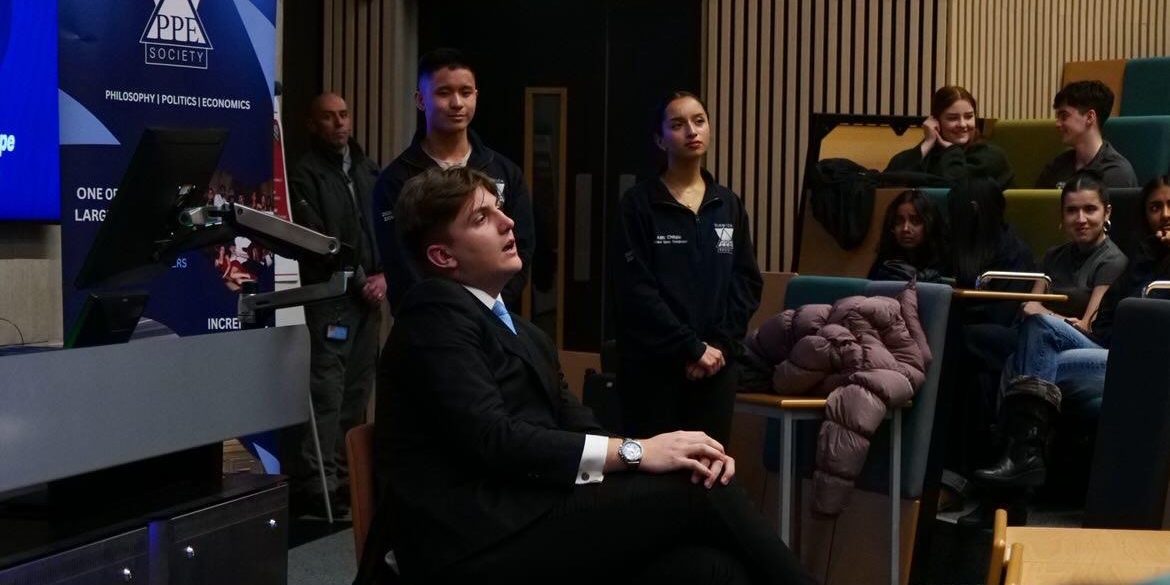
Cllr George Finch: Playing the victim
Among the many right-wing cliches echoed by Reform UK councillor George Finch at last week’s Q&A event, I was particularly intrigued by his insistence on playing the victim. This, in itself, is nothing new, of course. The populist far-right are well versed in criticising the political establishment and the ‘fake news’ media for infringing on their freedom of speech and suppressing their movement. Cllr Finch’s indictment of campus ‘wokism’ stifling open debate, a view he supported by misrepresenting polling data, was as unsurprising as seeing Reform UK MP Robert Jenrick attending protests with neo-Nazis.
What was interesting, instead, were the comments he made to members of the PPE Society exec before the event started. Speaker Series Coordinator Freya Dooks confirmed that Finch asked to be filmed walking past protesters in case something was thrown at him. He later added, once inside the building where the event was to be hosted, that he enjoyed walking past the students protesting outside.
This creates an interesting dynamic. Far-right parties like Reform UK attack the political establishment, and in particular the left, for attempting to silence them, while simultaneously looking to provoke the outrage they claim to be the victims of.
GB News, Reform UK’s very own propaganda machine, is now the most popular news channel in the UK. It is therefore difficult to believe that Reform UK politicians seriously believe their views are being silenced
The simple answer to this conundrum is that far-right parties like Reform UK do not believe their freedom of speech is being taken away, or at least not to the extent they allege. After all, the likes of Nigel Farage, Richard Tice, and Zia Yusuf are consistently featured on BBC Question Time, with Farage even hosting his own show on LBC up until 2020. GB News, Reform UK’s very own propaganda machine, is now the most popular news channel in the UK. It is therefore difficult to believe that Reform UK politicians seriously believe their views are being silenced. The question then becomes, why do they keep up the act?
The simple answer, once again, is that it benefits them. The Reform UK victimisation narrative works splendidly to create a virtuous cycle of growing support among sceptics and ideologues alike. Its leaders push the limits of acceptable political rhetoric under the guise of ‘asking questions’ or addressing ‘uncomfortable truths’, and when they are criticised for spewing hate, their truth-telling persona is vindicated. For Reform, all honest critique is an attempt to silence free speech, and the corrupt political establishment wouldn’t silence something if it wasn’t exposing an uncomfortable truth, right?
Thus, via rhetorical deceit or blatant lies, the right manufactures a moral crusade its would-be followers can identify with every time someone tells them that their favourite word is no longer in vogue. This is not to say that all Reform supporters are racists. But the narrative of the right creates a definitive wedge between an imaginary caricature of the left, and so-called ‘regular people’, subtly nudging those less politically inclined away from the scary communists and closer to the people that just want to ‘cart the weirdos off to the funny farm’. Who exactly are those weirdos? It is best not to ask.
Preventing the most popular party in the UK from speaking at public events only plays into their victim complex
While it is true that a left-wing diagnosis of society’s problem similarly features the binary of a powerful class engaged in the institutional suppression of the majority, its implications are less sinister. The left’s narrative of suppression is inclusive and not delineated in racial terms. Marx and Engels did not say, ‘White workers of the world unite.’ It is no coincidence, therefore, that the revolutionary Black Panther Party in the United States was ardently Marxist.
The right’s narrative of victimisation, on the other hand, is exclusively racial. This was made evident by Cllr George Finch himself. According to him, society has become too obsessed with feelings over truth and hard work. Why his reluctance to consider feelings only applies to ethnic minorities and asylum seekers, however, and not to Warwickshire couples in their 50s, I cannot decipher.
This discussion speaks to the broader debate of whether to platform a figure like George Finch on campus. I understand the reluctance to legitimise his views by allowing him to speak. But as much as I agree with this position, it comes a few years too late. Preventing the most popular party in the UK from speaking at public events only plays into their victim complex. Don’t make it easy for them. Without a coherent left-wing counter-narrative, any attempt to boycott Reform UK will only bolster its support. Luckily for the future of British politics, Cllr Finch bore witness to that counter-narrative first-hand, and it ended for him exactly as badly as expected.
Comments (3)
Throwing a shoe like he’s George W Bush lol
Cllr Finch bans me from speaking during main agenda items of his cabinet meeting unless I provide him a public apology for asking question on alleged 2AM physical attack in Nuneaton that seems very suspect.
I think he should be allowed to speak at universities as long as someone like me is allowed to take part at the same time. I suspect he would then back out. Look at the coward at the last cabinet meeting
https://warwickshire.public-i.tv/core/portal/webcast_interactive/1045032/start_time/5667000?force_language_code=en_GB
mid take