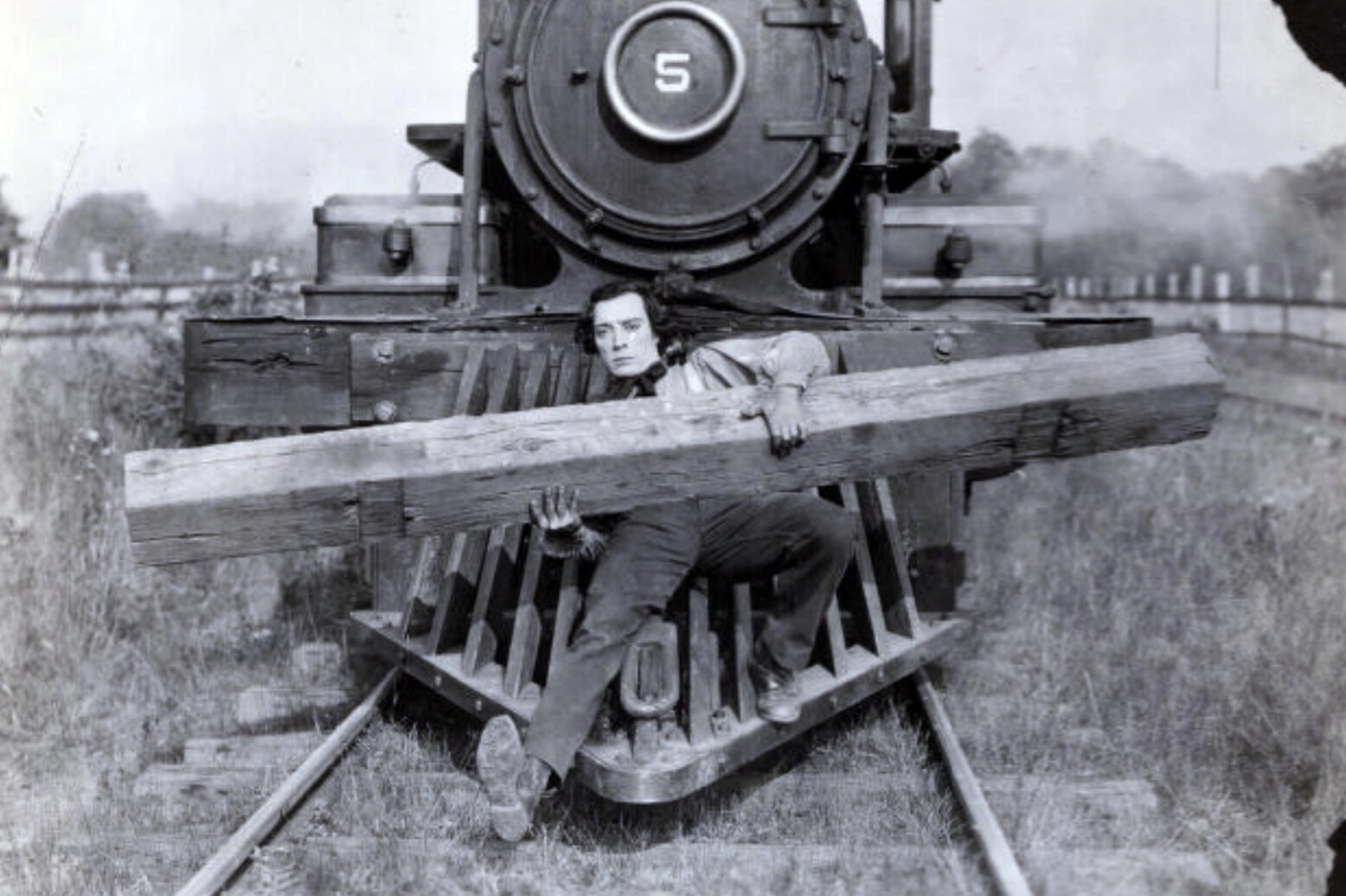
Buster Keaton’s ‘The General’: Why do we root for a confederate soldier?
The Confederacy was an institution that seceded from the United States in 1861 to preserve its Antebellum way of life, and continue to profit off millions of southern slaves. So, in 1926, why did Buster Keaton think it was a good idea to make the hero we root for, in his slapstick adventure extravaganza, a soldier fighting for this same institution? Because he wasn’t.
It’s very surprising to watch a film from a contemporary standpoint that takes a protagonist-based outlook on the confederacy in the American Civil War, rooting for a southern protagonist, and for it to not be shrouded in controversy. For example, 1939’s Gone with the Wind and 1915’s The Birth of a Nation, are both highly influential films that are yet often criticised to present the ‘lost cause myth’, a romanticised view of the Confederacy in the Civil War. So, how is it that Buster Keaton avoids this scrutiny? Firstly, as a slapstick comedy, a lot of eyes are indubitably on Keaton’s trademarks: his domino effect situational comedy style, camera framing for visual gags with dramatic irony, which his iconic deadpan face is oblivious to, as well as his daring and inventive stunts. However, the most important part of the film are his character, Johnnie Gray’s, motivations.
This sets a direct conflict between the relatable and legitimate stakes of Johnnie’s love for Annabelle and its obstacle being the Confederacy.
From the get-go, it’s clear that Johnnie doesn’t have an interest in being a solider. He is a train engineer who has two sweethearts in his life, his train called ‘The General’ as well as Annabelle, another southerner. This kind of satisfaction in your life, being with the people you love and having a job related to your passion, is something an audience relates to and desires, and is certainly what Johnnie as an individual is founded in. It is only when Annabelle’s very nationalist brother and father try to be first to enlist, (when Johnnie doesn’t even leave his seat after hearing the news), that he races to the recruitment office. However, he is deemed more valuable to the state in his engineering role, to the dismay of Annabelle and her family, who don’t believe him when he says the state didn’t enlist him. Annabelle tells him ‘not to speak to her again until he’s in uniform’. This sets up the conflict between the symbolism of Johnnie’s identity. His individualism is founded in being an engineer and loving his train, which clashes with the obstacle of the family of his beloved Annabelle being cultivated to believe that one’s value is in what you bring to the state. This is evidently an ironic hypocrisy as America was founded on the concept of individual liberty, as well as freedom from a big state. This sets a direct conflict between the relatable and legitimate stakes of Johnnie’s love for Annabelle and its obstacle being the Confederacy.
A year later, Johnnie still works on the railway, and Annabelle hears her father has been wounded. She travels on the General, and her and Johnnie still aren’t talking when it stops for a break for the workers. Little do they know, however, Union spies wait to steal the train and burn everything behind them as they race away to prevent reinforcements for a surprise attack. It turns out, Annabelle went back on the train for her bags just as the Union soldiers drive away with it, much to Johnnie’s dismay. He calls confederate soldiers to board another train in pursuit but initially doesn’t realise the engine and carts are not connected. With it being too late to look back, what follows is a cat and mouse chase with Johnnie a one-man army – giving way to his strength and competence with trains as an individual on full display. He traverses challenge after challenge by jumping off and quickly switching the inverted railway turnouts, climbing to the front of a moving train to clear debris and even holding onto the gap between two disconnecting train carts.
Eventually, after a night hiding behind Union lines and overhearing their plans, he saves Annabelle and reclaims his train, rushing back to the south to warn them of the surprise attack. Thus, Johnnie displays his further strengths as an individual, symbolised through his slapstick-based maneuverers with his reclaimed train, this time as the mouse in the chase throwing the cat off its tail. He pulls apart the tracks behind him, and pulls down trees to block the path. After warning the south and bringing Annabelle home, he joins the soldiers for the epic battle scene by the river. Interestingly, during this scene where he is serving the state, Johnnie’s competence is exhibited in a completely different light when he’s a soldier. He looks around cluelessly as gunshots ring around him, constantly dropping and flinging his sword about carelessly. By blind luck, he flings his sword into an enemy sniper, and the Confederacy wins the day.
Now should be the time for him to walk off into the sunset but Keaton has one last surprise for us.
The ending is the protagonist’s reward for completing his goal, as is conventional in film. He’s saved his home and the girl. Now should be the time for him to walk off into the sunset but Keaton has one last surprise for us. Following the battle scene, which deploys an epic degree of filmmaking with its abundance of extras, and grand practical effects, Keaton is rewarded for his antics throughout the film. Is he rewarded by getting to live in peace with Annabelle? No. Is he rewarded by getting to live in peace with his train? No. Instead, Johnnie’s character finds himself in over his head by getting rewarded with his incorporation into the Confederate army, promoted to the rank of lieutenant. Notably, it is only at this point Annabelle’s character finally shows interest towards Johnnie again. This feels deeply cynical when you consider his individual achievements of chasing the Union train of soldiers, spying behind Union lines, getting Annabelle back to town on his train and throwing everyone off his path. It wasn’t for the Confederacy, it was all for her. Although, it is only in this moment, when the ‘Chekhov’s gun’ narrative principle of everything having pay-offs is evident. Annabelle sees Johnnie in uniform, linking to what she mentioned earlier, and he truly wins her over.
Even in this somewhat twisted way of achieving his goal, Johnnie still cannot rest. As he finally gets his alone time with Annabelle and is about to get his earned climatic kiss, Confederate soldiers are called, and march on past him. He is obligated to salute each one that passes, never quite getting to kiss Annabelle between each salute. Despite all his work for the state in the film, even if it is motivated solely by Annabelle, Johnnie’s reward is more state work because that is what blindly-led nationalism can cultivate. It’s a darkly twisted end when the curtains close and we leave Johnnie; he has to fight a war he doesn’t want to and given the competence of his character displayed as a soldier beforehand, it’s unlikely he’ll see Annabelle again.
The General is a comment on blind nationalism
Ultimately, we may root for a protagonist from the Confederacy, but this is not rooting for the Confederacy as a state and institution. It is only through caring about Johnnie’s individual character, by way of the simple truth that he wants one thing, that we gain insight into how the Confederate state treats this relatable, motivated character. Whilst he fights for the state, he is not rewarded with his individualist goal of the film, which is his own interest in Annabelle, and instead becomes entangled within the machine. Despite everything Johnnie has accomplished, there’s no rest for him when the state comes knocking on his door, and the old men send the young to fight. He has to do it all again, and instead of rewarding Johnnie, the state has essentially given itself another soldier. Therefore, The General is a comment on blind nationalism and cultivated belief in one’s value to be tied to service for their country opposed to as an individual. It is a film that subdues any reading of itself to be a sympathetic evaluation of the lost cause of the Confederacy myth. Rather, The General leaves us with a darkly comic and foreboding feeling that in serving such an institution, Johnnie may not be coming home.
Comments