A reader’s critique of The Count of Monte Cristo
I was genuinely thrilled when I first heard about the release of a new mini-series adaptation of Alexandre Dumas’ magnum opus, The Count of Monte Cristo. Maybe more than I should’ve been — but in truth, it felt like something I’d earned.
Back in school, I was always quietly envious of the kids who, in the week before the holidays, would smugly announce that they had actually read the book behind whatever film our teacher was about to put on. Consequently, my experience of watching Charlie and the Chocolate Factory or Fantastic Mr Fox felt somehow degraded — as if I was accessing culture in a second-hand, diluted form. It left me feeling not just intellectually subordinate, but almost guilty for taking what seemed like a shortcut.
So, when I heard about this adaptation and scheduled a visit to my grandparents, who spend most of their time exhausting multiple streaming services’ catalogues per day, I thought I finally had the chance to redeem that past cultural inferiority and join the ranks of the “I read the book first” crowd. Unfortunately, despite my hopeful enthusiasm, this experience didn’t therapize such intellectual trauma of my childhood — instead, I was left underwhelmed.
When I finished the book myself, I found its coordinated meditations on revenge lingering in my mind
Reading all 1,312 pages of the epic, revenge-themed classic The Count of Monte Cristo not only provided me with a performative achievement I could shamelessly (and perhaps relentlessly) boast about — and maybe I’m doing exactly that by writing this — but also instilled in me some timeless wisdom about the more optimistic truths of the human experience. These are lessons one might only come to realise after being thrown into a sea-trapped dungeon for decades over a crime they didn’t commit. Like most rich reading experiences, the novel offered me a sweeping, bird’s-eye view of how different temperaments and moral choices shape the course of people’s lives — for better or worse — effectively serving as a practical guide to the consequences of character.
When navigating the internet, it’s easy to stumble across pseudo-profound platitudes — well-intentioned but ultimately hollow. At first glance, a line like “All human wisdom is contained in these two words: wait and hope” could seem to fall into that category.
And yet, when those words arrive as the novel’s final statement, crystallising the summit of your immersion in a story of constantly fluctuating fortunes, their truth becomes undeniable. You can’t help but begin to frame your own life differently.
When I finished the book myself, I found its coordinated meditations on revenge lingering in my mind. In fact, I even produced my own fluffy, buzzword-laden reflection — “let their conscience be the executioner” — which I shared, certainly to the bemusement of my Instagram story viewers. But that hardly mattered. Thanks to Dumas, that sentiment had become my truth.
This (casting) prompted the series to be what I would coin ‘protagonistic’
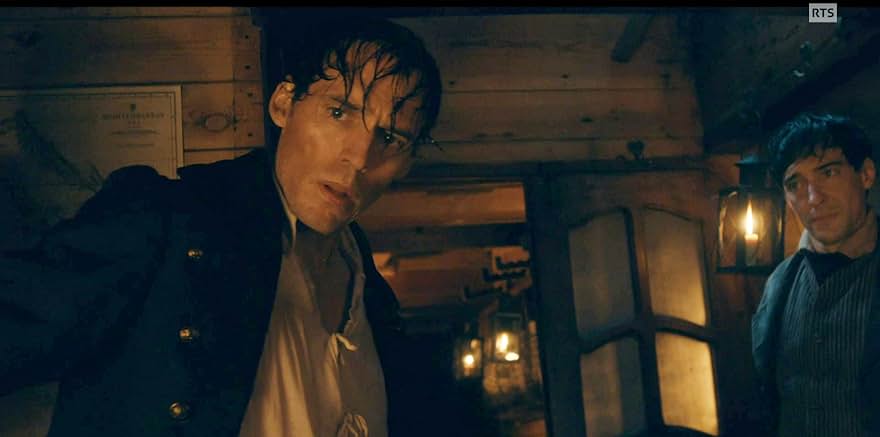
So then, sitting down to watch the series, anticipating I could relive this transformative experience in a more passive and visual way — why did this not happen? Obviously, generally speaking, these productions are never going to be able to replicate the visions your imagination could construct through reading; such visions are intrinsically linked to your psyche in a reflectively revealing way. But I think there was one glaringly specific problem with this production that especially inhibited this imaginative mistranslation, and I suspect it’s where the majority of their budget was channelled into. Launching on the relatively new ‘free’ — but peppered with adverts — streaming service UDave, the producers obviously sought a legitimising starring actor to guarantee the capture of a considerable audience, and therefore Sam Claflin (The Hunger Games actor, stroke handsome British rom-com extraordinaire) took on the leading role of Edmond Dantès (the Count of Monte Cristo).
This prompted the series to be what I would coin ‘protagonistic’, in the blunt sense that we are constantly viewing the world and transitioning through scenes with Sam Claflin (literally, his face is constantly smouldering our screens). This, unfortunately for those transitioning from the book to the series, undermines the significance of the transformation of our leading character in the book. In the book, a third of the way through, when Dantès’ fortune swivels for the second time, we freshly begin to navigate the world through those implicated in the Count’s search for vengeance. He is first, for instance, encountered twice by the newly introduced characters Franz d’Épinay and Albert de Morcerf during their vacation to Italy: first on the Island of Monte Cristo, he appears exclusively to Franz as an enigmatic, wealthy eccentric named ‘Sinbad the Sailor’, kitted out with all the orientalist motifs of the era; and second, he appears in the aristocratic scene of the theatre boxes of Rome, introducing himself now as the Count, with boys attesting to his gothic, supernatural persona by describing him in vampiric terms.
The visual and narrative decisions made in the adaptation obscure one of the most haunting elements of Dumas’s philosophical vision
The effect of this presentation on my imagination was to depict the Count as someone entirely abstracted from the youthful, promising young man we were introduced to at the start of the novel as Edmond. He becomes a persona so shaped and crushed by both misery and the craving for vengeance that he appears almost non-human. In fact, the novel never fully reconciles this transformation with his past love story with Mercédès, the young woman who waited for him throughout his years of imprisonment in Marseille. Their relationship never reaches a state of redemption; instead, the Count is left to search for love and meaning within the context of his new identity, one that no longer fits the life he once had.
Unfortunately, and probably unsurprisingly, merely getting Sam Claflin to grow a beard and adopt a more intense, brooding expression couldn’t replicate this impression for me. And maybe that’s why the series ultimately must conclude with redemption for the Count’s relationship with Mercédès — because with only weak visual cues to convey the psychological weight of his transformation, viewers would likely be confused by his cold rejection of her attempts at reconciliation. Of course, there’s nothing inherently wrong with this alternate ending, but it does highlight how the visual and narrative decisions made in the adaptation obscure one of the most haunting elements of Dumas’s philosophical vision: that some losses are so absolute, and some transformations so total, that even love — especially love — cannot survive them.
Comments (2)
I have just completed the series. Having not read the book, I can only comment on what unfolded over the course of the eight episodes. I found this to be a first-rate series, complete with stunning locations and excellent casting. There is a recent full-length film out now, as well, and the critics seem to prefer the film over this series. Having watched the previews of the film, I have to say that I prefer the pacing and feel of this series version. Why? Although the sweep of the outdoor scenes are wonderful in the series version, it still feels like a stage play, which is a good thing. It is not loud and brash, like films tend to be, but rather intimate in its characterizations. It has a Masterpiece Theatre vibe, only better. So, to wrap up my review, I truly enjoyed this series version. It had the kind of pacing and feel I appreciate. Oh, and one more thing…Mercedes felt like a mature woman with great depth, not just a cute actress. It was another excellent casting choice in a series full of great performances.
This is a good analysis. I also feel it’s easy to villify a woman, especially at the time Dumas wrote this book. Some might argue she married his enemy so deserves to suffer. But think of the lack of choices women had back then. Women had no rights and very few careers were open to them. Mercedes also believed he was dead. She deserves to have a good ending.