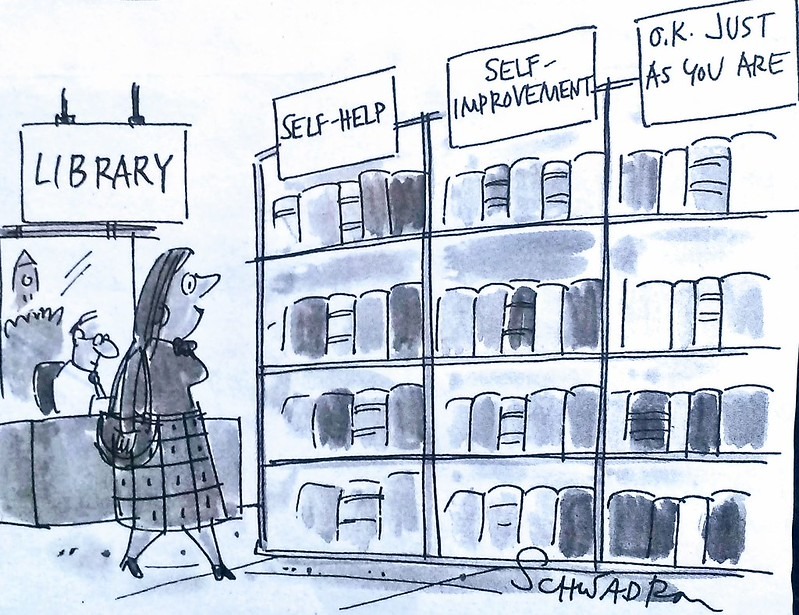
Motivation or manipulation?: Selling the illusion of self-improvement
It is an inescapable truth that those who read self-help books often look down on those who read fiction, and vice versa. I once knew a girl whose parents only allowed her to read self-help books and nothing else. They thought that fiction was a waste of time. Likewise, as a fiction reader, when I visit the bookstore I almost always skip the self-help aisle. The other day I went in, spent a good while flicking through the books, and saw that modern self-help books don’t just offer motivation, but also implicitly impact the way we perceive one’s individual value in current culture.
I saw that a big portion of self-help books revolved around maximising productivity. There were shelves of books populated with titles like Getting Sh*t Done that seemed to prioritise the efficiency in one’s life above all else. My issue arose here: self-help and personal value has become equated to one’s productivity and increasingly organised schedule. In my mind, this fundamentally impacts the wider culture of reading. Books, once an art form, have become a platform for the integration of capitalism into one’s own life. These books promote a bureaucratised way of living, where all our habits must be put on a pedestal and re-assessed to assure maximum efficiency. These books talk about mental health like factory owners talk about their broken machines. Thus, I question whether these books are actual agents of self-improvement or capitalistic cages for our minds.
The Buddhist practice of meditation had been stripped from its cultural and spiritual significance and had been repackaged as a corporate wellness guide
However, these aren’t the only brand of self-help books. There are many books within the genre that focus on promoting inner peace and those that deal with anxiety. I was mainly intrigued by the entire shelf of books dedicated to meditation and mindfulness as the ‘new’ approach to dealing with stress. One book in particular had even called its ideas ‘revolutionary’. I couldn’t help but notice that a lot of these pieces of advice were borrowed ideas – borrowed from the East. Within these books, the Buddhist practice of meditation had been stripped from its cultural and spiritual significance and had been repackaged as a corporate wellness guide. This proposed an interesting contrast. On the one hand, you have self-help books telling you to busy up and manage your schedule, while on the other hand, you have colonised books that help you deal with your packed corporate life. These two premises contradict, and yet pair well together. Books like Mindfulness at Work thus act seemingly as a cure for the stress you ought to accumulate from your newly productive schedule. There seems to be a vicious cycle at hand.
Rather than pointing the finger at those who put you in this hardship, you point the finger at yourself. You maximise your value. It is certainly a different – and toxic – mentality
Rather than identifying the cause of our depressions, we wish to fix it with the myth of meritocracy. It is almost presented as if you buy that meditation book and make your bed every morning, you will suddenly feel immensely better. These practices simply move one’s mind from one capitalist cage to another. I found David Goggins’ books to be an interesting example of this. His book is an autobiography that outlines how the hardships he has faced in his life fuelled him to strive for improvement. He frames his trauma and hardships as a personal task which he strives to overcome rather than critiquing the ways in which the system had failed him. This overt oversimplification of systemic racism and structural inequalities is striking. Rather than pointing the finger at those who put you in this hardship, you point the finger at yourself. You maximise your value. It is certainly a different – and toxic – mentality.
In this regard, self-help books become a microcosm for the mentality that has unfortunately plagued many people in our society. The new Netflix documentary on the manosphere exemplifies this perfectly. Louis Theroux interviews two young men who have experienced a lot of darkness and depression in their pasts yet, for them, this is a sign of weakness and a hurdle to be overcome by working out and enhancing their productivity. This mentality changed the way these men viewed their personal value, as if someone is only valuable if they increase their strength, optimise their productivity, and consequently maximise their output.
Therefore, tethering what it means to be human to values of arbitrary standards, such as ‘productivity’, is ironically unproductive for meaningful improvement. While, of course, there are self-help books that decentralise success, they are not in the majority. Rather, popular culture incentivises the consumption of self-help books which urge you to be mindful through presenting stolen ideas as ideals. Thus, it is key to remind oneself that to be a better human is not to have a rigorous colour-coded schedule or to be overly fixated on physical appearance.
Comments