The Father, The Son and the Holy Trilogy: The end of the Knives Out films
The return of eccentric, Southern detective was brought to Netflix in December of 2025, ending the year with a good old fashioned who-dunnit. The latest addition to the Knives Out trilogy, Wake up Dead Man, finds itself firmly planted into the altars and pews of Chimney Rock. The troubled ex-boxer-gone-priest Jud Duplencity, played by Josh O’Connor, finds himself sent to a small town to aid the local church ran by the tyrannical, fear-mongering, conservative priest, who has created a cult following that hang upon his every twisted word. Father Jud attempts to integrate himself into the church in hopes to acquaint himself with the flock and undo the damage that Monsignor Wicks, the corrupted word of the Lord, has irrevocably done.
Of course, this wouldn’t be a Knives Out film if some impossibly complex murder didn’t take place, and what more fitting than the age-old trope of the ‘impossible murder’ itself, with filmmaker Rian Johnson taking inspiration from Agatha Christie and putting his own spin on the classic murder mystery. Monsignor Wicks walks into a room, and when he is next seen he is unexplainably dead. The town prays for a saving grace, and that arrives in the form of none other than Benoit Blanc, world-renowned detective, heretic and fashion icon, throwing what seemed to be an idyllic church into a crime scene – secrets and truths threatening to tear down the church and its seemingly reverent community.
Johnson’s locked room mystery serves to call to attention the current state of affairs outside of the idyllic hamlet of Chimney Rock
Johnson disclosed to Gold Derby that the process of creating his latest film was difficult, saying it “was definitely the hardest script I’ve ever written.” And much like his previous films, Johnson has masterfully imbued political commentary into his art, he posed the question “Can I make a fun Benoit Blanc murder mystery that examines the issue of faith in America right now?” I believe that he has done just that. Having grown up religious and heavily inspired by the gothic poetry of Edgar Allen Poe, Johnson’s locked room mystery serves to call to attention the current state of affairs outside of the idyllic hamlet of Chimney Rock.
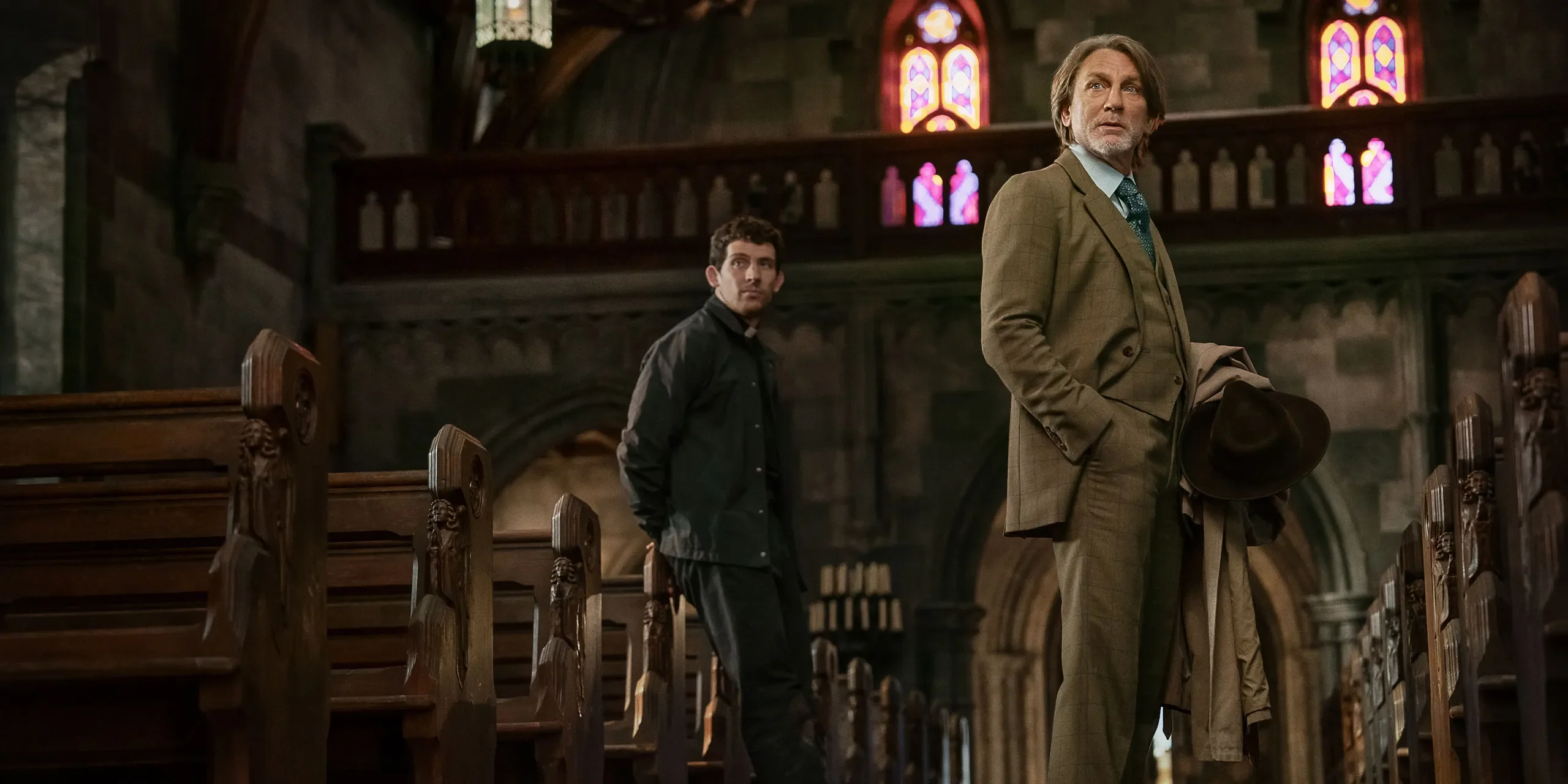
The film itself is cinematically beautiful, an ode to Christie’s classic novels, The Murder of Roger Ackroyd and Murder at the Vicarage, with its church setting. The use of a stained-glass lens over the camera during the flashbacks creates a dream-like feel to the film, unafraid to shy away from the merging of sacrilegious and religious motifs.
The utilisation of lighting was stunning and masterfully interplayed with shadows which truly added to the strained balance between faith and distrust, revelation and sacrifice, which we see with Jud and Blanc. The use of pious motifs was tastefully done, and I would say rather brave, especially within the current socio-political climate of the States, which Johnson has done on purpose. We see a shining beacon of hope through Father Jud, who acts as a promoter of true religion rather than hate and discrimination, and we see this commentary, and subtextual damnation of this type of hatred, with the characters like Wicks, who attempts to spew hatred in hopes that people leave his sermons outraged, radicalising his follower’s hatred with a simple prayer. Interplaying a character like Jud with a man of reason like Blanc demonstrates how differences in beliefs and lifestyles don’t have to be at war, but rather co-exist peacefully.
O’Connor’s ability to play a troubled man with a violent past, converted to a life of gentle love and faith is truly brilliant
Daniel Craig’s performance was witty, and full of energy as his character of Benoit Blanc is magnetic. He is loveably arrogant as we watch him in his element, solving the impossible, determined to save the innocent and seek out the guilty. Craig’s ability to unravel his previous chrysalis of serious roles, to blooming through a character that speaks to his interests, is vividly shown through the care and commitment to his role as Blanc, and it makes for a compelling character to watch. Josh O’Connor’s portrayal of a holy man should be added to the list of priests that actors have played well, such as Andrew Scott, who makes an appearance as a reclusive author. O’Connor’s ability to play a troubled man with a violent past, converted to a life of gentle love and faith is truly brilliant. His character’s desire for truth and for a place of acceptance and love is something to admire and seeing a portrayal of a religious figure such as Jud is refreshing, which I expect is what Johnson was attempting to showcase.
The story was strong, with a compelling hook and a murder that immediately grabbed one’s attention. It had the perfect amount of tension and comedy, and constantly left us in the dark, always one step ahead. There is only so much plot that can fit into two hours, but at times the film seemed a bit rushed or lost and would’ve benefitted from an exploration of some of the characters more, like Wicks himself, or giving more depth to the notorious Harlot Whore. Nonetheless, for a two-hour film there was plenty of shocking turn of events to keep us, as the audience, and Blanc himself, on his toes. Of course, this wouldn’t be a Knives Out film if there weren’t some grizzly yet elaborate murders, first with Wicks, then with Samson, Dr Nat and Martha all following, and yet the story still allowed for some softer, more quiet moments of revelation and sanctuary. Overall, the actors, cinematography and the aesthetics of Wake Up Dead Man made for an enjoyable viewing experience, and the perfect end to the trilogy of films.
Although we say goodbye to Benoit Blanc for now, this may not be the end, as Johnson disclosed to Forbes, “I had this other idea I’d been cooking for a while, and I thought, ‘Well, I’ve done three of these in a row. I’ll give Daniel a little break from me and go up and do something else’”, which gives us hope that maybe the loveable detective and his outrageous cases will return in the future.
Comments