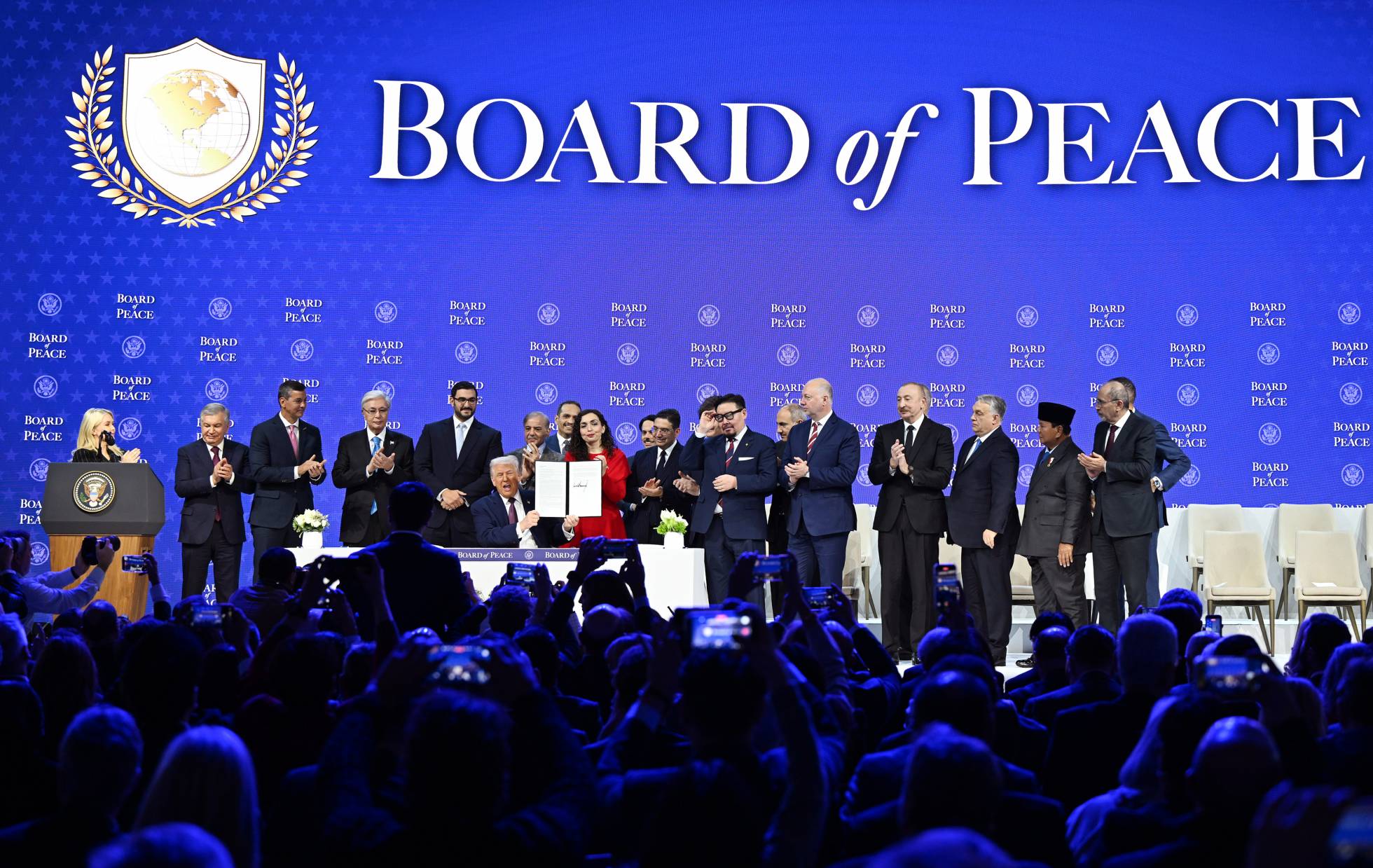
The Board of Peace: A UN deformed, not reformed
At the Davos Economic Forum in January, US President Donald Trump launched the Board of Peace, an organisation dedicated to international peacekeeping. It is perhaps extremely telling that of the 2,000 words of the Board of Peace charter, “chairman” constitutes 34 of them, making it the fourth most-used word in the document, behind “board”, “peace”, and “shall”. The Board of Peace, as it is proposed, is an organisation designed to orbit entirely around the Chairman, chained inextricably in its every mechanism to his will. With this in mind, there is little mystery as to who the charter explicitly names as the individual expected to fulfil the role of Chairman.
Article 3.2 (a) of the charter states: “Donald J. Trump shall serve as inaugural Chairman of the Board of Peace, and he shall separately serve as inaugural representative of the United States of America, subject only to the provisions of Chapter III.” Not only is it extremely unusual for any individual to be explicitly named and encoded in a charter as Chairman of any organisation, but the charter also lays out markedly tight regulations around his replacement. According to Article 3.3 of the charter, replacement of the Chairman “may occur only following voluntary resignation or as a result of incapacity, as determined by a unanimous vote of the Executive Board.”
Though the UN is generally viewed favourably by most people, it frequently draws criticism for its perceived inefficiency, indecisiveness, and ineffectiveness
Almost shamelessly, Article 4.1 (a), only two items down, bestows on the Chairman absolute authority to select the members of the Executive Board. There is no function of the Board of Peace that is beyond the reach of the long arm of the Chairman. The Chairman’s exclusive powers include, but are not limited to:
- Dictate membership of the Board through invitation (Article 2.1)
- Renew (or not renew) the memberships of Member States at the end of their three-year terms (Article 2.2(c))
- Revoke the memberships of Member States (this can be vetoed by a two-thirds majority of Member States) (Article 2.3)
- Dissolve the Board of Peace (Article 10.2)
- Decide the times and locations of Board of Peace meetings (Article 3.1(c))
- Create, modify, or dissolve subsidiary entities as necessary or appropriate to fulfil the Board of Peace’s mission (Article 3.2(b))
- Designate his successor as Chairman (Article 3.3)
- Select the members of the Executive Board (Article 4.1(a))
Permanent memberships can also be earned by countries that contribute $1 billion or more in the first year. Thus far, the majority of the US’s allies in Europe and NATO have declined to join, a fact to which President Trump has responded with the threat of further economic hostilities. For example, French President Macron faced the proposal of a 200% tariff on French wines and champagne should he refuse to join the Board.
In many ways, the highly centralised nature of the charter represents one of the key frustrations that organisations such as the United Nations so often inspire. Though the UN is generally viewed favourably by most people, it frequently draws criticism for its perceived inefficiency, indecisiveness, and ineffectiveness. For many, the UN is as much a symbol of bureaucratic impotence as it is an organisation of international justice.
This is the angle that President Trump is seeking to take when promoting his new project. While he has stated that the Board of Peace will exist to strengthen rather than undermine the UN, and that the Board will operate in conjunction with the UN, he is also transparent about his disdain for the body. According to the BBC, the American President has stated that “The UN just hasn’t been very helpful”, and that “it hasn’t lived up to its potential”, going on to assert “The UN should have settled every one of the wars that I settled.”
Through the Board, over which he has supreme authority, the interests of the US will be carried out on the international stage under the guise of humanitarian justice
Although few would deny that there is room for changes to the modus operandi of the UN, and potentially even glaring flaws baked into the UN’s constitution that endemically hamper its effectiveness as an international peacekeeping body, not many find entrusting global justice to an authority at the sole behest of the US a more appealing prospect. The reluctant uptake (as of yet) by other established Western democracies of the programme seems to suggest they find the current system preferable – to entrust global justice to a democratic and representative constitutionally equal collective, rather than to allow the cause of keeping international peace to be appropriated in its entirety by the Chairman, a position which will be perpetually dominated by the US, as Article 3.3 ensures.
If the Board of Peace does grow to succeed the UN as the arbiter of international justice, this will provide for Trump what is essentially a laundering operation for his international ambitions. Through the Board, over which he has supreme authority, the interests of the US will be carried out on the international stage under the guise of humanitarian justice. To take the Gaza genocide as an example, the Board of Peace is “committed to building a secure and prosperous future for Gaza that delivers lasting peace, stability, and opportunity for its people”, according to the White House. However, the Board of Peace currently has amongst its members no Palestinian representatives.
The fact that President Trump’s close political ally Benjamin Netanyahu’s Israel has managed to claim membership has been cited by many as an example of a US bias and double standards in the region – an issue that seems to be only exacerbated by this proposed ‘Board of Peace’ system. Further, the fact that permanent memberships can be bought, albeit for a high price, also lends the impression that the proposed US-helmed justice has a price, which, if met, would enable the manipulation of international justice by potentially malign actors.
To revoke the membership of a Member State requires a supermajority of 67%, significantly hindering the Member States’ ability to provide checks and balances on the Chairman’s authority
On a more methodological note, the charter of the Board of Peace puts on full display a certain hypocrisy in its constitution. Largely, its structure represents the antithesis of the UN, an alternative to the slow decision-making built around consensus. However, where the charter may enable challenges to the Chairman’s power is where this inefficient and easily petrified system is deployed. As earlier mentioned, Article 2.3 of the charter states that to veto the Chairman’s decision to revoke the membership of a Member State requires a supermajority of 67%, significantly hindering the Member States’ ability to provide checks and balances on the Chairman’s authority.
The choice to include this mechanism in the charter rather than simply bestowing on the Chairman exclusive authority to remove Member States unchallenged perhaps speaks to an attempt to legitimise the Board of Peace by co-opting the UN model, where it is a help, not a hindrance, to the Chairman’s absolute authority. While perhaps not as egregious as the UN’s ‘perpetually paralysed’ Security Council, it does at the very least reveal that the Board’s philosophy towards efficient centralised action is selectively applied to narrow avenues in order to challenge the authority of the Chairman whilst maintaining a semblance of the UN-style consensus model that lends it legitimacy.
The Board of Peace seems riddled with hypocrisies, and many will argue these inconsistencies reveal its true character as a mechanism to legitimise US global interests through the lens of international peacekeeping. In seeking to commandeer the legitimacy of the UN as the ultimate authority on global action and manufacture consent through enforced membership, President Trump’s new charter seems to attempt to wrestle control away from previously established institutions of global governance. However, for many, the point remains – the UN sometimes is too slow, for sure, and needs to be reformed, for sure, but it is democratic and representative, two of the fundamental tenets of justice.
Comments