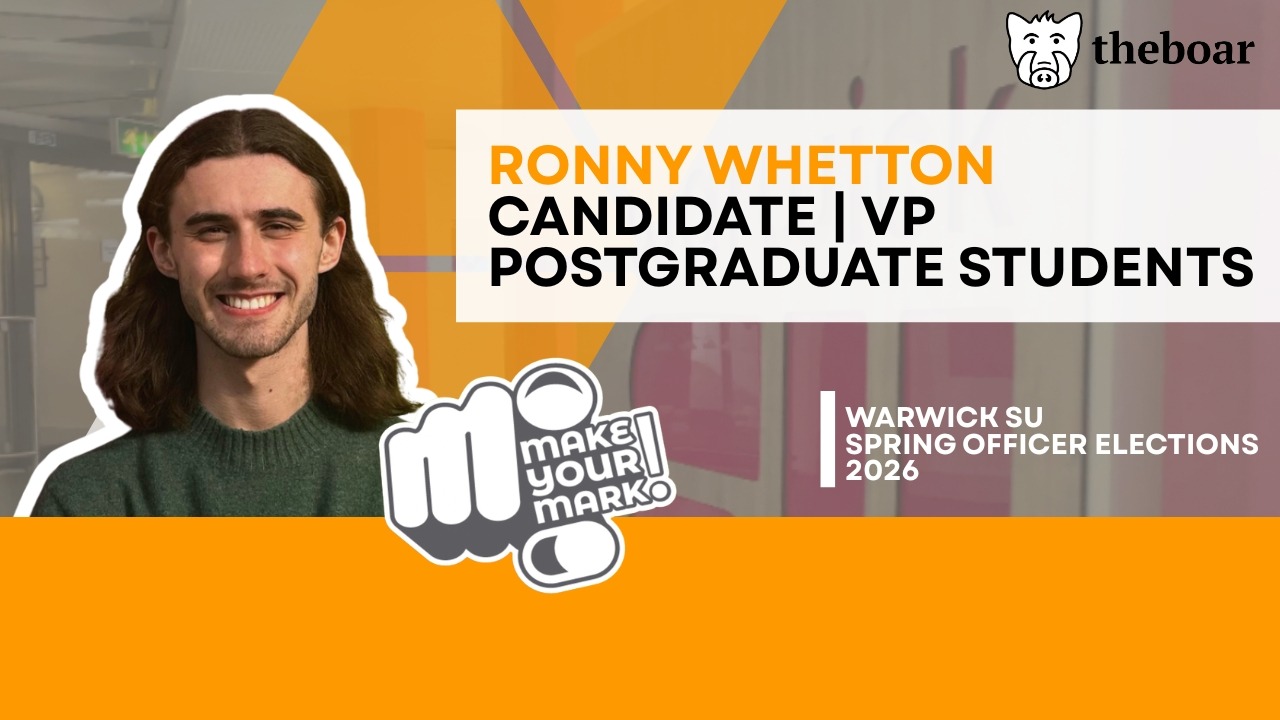
SU Spring Elections 2026 Interviews: Ronny Whetton, VP Postgraduates
In the run-up to the Warwick Students’ Union (SU) Spring Elections, The Boar offered all Full-Time Officer (FTO) candidates the opportunity to be interviewed.
Ronny Whetton, a postgraduate student at the University, joined The Boar to discuss his campaign for VP Postgraduates, outlining his plans to reform SU structures, improve support services, and strengthen engagement with the postgraduate community.
Why did you decide to run for this position, and what makes you stand out from other candidates?
Whetton believes there are significant issues with how postgraduate students are represented within the SU, arguing that postgraduates are often “forgotten” in existing structures.
Drawing on his experience working within SU structures during both his undergraduate degree and this year as a postgraduate, he believes he is well placed to address these problems.
“I understand what needs to be changed, how we can change it, and what needs to be improved,” he said, adding that his goal is to “make the overall student experience much better for postgraduates”.
Many postgraduate students feel disengaged from the SU, societies, and sports clubs. How would you make the SU more inclusive to postgraduates?
Whetton highlighted the differences between Postgraduate Taught (PGT) and Postgraduate Research (PGR) programmes. While PGT degrees involve structured, classroom-based modules, PGR programmes focus on independent research under a supervisor.
He argued that although PGT students are often more involved in academic life, PGR students can “often feel left behind and maybe not as represented,” partly because multiple bodies are responsible for representing them. To improve engagement, Whetton believes the SU needs to rethink its structures and outreach. “There can be a massive amount done in terms of eligibility criteria and overall SU structures,” he said.
One of his key ideas is that the SU should meet postgraduate students “where they are rather than asking them to just come to [the SU].”
He noted that many postgraduates balance demanding courses with work, family responsibilities, and other commitments. As part of this, he wants to change the rules that prevent students from sitting on multiple forums.
Allowing postgraduates to participate in more than one forum, he argued, would make it easier for them to represent both themselves and their peers. His own experience of being able to attend the Societies Forum but not the Postgraduate Forum highlighted what he describes as “disjointed strategies” within the SU. Ultimately, he hopes to ensure postgraduates are “listened to at every level”.
What new services, provisions, or spaces would you aim to introduce to support postgraduate students studying at Warwick?
Beyond structural reforms, Whetton says another key pledge in his manifesto is improving wellbeing services tailored specifically to postgraduate students. From his own experience, he argued that current wellbeing resources are often too general.
“A lot of the resources assume that you are a fresher or that your schedule is akin to an undergraduate,” he says. This can overlook the differences between postgraduate study paths, particularly between humanities programmes and STEM degrees that involve long hours in laboratories.
He also wants to expand financial support systems for students, particularly postgraduates.
“Cost is one of the biggest obstacles to people seeking to study postgraduate,” he said. For many students, the financial burden means they must take on work alongside their studies, which can create further wellbeing challenges.
Overall, he hopes to develop a more “unified strategy” that improves both wellbeing support and the accessibility and communication of financial assistance.
How would you ensure that postgraduate students who come to Warwick from different countries feel welcome and supported during their time here?
Whetton believes the “state of national politics here” makes this increasingly important. One of his manifesto pledges aims to increase “support systems and resources for international students so they feel fully supported” – which could include explanations of “employment culture in this country”, including the rights of an employee or “encouraging unionisation”.
More broadly, he argued that universities should actively resist hostile rhetoric directed at international communities.
“We should be proud of the fact that we are one of the most international universities in the world,” he said. “That is a massive core pillar of what makes us a great university.”
Many Postgraduates also deliver teaching to undergraduates. How do you represent and protect these Postgraduates’ particular interests?
Whetton divided this issue into two key points.
First, he emphasised the importance of workplace unions. Encouraging postgraduate teachers to join unions, he argued, can strengthen efforts to secure “more robust contracts,” improved protections, and better pay.
He also pointed out that the working expectations placed on postgraduate teachers make it difficult for them to engage with SU activities and the wider Warwick community: “They are expected to be available 9-5, which makes it so difficult to engage with the Students’ Union and the wider community at Warwick.”
Second, he highlighted the need for stronger postgraduate representation within SU governance. Whetton warned against reducing postgraduate representation due to perceived low engagement, arguing that this would ignore the structural barriers preventing participation.
“Any attempt to downscale postgraduate representation using lack of engagement as a justification is a complete ignorance of the problem,” he said. He believes there is currently not enough being done to engage postgraduate representation, causing a “self-fulfilling prophecy”. Instead, he believes the SU should create more resources and opportunities for engagement so that it can better represent postgraduate students, who make up roughly a third of its membership.
This interview, along with all other interviews for Full-Time Officer positions, can be watched in full using the link here.
You can also view a list of all candidates and their manifestos here.
Comments