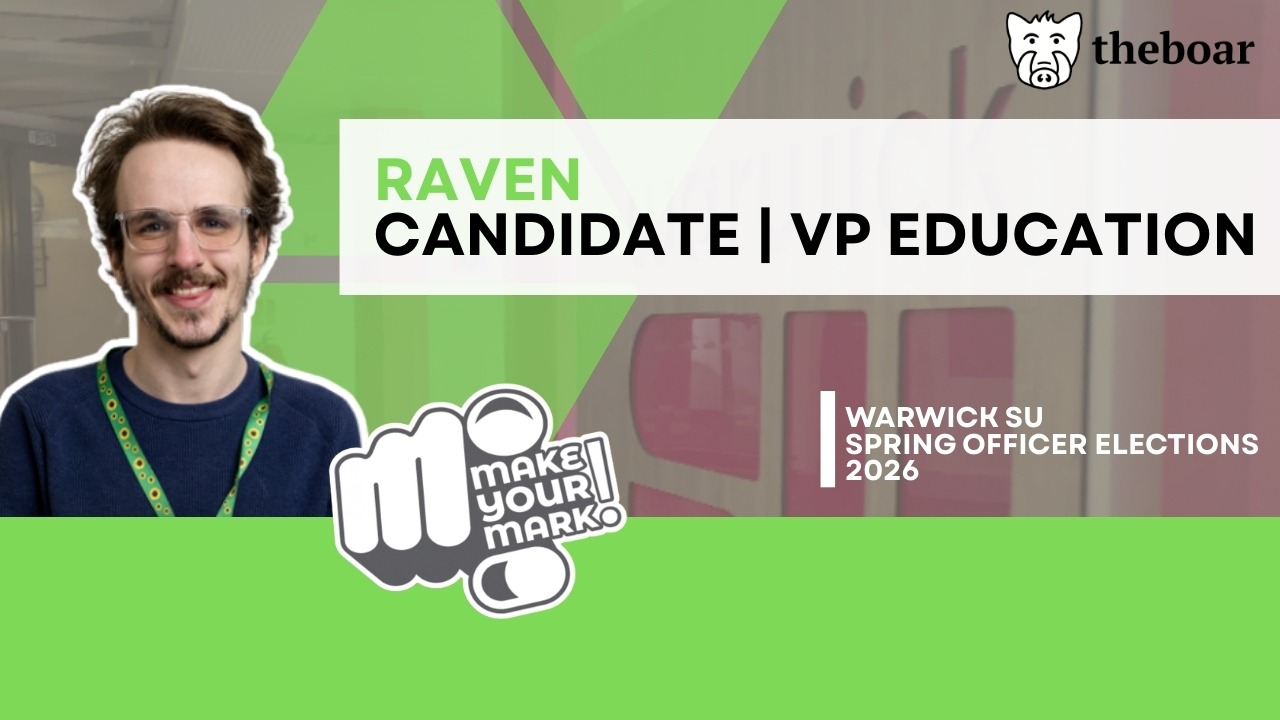
SU Spring Elections 2026 Interviews: Raven, VP Education
In the run-up to the Warwick Students’ Union (SU) Spring Elections, The Boar offered all Full-Time Officer (FTO) candidates the opportunity to be interviewed.
Raven, one of five candidates standing to become Vice President for Education, discussed their campaign for the position with The Boar. The interview explored Raven’s ambitions to create a wider platform for students to share their concerns, advocate for those who they feel the university does not adequately support, and improve learning experience.
Why did you decide to run for this position?
Raven told The Boar that they have been “involved in educational spaces for many years”. On arriving at Warwick, they “built on that to start using my voice to share opinions related to my course, and then worked my way up to things that are more uni-wide issues.”
“So from there I’ve ended up at [being a candidate for] VP for Education, because it’s the next step up from where I’ve been this year, which is one of the Faculty Reps on the Academic Forum.”
What would your key priorities be if elected as VP for Education?
Raven mentioned three broad points that their campaign is centred around. First, Raven mentioned closing the feedback loop. “This is something that I think is possibly one of the biggest issues and something where I’ve gotten unique insight, having been on the Academic Forum this year.
“One of the huge problems with academic representation and making sure students are heard when it comes to academic issues is people need to know who their representatives actually are, what the various Academic Representative roles actually do, and from that then they can actually start being heard on a wider scale.”
Raven also suggested that there needed to be a focus on improving the accessibility of education at Warwick. They highlighted how they felt there was “quite a large failure on the part of the university” in regards to first year and supported students. “I sat in a meeting with the accommodation team recently to discuss a lot of these things, and it’s disheartening to see but the conversation was productive: I want to try and see what can be done. It comes down to practical mitigations”.
“Universal lecture capture also falls under the accessibility point, although there are already ongoing discussions about implementing this within the next year. I do believe this would be a broadly positive policy to implement, and I think it will bring consistency across the University”.
Raven also mentioned how information about mitigating circumstances is not easily accessible across all departments: “I want to also push the University and push the departments to make that information clearer to students and bring it more in line with documents like the Disability Code of Practice.” Alongside this, Raven also discussed the importance of safety within lectures, and how changes to policy about lecture attendance could have consequences that the University needs to ensure it accounts for.
Raven’s final priority, if elected, would be to improve students’ learning experience. Raven focused on the need to improve the support available to independent and estranged students, citing their own experiences with the University. “There have been quite a few discussions through various university committees recently about trialling out assessment and feedback templates, which are being discussed across various departments, basically to give them a model to work on, level the playing field and ensure students know what to expect out of their assessments.”
Finally, Raven touched on independent and estranged student support. Citing their own experiences with the University, Raven suggested that “the departmental support for independent and estranged students is lacking in many, many departments across the university and it’s also very inconsistent where there is support in place.”
Many students “get sent round in a loop between wellbeing and your department and other places in the University: people shouldn’t have to go through that, and especially in a scenario where you’re more inherently at risk. That should not have an impact on someone’s degree”.
What changes do you think are necessary in terms of assessments and exams at Warwick, and how would you work to achieve this?
When asked this question, Raven firstly focused on the progress that Warwick has made this year already, mentioning how the earlier release of exam timetables has improved student experience. Raven then went on to describe how “when people don’t know what the expectations of their coursework or exams are, then you inherently don’t get the most out of the learning experience. The templates will be a good start on that.”
“From a transparency point of view, I think there are also improvements that need to be made there. There are various departments where they hide the module distribution, average marks within the module. There are some departments that have the fear that students will ‘game the system’ that have a slightly different average”. Raven suggested that this information needs to be accessible “to be able to hold people accountable… [so students] know what’s going wrong and who to get in contact with”.
SSLCs are supposed to be the primary forum for academic feedback at Warwick. Many students feel their concerns don’t often lead to visible change, so how would you ensure that SSLCs lead to tangible outcomes rather than just discussions?
Having been a Computer Science SSLC representative for two years, Raven claimed they felt very well positioned to discuss these issues. They suggested that “it can feel like the buck stops at SSLC if a discussion doesn’t end up going anywhere.”
“It’s quite a multifaceted issue, there’s the surface level issues where there needs to be a reform of the SSLC rep training that the SU provides. The other part is that people need to know what the purpose of the roles are, what the structure is, to know what the points of escalation are.
“Students don’t necessarily know that Faculty Reps are the point of contact and that we sit on most of the high up University Committees, where we can raise these issues and have spoken at great length about them, but we can only do that if we’re able to get that information out of people”.
Humanities and arts courses across the country are being defunded more than ever, and Warwick is not immune, having seen staff cuts in the past year. How would you work to safeguard Humanities subjects at Warwick?
Although they are a STEM student, Raven suggested that “Faculty Reps [of Humanities subjects] do raise these issues to Committees, and something that I will emphasise to people when I am speaking to them is that I will have conversations about, and the most important thing is, providing an open platform for people to come and speak about these issues.”
“I think everybody should have the ability to both advocate for themselves and also have points of contact that can advocate for them on their behalf, to protect the courses that they’re passionate about.”
This interview, along with all other interviews for Full-Time Officer positions, can be watched in full using the link here.
You can also view a list of all candidates and their manifestos here.
Comments