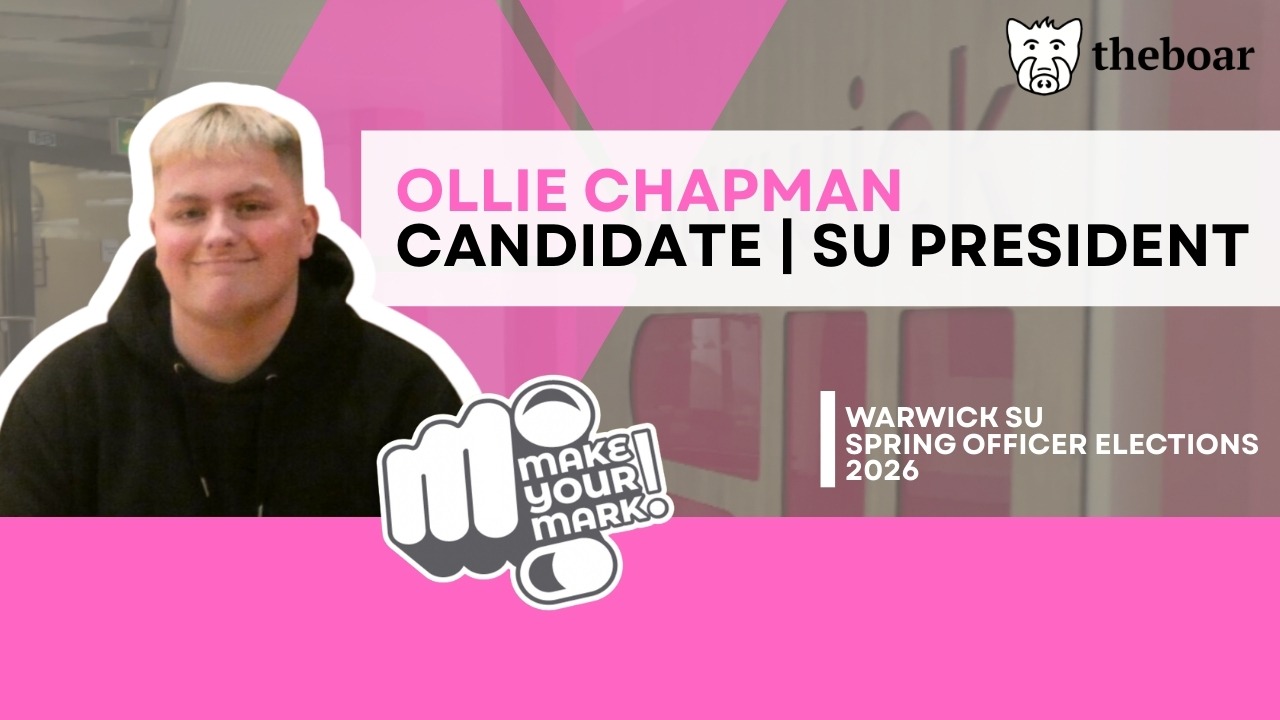
SU Spring Elections 2026 Interviews: Ollie Chapman, President
In the run-up to the Warwick Students’ Union (SU) Spring Elections, The Boar offered all Full-Time Officer (FTO) candidates the opportunity to be interviewed.
Ollie Chapman, one of the candidates running to be the next President of the SU, sat down with The Boar’s Co-News Editor, Tom Ryan, to discuss his plans and goals for the position if he were to be elected.
Why did you decide to run for this position and what makes you stand out from the other candidates?
Chapman began by emphasising that he was “incredibly passionate about the SU” and “affecting change in the Warwick community”, pointing out the “various campaigns” he had been involved in both as a student and as the current VP Welfare & Campaigns.
On the topic of setting himself apart from other candidates, Chapman said that: “I definitely think I have the most experience, not only from my time this year as a Full-Time Officer, but also what that’s brought for me. So, being on University committees, having chaired a sub-committee of the Board of Trustees, and sitting on the Board of Trustees of the organisation.”
He went on to add that he has also “chaired Student Council in the past and sat on multiple SU forums and, throughout my time this year, I’ve delivered multiple campaigns and been leading the SU publicly.”
What are your key manifesto pledges?
Chapman outlined his four key manifesto pledges, including:
1. Campaign for a rent freeze of on-campus accommodation: Pointing to an article in The Boar from 2024 that found that over half of students were expressing dissatisfaction with the value for money of on-campus accommodation, Chapman said the situation is “really unacceptable” and a “massive concern of mine”. He said he would look towards other SUs across the country as examples and undertake “independent SU surveys” to investigate accommodation prices.
2. Create a basic needs hub in the SU: Chapman said a basic needs hub – “a cost that we should be taking upon ourselves as a University and a Union” – would “ensure that students have the bare minimum for work, nutrition, and nighttime safety.” He said he would look towards the ‘successful’ models from Leeds and Manchester’s SUs in rolling out the project, which would be “a natural next step” from recent campaigns like End Period Poverty and Food for Thought, which Chapman set up this year.
3. Hold Stagecoach accountable in a public manner to ensure reliability and fair prices: Commenting that Stagecoach had reached a “breaking point where the service quality has been decreasing over time and prices have continued to be hiked up”, Chapman said he would continue to report “student feedback directly to Stagecoach, involving the local authority, local councils, Members of Parliament, and also senior University colleagues.” He also added he wants to create a “big bus assembly, which would essentially be a public accountability forum where people from companies like Stagecoach and National Express would be asked to come and deliver a panel to students [who] can ask them open questions and hopefully receive honest responses about the situation of buses at Warwick at the moment.”
4. Re-establish the SU as the home of student campaigns and activism: “I think that would look like mapping funding for student groups and aiming to have all of our funding pots empty by the end of the year, encouraging collaboration between Part-time and Full-time officers with those student groups and linking them up through the SU”, Chapman said. He would also aim to create “a better forum for advertising student campaigns” and bring “student groups into the involvement of the organisation of history months”, like Black History Month and LGBTQ History Month.
What do you think the biggest issue facing Warwick students right now is, and how do you plan to tackle it?
Chapman opens: “[That] is a really big question”. However, he adds that two issues come to mind. The first being students being the ‘unacceptable’ situation of some first-year students being housed off-campus this year, and the “general affordability point, which obviously I did touch on in my key priorities”.
“I hope that some of my priorities that I outlined sort of link and show you why I’m passionate about that as well”, Chapman said, before signalling back to his work on campaigns this year including Food for Thought, free STI testing on campus, and Menstrual Health Day, which he said hopefully shows that he is “really passionate about making campus affordable”.
The SU has to work closely with the University throughout the year and, if you were elected as President, you would be the face of student voice in communications with the University. What sort of relationship would you want to foster between the SU and the University?
“I think [a relationship with senior University colleagues] should look like a two-way relationship where both parties are willing to collaborate, but also discuss important, controversial, and deeply important problems that are the reality of many Warwick students”, Chapman begins.
He continued by saying that he “certainly wouldn’t be straying from my values or principles as President, and I hope that the relationship I’d have with these colleagues would be an honest one with mutual respect as well for the interests that we both represent.”
Beyond senior University officials, Chapman also said he would like to work closer with University departments, such as the Student Experience team and academic departments.
It’s a perennial debate on campus: the cost-of-living crisis. What would you do as SU President to support students who feel priced out of uni life or who are struggling at university financially?
Chapman reiterated his manifesto pledge of introducing a basic needs hub, which would build upon the work of campaigns like the Eat Well Hubs, which he introduced this year as VP Welfare & Campaigns. “It’s something I’m really proud of, and I hope that the students that need it have been able to access it”, he added.
He also added that holding Stagecoach to account and introducing an on-campus rent freeze would hopefully support students financially, and that as President, he would use his position to “push that point” to senior colleagues.
How will you work to make the SU more sustainable and hold the University accountable for its net-zero targets?
Praising the work of the University’s Sustainability Team as “amazing”, Chapman said he’d like the SU to work closer with the Team to “bring those standards over to the SU”, particularly SU-run outlets like the Dirty Duck and Copper Rooms.
He appreciated the difficulty of aligning environmental goals with running campaigns like anti-spiking initiatives which use single-use items, but said he would look at “how we can deliver the best service we can while also ensuring that our standards on the environment are increasing sustainability”.
“I think a lot of the work that’s been done this year, especially by the Part-Time Officer team, is something I’d like to continue”, Chapman said.
Research by The Boar found that three quarters of Leamington students are missing lectures due to bus delays. How would you seek to improve transport for students, especially for those living off campus?
Chapman began by saying that the “lack of transparency alongside the lack of good service” was infuriating students who had no way of speaking to the people that are delivering the services, so he reiterated wanting to involve other parties in creating a “united from against” the problem and to speak directly to officials at the bus companies, particularly Stagecoach.
“I think that means we need to collaborate with the University because they have a lot of sway, so that’s how I would like to go about that”, he said.
Chapman also reiterated the “class divide”, which he had earlier mentioned alongside his manifesto points, with students who are priced out of driving or taking taxis feeling the brunt of the issue more, especially with upcoming term three exams.
More than 600 freshers were placed off campus this year after the University ‘ran’ out of rooms for those first year students. What do you think the SU could do to support these students, and any students who may be affected in the coming academic year?
Chapman believes there are two injustices with this situation: firstly, that it happened at all, and secondly, that there has been a lack of explanation from the University. He said he would like to get “some form of commitment” from the University, but admitted he did not want to pledge anything specific without knowing he would be able to deliver it.
One guarantee which he said he would like to receive from the University is that bus passes for any affected students next year would be covered so that students did not have to pay themselves, given that they were already missing out on the University experience and from accessing SU services like the Dirty Duck in the evenings.
“What I would pledge is as your President [is that] I’ll be going to the University and asking them: ‘Can you give us at least a five-year commitment on what your plan is for accommodations on-campus and where you see the massive increase of students that you’re allowing your departments to take upon? Where are they going to live?’”
This interview, along with all other interviews for Full-Time Officer positions, can be watched in full using the link here.
You can also view a list of all candidates and their manifestos here.
Comments