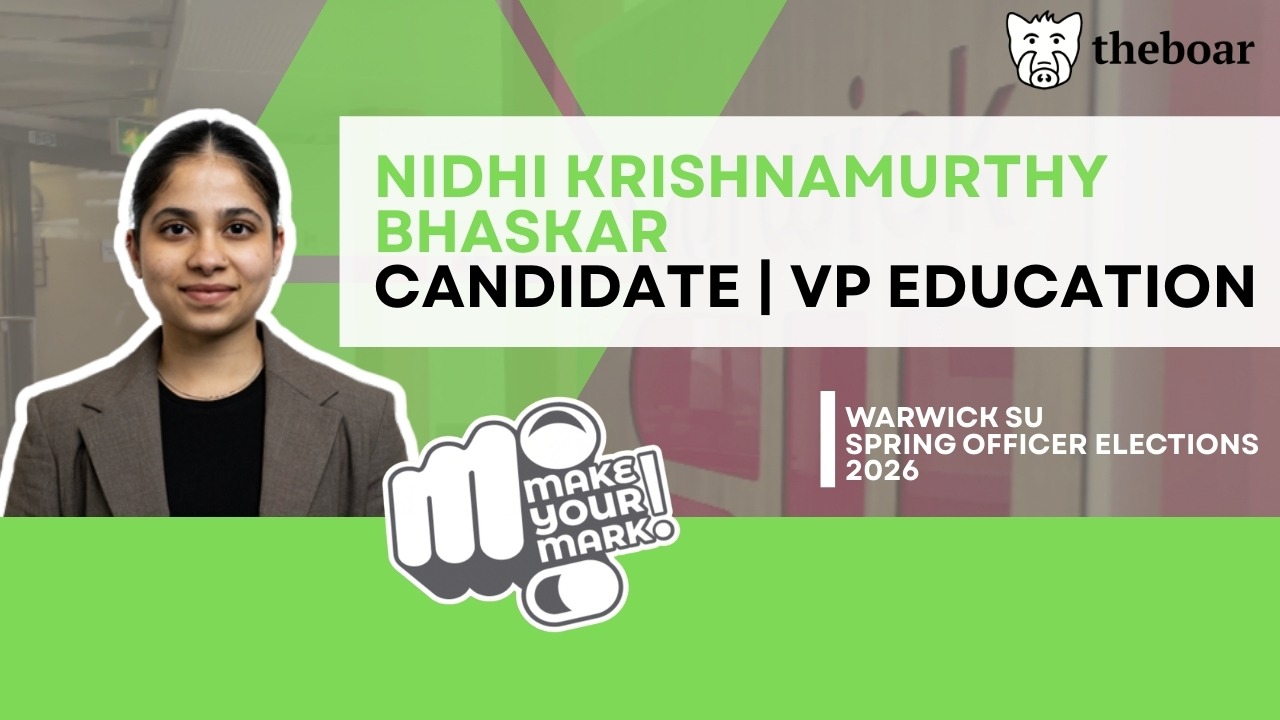
SU Spring Elections 2026 Interviews: Nidhi Krishnamurthy Bhaskar, VP Education
In the run-up to the Warwick Students’ Union (SU) Spring Elections, The Boar offered all Full-Time Officer (FTO) candidates the opportunity to be interviewed.
In this interview, VP Education candidate Nidhi Krishnamurthy Bhaskar outlined why she is running for the role, her priorities for academic feedback and wellbeing, and the changes she would like to see to assessments, exams, and support for humanities subjects at Warwick.
Why did you decide to run for this position?
Bhaskar explained that she chose to run for VP Education because academics are “the core principle” of why students attend the university. She said she wants to make that core “strong and smooth and meaningful for the students who are taking steps in their future”.
She added that education should not add unnecessary pressure to students and argued that Warwick “should be an example for the future”. For her, this is the “main intention” behind standing for the role.
What would your key priorities be if elected as VP for Education?
Bhaskar named three main priorities. The first is making sure that student feedback is not only heard, but “put into action”. She argued that many students discuss concerns informally with friends or coursemates, but do not always feel encouraged to complete forms or raise issues directly with departments.
Her second priority is “eliminating unnecessary academic pressure”, particularly around “deadline clustering”, timetabling issues, and late timetables. She said she would want to ensure these are dealt with “in time” so they do not add pressure to students’ learning.
Her third priority is improving “wellbeing and accessibility” during students’ time at Warwick. Bhaskar argued that education often comes with “mental pressure”, and that reducing that pressure requires stronger well-being support alongside academic provision.
What changes do you think are necessary in terms of assessments and exams at Warwick, and how would you work to achieve these?
Bhaskar again highlighted the structure and timing of exam timetables as a key issue. She said she would focus on “the way they are issued in a structured and organized way and in an earlier way”, rather than students having to deal with late timetable announcements.
She also pointed to assignment deadlines and academic support as areas for improvement. She said she would focus on “contacting the department staff” and “getting the SSLC members involved in the meetings” to help push these concerns forward.
SSLCs are supposed to be the primary forum for academic feedback at Warwick, but many students feel their concerns often do not lead to visible change. How would you ensure that SSLCs lead to tangible outcomes, rather than just discussions?
Bhaskar said she would encourage more students to participate in SSLC feedback processes, particularly by making forms shorter and easier to complete. She argued that “when the forms are lengthy, many would give up in the middle” or not even “make an effort to fill in the form”.
She suggested that keeping forms short would increase participation and make it easier to gather student concerns. On outcomes, she added that “problem solving and communication” would be central to her approach, to make sure actions are carried out “rather than keeping them just in words”.
Humanities and arts courses across the country are being defunded more than ever at the moment, and Warwick is not immune, having seen staff cuts in the past year. How would you work to safeguard humanities subjects at Warwick?
Bhaskar said she would encourage more students to take up humanities and arts by giving them a clearer sense of where those subjects can lead. One of her proposals is to invite alumni to speak about “how did they lead the path of their arts and humanities career”, so students can see examples of successful career routes.
She also said she would want to “eliminate the negativity around it” and increase awareness through social media. In her view, greater visibility for the humanities and arts, alongside alumni talks, would help more students see them as valuable and viable career paths.
This interview, along with all other interviews for Full-Time Officer positions, can be watched in full using the link here.
You can also view a list of all candidates and their manifestos here.
Comments