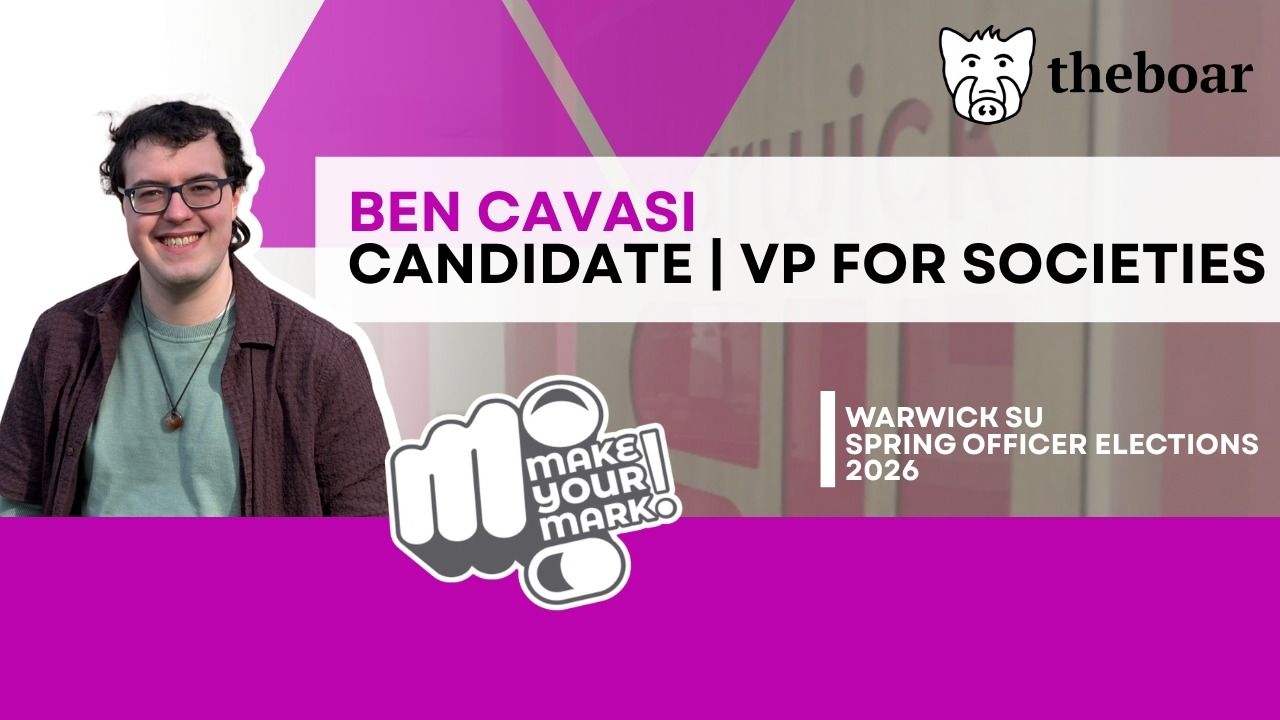
SU Spring Elections 2026 Interviews: Ben Cavasi, VP Societies
In the run-up to the Warwick Students’ Union (SU) Spring Elections, The Boar offered all Full-Time Officer (FTO) candidates the opportunity to be interviewed.
Ben Cavasi, candidate for VP Societies, sat down with The Boar to discuss his campaign. Throughout his interview, Cavasi outlined his hopes to ensure that societies remain welcoming and inclusive to all students. He aims to prioritise affordability, supporting the student community, and facilitating more collaboration between societies, and with the SU.
Why did you decide to run for this position?
Cavasi noted his experience working at the SU last year as a Democracy Assistant involved in the elections, as well as being involved in a variety of societies during his time at Warwick, both as a member of executive committees and as a regular member.
“The experience that I gained from doing all of these different things made me feel as though I could be someone who really brings in change and makes sure that the system runs as smoothly as possible.”
He cited “getting to use what I’ve learned” and “getting to make change that I think would be beneficial” as driving factors in running for the position.
What’s your experience with societies at Warwick?
“I’ve been on exec teams. I was Head of Arts at RAW, the student radio station. I also worked as social media manager at Warwick Improv Society as well. As part of those, I was really heavily involved with liaising with other societies, organising events, making posts. So I know everything that a society does and how much effort it all is as well.
“I’ve also been involved just as a member in societies as well. I’ve done stuff with Musical Theatre, [Nintendo Society], and The Boar as well. So I’ve kind of seen a bit of everything, I suppose is probably the best way to put it.”
Cavasi believes his experience as a member of these societies has helped him to understand what students “might need changing or adapting or how we can do things better”, while being an exec member and liaising with the SU has allowed him to think about which things need improvement and where processes can be streamlined.
We have over 250 societies at Warwick. How as VP Societies would you make sure that everyone feels welcome at one – or several – of these societies, regardless of their background? How will you foster a sense of inclusion in societies at Warwick?
Cavasi said that “community is one of the big aspects of my manifesto that I really want to emphasise.” He said that both to him personally, and generally for all students, “societies are probably one of the most important things that you can do at Warwick: they’re where you can find your passions”. Cavasi said that his time in various societies at Warwick has allowed him to discover his ambitions for his future career, and cited this as a significant reason for their importance to students.
“I think part of what makes them so important is the sense of community they bring to lots of people.”
Cavasi said that, as a Full-Time Officer, he would aim to work closely with societies to make new events, be those collaborations with the SU, or between societies.
“I know in the past there’s been cases of societies collaborating with SU outlets to do special drinks and that sort of stuff. I want to do more of that and work on the relationship between societies and the SU, but also the relationship between societies themselves: how they interact and collaborate.” One idea Cavasi has for fostering the community at Warwick is helping cultural societies put on cultural events that align with the wider national calendar.
Cavasi was keen to emphasise the importance of inclusion: “One of the most important things about societies is that they’re really welcoming.” In order to maintain an ethos of societies ‘letting anyone in’, Cavasi would look to “instigate a fairer funding system so that societies are more fairly balanced” as well as a brand new ‘Stamp Your Soc’ programme.
“It’s basically this idea of a stamp programme that would be used in freshers’ week and even beyond if it’s successful there as a trial test. [It would aim to] encourage freshers to join new societies, societies that they might not have initially thought of … something that they might look at once in the Societies Fair and think, ‘maybe that’s not for me’ on first glance, but then they might try it and think, ‘you know, this is really fun’.”
The initiative would seek to help societies at Warwick “stay healthy and make sure that they have a constant stream of new members, because that’s what builds that community”.
The Society Federation membership fee fell for the second time in a row this year, from £16 to £12 for undergraduates. However, some students will still feel priced out of societies by this, especially when you consider the cost of individual society events. How will you continue to help people feel like they’re not being priced out of societies?
“Affordability is another really key point in my manifesto. One of the main things that I want to advocate for – it’s right at the top of the list – is looking at phasing out the socs federation fee. It’s something that different students’ unions across the country have done and it’s worked really well for them.”
To support this long-term plan of phasing out the fee entirely, Cavasi would look to reduce the federation fee again from the current £12 for undergraduates. He aims to explore alternative funding systems, especially “one that puts less pressure on society members” to subsidise society grants.
Cavasi also noted the importance of federation fee exempt societies, and would aim to make the process clearer: “Making sure that people know what a fed exempt society is and making sure that it is essentially free to join at point of access.
“I think those [federation fee exempt societies] are some of the most important societies, because they’re inherently about inclusion and about making people feel like part of a community at Warwick.”
Cavasi would also look to subsidise transport to and from society events and competitions “to help make societies a lot more affordable”. He gave the example of travelling to awards ceremonies: “You’ve done amazing work, as lots of societies do, and you’ve won an award for it – you deserve to go and collect that award in person, and it shouldn’t be such a strain on your finances, as it often is these days, especially with how much UK trains cost.”
Cavasi would seek to prioritise the affordability of travel, “making sure that they can go to their competitions, that they can go compete and win awards and do all the amazing things that societies do every single day [without being] priced out”.
“I think the cost-of-living is still very much an active thing and it is affecting students, be that through rent, or through food. Societies naturally might fall to the bottom of that priority list because people have to eat. So I think it’s really important that we do what we can to make sure that people are able to partake in societies, because, as I said, they’re one of the most important things you can do [at Warwick].”
After the Warwick Conservatives scandal, the SU enforced mandatory anti-Semitism training for all club members, as well as Islamophobia training for exec members. Do you think that all clubs should be forced to do more in terms of educating their exec members so that incidents like this do not happen again?
“Definitely. I, like many other people, saw what happened over the summer break [in 2024], and it was shocking. It was a really awful situation and we need to make sure that it never happens again.
“One of the main things that I want to do in my manifesto is reform and review exec training [to make] it more accessible, more informative, but also more engaging as well. That [anti-discrimination training] is definitely something that I’d be looking to include as part of the reform that I want to bring in because I think it’s something that’s really important. People can’t go to a society and feel like they’re not wanted and feel like they might be prejudiced for speaking their mind or their views or something like that. It’s definitely an issue that does need addressing and I think that probably the best way to do it is by implementing training and making sure people know what they’re saying and the implications of it.”
Cavasi reiterated that he wants societies to be “really inclusive and really welcoming”, “because, at the end of the day, they’re not meant to be these awful places … they’re meant to be nice groups of people who meet up, with similar interests, to do things that they enjoy”.
This interview, along with all other interviews for Full-Time Officer positions, can be watched in full using the link here.
You can also view a list of all candidates and their manifestos here.
Comments