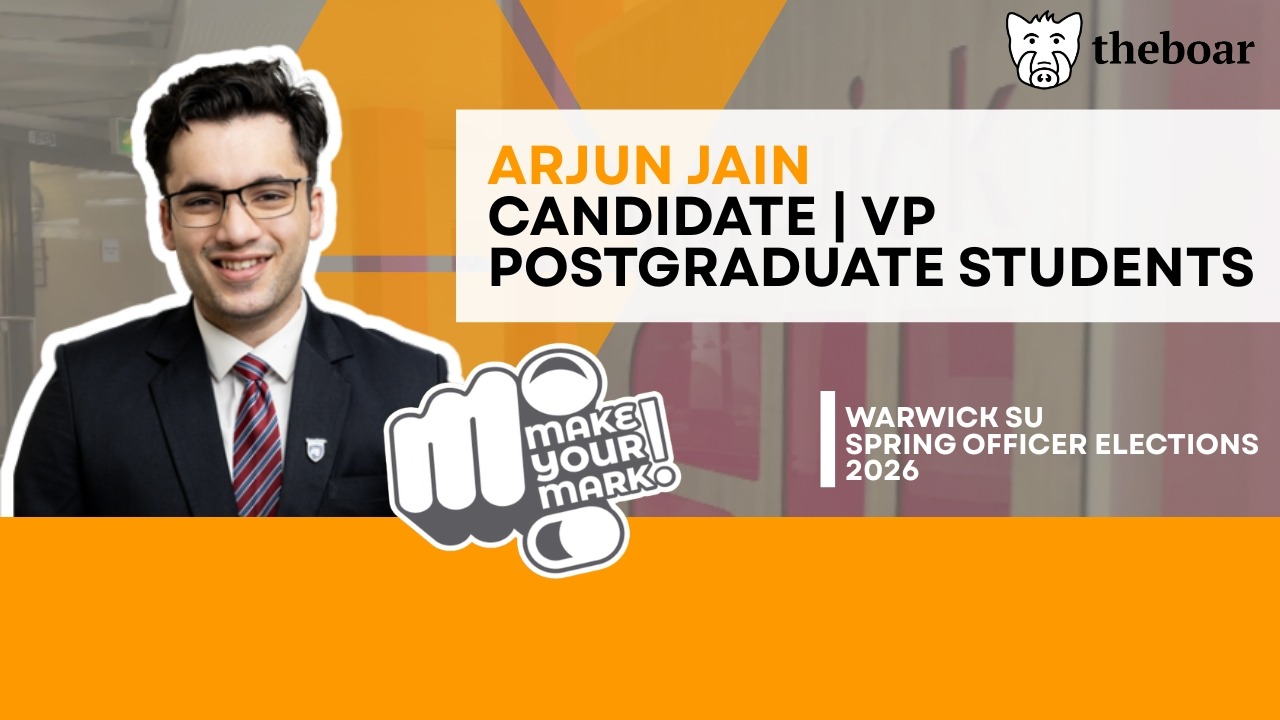
SU Spring Elections 2026 Interviews: Arjun Jain, VP Postgraduates
In the run-up to the Warwick Students’ Union (SU) Spring Elections, The Boar offered all Full-Time Officer (FTO) candidates the opportunity to be interviewed.
Arjun Jain, a Warwick Business School student and one of 11 different candidates running for the position of Vice President for Postgraduates, spoke to The Boar about the challenges unique to postgrad students, and his ‘achievable’ solutions to these.
Why did you decide to run for this position and what makes you stand out from the other candidates?
Jain touted “implementation” as his core motivation for running for the VP Postgrads position. “Postgraduate time at Warwick is short and intense,” he noted. “Many of us balance academic pressure, career uncertainty, and financial responsibilities, often being far away from home.” He believes that representation for postgraduates needs to be structured and outcome-driven, given the short timespan of most courses, and that his policy platform reflects this.
“What makes me stand out is my focus on implementation. My manifesto is built around four achievable priorities within a one-year mandate. I’m not promising transformation – I’m promising measurable progress, regular reporting, and a structured follow-through approach.”
Many postgraduate students feel disengaged from the SU, societies, and sports clubs. How would you make the SU more inclusive to postgraduates?
Jain agreed immediately with the notion of disengagement, arguing that “many SU structures and societies are historically undergraduate-focused”. “My approach would be twofold,” he continued. “Firstly, advocating for clear postgraduate representation within societies and SU initiatives, including transparent selection processes and encouraging societies to actively consider PG inclusion.”
“Secondly, I’d focus on improving visibility of opportunities specifically relevant to postgraduates. Whether that’s networking events, sport, formals that fit tighter schedules, or flexible participation models. Inclusion starts with making spaces visibly accessible and practically workable for PG schedules as well.”
What new services, provisions, or spaces would you aim to introduce to support postgraduates studying at Warwick?
Jain demurred that he is cautious about promising “entirely new, large-scale infrastructures and services within a one-year term”. Instead, he says, he would like to focus on strengthening existing structures: “Particularly speaking, careers departments and the Students’ Union.”
Among the changes Jain envisions pushing through as Vice President are structured postgraduate forums broader than the current existing committee, “clearer communication channels, targeted employer engagement initiatives, and practical workshops around cost-of-living strategies and professional networking”. “It’s about improving alignment, rather than duplicating or formalising more services which are less aligned.”
How would you ensure that postgraduate students who come to Warwick from different countries feel welcome and supported during their time here?
“International postgraduates often face additional uncertainty around visas, postgraduate pathways, and adapting to new environments,” Jain said, noting that he understands this firsthand as an international student himself. He said he would like to implement “structured town halls focused on international concerns”, as well as to act as an advocate for clearer communication around visa transitions and post-study options.
“I would also additionally ensure that these concerns are consistently represented in Union discussions. You know, support begins with visibility and structured advocacy.”
Many postgraduates also deliver teaching to undergraduates. How would you represent and protect these postgraduates’ particular interests?
Postgraduate students who teach “sit in a very unique position”, Jain remarked. “They’re both students and educators.” He hopes to ensure their concerns are formally recorded and raised within the relevant communities, “particularly around workload clarity, training, and communication between departments and tutors”.
“Representation here means making sure the dual role is recognised,” he concluded, “and that there is a structured channel to raise concerns without fear of being overlooked or simply penalised for it.”
This interview, along with all other interviews for Full-Time Officer positions, can be watched in full using the link here.
You can also view a list of all candidates and their manifestos here.
Comments