Security agency or shadow militia? A student’s guide to ICE
The fatal shooting of 37-year-old Renee Nicole Good in Minneapolis on 7 January sparked protests across the US and increased scrutiny of the Immigration and Customs Enforcement (ICE) agency. ICE has dramatically expanded its operations, conducting thousands of arrests that have increasingly led to clashes with local communities and protesters. As the agency takes on a more visible and assertive role in American cities, questions of authority and impact have resurfaced. What exactly is ICE, and what powers does it hold over citizens and non-citizens alike? Most importantly, how do these enforcement practices shape the daily lives of migrants?
In 2003, ICE was established as part of the Department of Homeland Security, following the 9/11 attacks in 2001. ICE took over the roles of agencies, including the Immigration and Naturalization Service, to oversee the United States borders and enforce immigration law. However, ICE is not the only organisation within the Department of Homeland Security responsible for immigration, working alongside Citizenship and Immigration Services and Customs and Border Protection. This adds complexity to the debate surrounding ICE, as many actions perceived as ICE’s responsibility actually come under the remit of other agencies.
Agents have the power to arrest people ICE whom suspects of being in the US illegally, though they require judicial warrants to enter private homes. US citizens theoretically cannot be arrested by ICE unless they assault an officer, though the reality on the ground is different. ProPublica reported that 170 US citizens were detained in the first nine months of Trump’s second term, including 20 children. The majority were accused of assaulting or impeding officers, but almost half had no charges filed against them, and only a handful pleaded guilty. The data is likely an underestimate, however, as ICE does not record the number of US citizens arrested, and many more are detained briefly before being released without an official arrest.
As part of Trump’s ‘One Big Beautiful Bill’ passed through Congress last July, ICE received a funding boost which, by some estimates, more than doubled annual spending to $22 billion each year for the next four years
During the first year of President Trump’s second term, both the role and size of ICE have expanded significantly, accompanied by funding increases. As part of Trump’s ‘One Big Beautiful Bill’ passed through Congress last July, ICE received a funding boost which, by some estimates, more than doubled annual spending to $22 billion each year for the next four years. For context, $22 billion is representative of what a European country like the Netherlands spends on their entire armed forces.
The US has spent additional resources, such as the $30 billion spent over the past four years for the hiring of 10,000 new officers and the $45 billion earmarked for the detention of more than 100,000 immigrants. Similarly, the Customs and Border Patrol has been given $47 billion to continue building the wall on the US-Mexico border, which Trump first envisioned in 2015. In stark contrast, the hiring of new immigration judges has been capped, and spending on legal support and the processing of migrants has been cut. This divergence demonstrates that Trump’s priority is not building a stable and fair immigration system but rather detaining and deporting as many people as possible.
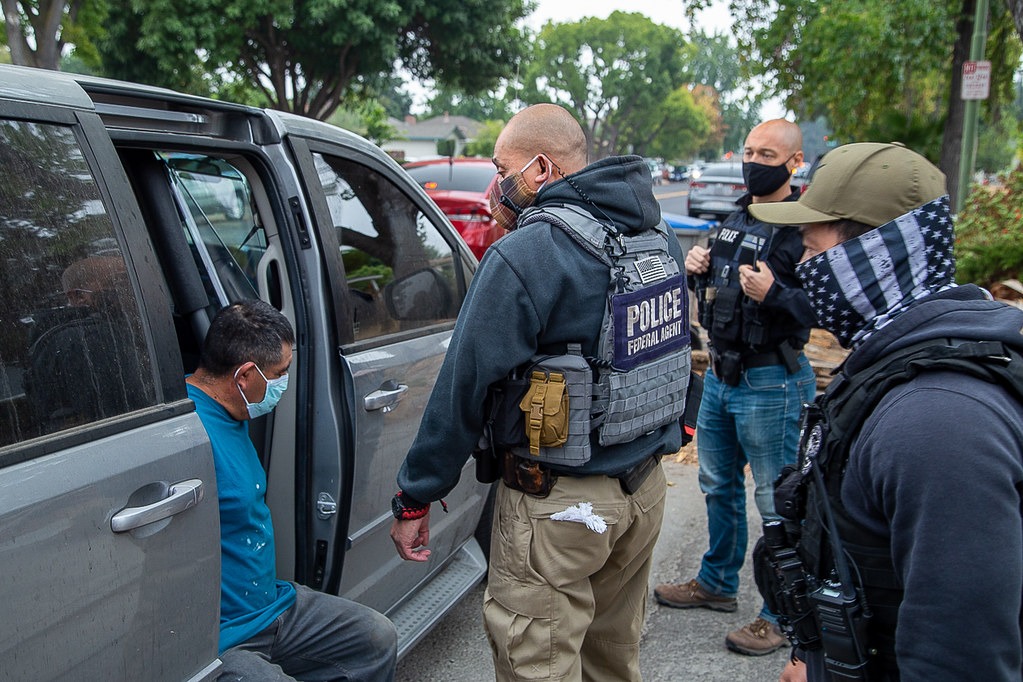
The most pertinent example of the growing reach of ICE has been Operation Metro Surge in Minneapolis, which has seen 3,000 arrests by officers. Described by the Department of Homeland Security as the “largest immigration enforcement operation ever carried out”, over 2,000 agents have been deployed in the city and the surrounding areas.
The most controversial aspect of Operation Metro Surge was the killing of two US citizens, Renee Nicole Good and Alex Pretti. Good was shot on 7 January by agents who claimed she was driving her car at them, a claim later disproven by footage of the event. Homeland Security Secretary Kristi Noem and Vice President JD Vance both described Good’s actions as “domestic terrorism” in spite of the presented evidence. Alex Pretti was tackled to the ground and shot several times by Border Patrol agents on 24 January after intervening in an altercation between officers and other civilians. Pretti had a legal gun removed from his holster before he was killed by at least ten gunshots while lying on the ground. A US government official, this time Stephen Miller, falsely described the victim of extrajudicial violence as a “domestic terrorist”.
Yet another inflammatory aspect of ICE’s actions is their handling of the detention of children. A Marshall Project analysis of data from the Deportation Data Project showed that 170 children a day were detained on average since Trump took office. The most infamous example was five-year-old Liam Ramos, returning home from school wearing his blue bunny hat, who was sent from Minneapolis to a deportation centre in Texas with his father. Liam and his father had arrived in the US legally and had an active asylum case. Though they were eventually released, there are other cases of children being held in squalid conditions for months on end.
The Trump administration’s deployment of ICE is wider than the enforcement of immigration law. ICE agents accompanied Vice President Vance and Secretary of State Marco Rubio to the opening of the Winter Olympics in Milan-Cortina, prompting widespread criticism, including from the mayor of Milan. Though the involvement of the Department of Homeland Security in security overseas is not unheard of, this event signals alarm over ICE expansion.
A likely end result of ICE’s involvement is the deterring of eligible US voters, particularly in minority communities. ICE agents at polling stations may create an atmosphere of fear and a high likelihood of racial profiling
Steve Bannon, a former advisor to President Trump, recently stated that the federal government “should take over voting” and that “ICE is going to be around the polls in the 2026 midterm elections”. Bannon and others around Trump have long maintained, in spite of the evidence, that there is widespread voting fraud by illegal immigrants, presenting ICE as a solution. However, a likely end result of ICE’s involvement is the deterring of eligible US voters, particularly in minority communities. ICE agents at polling stations may create an atmosphere of fear and a high likelihood of racial profiling.
Similarly, concerns have been raised about the possible role of ICE as an anti-democratic force. ICE already meets many of the criteria of a paramilitary, as a highly militarised force operating with less oversight, and is highly politically aligned with Trump. In 2016, 95% of its unionised voting members endorsed Trump, and this loyalty will likely have been solidified with the latest recruitment drive. It is not implausible that Trump will try again to retain power if he loses another election and could desire a friendly paramilitary force.
Officially, ICE may only be responsible for customs and immigration, but it has clearly taken a wider role as a political and military force. The thousands of agents in tactical uniforms patrolling the streets of cities like Minneapolis are a visible sign of this transformation in the interaction between the state and public in the US. This shift is being felt in an atmosphere of fear and loss of both liberty and life. Whether ICE remains an agency of ‘security’ or becomes one of permanent domestic surveillance and control is a question yet to be answered.
Comments