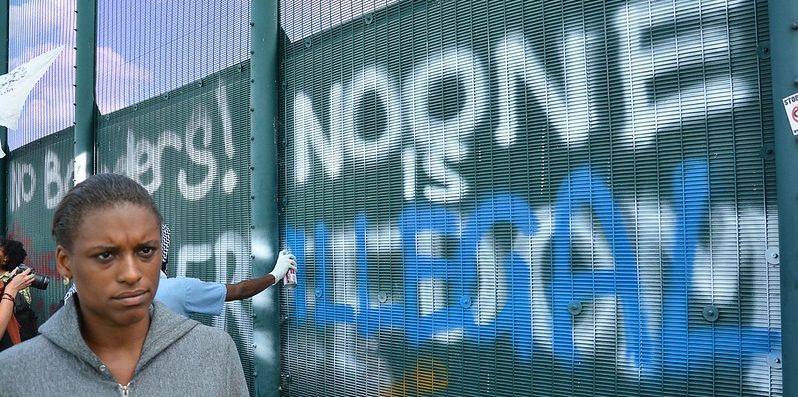
Immigration anxiety at its highest since 2015 – A case of national paranoia?
A recent speech by Reform UK Shadow Home Secretary Zia Yusuf appreciated the invaluable work of immigrants in the UK, and condemned the “sheer scale” of immigration as having “broken Britain” in the same breath.
‘Well… which is it?’ I wondered, looking in vague disbelief at the man behind the podium. Can the immigrant NHS doctor heal and break the country simultaneously?
Now, the concern of overpopulation leading to overcrowding, especially in prisons, that Yusuf brings up, is a reasonable one. But to lay the blame for several national issues on the backs of migrants not only mitigates the contributions of British people to these, but also inflates the image of immigration, regardless of its legality, as a demonised force.
There is little evidence to suggest that migrants are overwhelming hospital rooms and snatching appointments from British citizens, as is a common fear
August 2025 saw 48% of Britons highlight immigration as one of the UK’s biggest concerns. Moving into the new year, this national anxiety has not ceased, continually expressed in often violent or hateful ways. Yet, statistics measuring the actual consequences of immigration suggest that these are not as overwhelming as feared.
After Brexit came into effect on New Year’s Eve 2020, immigration levels certainly did rise in what the media quipped as “the Boriswave”. Even the name is ammunition for today’s political leaders, leveraging their migration policies as improvements to Boris Johnson’s approach. However, The Guardian reports that immigration levels have since lowered, particularly with the reduction in health and care visas. With recent rule changes regarding settlement grants, these levels are expected to decrease further. Yet anxiety continues to persist around the fiscal impacts of immigration levels, with many convinced that these are behind the UK’s economic crises.
By contrast, The Migrant Observatory at the University of Oxford states that the fiscal costs of migration represent less than 1% of the country’s GDP. Adding to this, the researchers have explained that gaps in evidence, often due to minimising the differences in characteristics between migrants and UK-born residents, have obscured the fiscal effects of immigration. For example, The Guardian predicts that many migrants, not needing to undergo the British school system, but having to pay for NHS treatment, are unlikely to become more expensive for the UK in the coming years.
Circling back to the topic of the NHS, there is little evidence to suggest that migrants are overwhelming hospital rooms and snatching appointments from British citizens, as is a common fear. A BBC report from last year even quoted health chiefs as being “extremely grateful” for migrant workers, who filled vacant job roles amidst the NHS crisis. This year, NHS doctor Ammad Butt’s article claims that British healthcare has never been able to function without migration.
When given the option, condemnation steers away from immigrants and towards a richer and more powerful ‘scapegoat’ – one that is scarier to confront
So, with little evidence to base national fear on, the public turns to what is accessible, quick, and perceived as the epicentre of “trust”: the media. And what the media often does, by hanging onto the words of political parties, is paint migrants as a force that could be detrimental if uncontrolled. Butt also points out in his article that ethnic differences are easy to demonise. All it takes is a social media scroll to see images of waiting rooms with distinctly non-white patients, who may be British but are captioned as “foreigners” anyway.
To top it off, when the camera pans to Nigel Farage, the work of migrant doctors, the challenges of migrant students, and the sacrifices of migrant parents disappear under the fearmongering of their common label. Instead, narratives of rich politicians dominate the media’s image of migrants. On that note, there has been an ongoing debate about whether taxing wealthy elites (and politicians) can improve the UK’s economic condition more than deflecting migration. It’s a nuanced issue of blame that I doubt can ever be concretely resolved, but it’s worth speculating on.
Last year, the think tank Persuasion found that 44% of Britons, with a Gen-Z majority, blamed the rich for national problems. That’s 6% more than those who blamed migrants. Thus, when given the option, condemnation steers away from immigrants and towards a richer and more powerful ‘scapegoat’ – one that is scarier to confront. Yet such confrontation, i.e., via the wealth tax, is supported as a better strategy for tackling Britain’s broken economy.
A past study by the Guardian suggested that a global levy on the top 0.5% could raise roughly $2.1 trillion, with the UK alone generating $31 billion annually. Though such a transformative economic boost could encourage the rich to flee the country and make it difficult to determine who is “ultra-wealthy”, it can be used positively across a range of British crises. NHS funding is only one possibility.
There is little empathy for those who have made dangerous journeys, frequently from dangerous places, for the hope of a safe and normal life
So, why is defining the country’s condition so strongly spearheaded by cherry-picking the contributions of migrants just trying to survive? Why promote a narrative of fear, hostility, and “invasion” for the sake of political gain? What is stopping Britain from looking inwards at its own hierarchies, systematic failures, and wealth distribution to hold itself accountable first?
There are issues with an increased population, resource exhaustion, and unemployment, yes, but the scale of issues on top of these estranges migrants and devalues their work under a system that already fails to regard them as human. There is little empathy for those who have made dangerous journeys, frequently from dangerous places, for the hope of a safe and normal life.
For all the talk of ‘British values’ bouncing around in the political world and on TV screens, “respect and tolerance” seems to be losing its grip, pointing fingers at the brown family on a boat rather than the white man in a mansion.
Comments