From Bad Bunny to boycotts: Why sport is anything but apolitical
Sport is no stranger to politics. Despite what the International Olympic Committee (IOC) would have you believe – a Ukrainian sportswoman was banned just last month for paying tribute to athletes killed by Russia – sport has never been ‘beyond’ politics.
Bad Bunny’s half time show at the Super Bowl was a case in point, breaking new ground by being sung entirely in Spanish. This clearly irked Trump, who posted on Truth Social: “The Super Bowl Halftime Show is absolutely terrible, one of the worst, EVER! It makes no sense… Nobody understands a word this guy is saying.” The latter sentiment would presumably come as a surprise to his sizable Hispanic base. This rebuke is despite Bad Bunny declining to directly criticise his administration beyond implicit commentary on the president’s response to Hurricane Maria in 2017. The Puerto Rican opted instead for a message of unity (perhaps best summed up by a couple getting married during the performance).
More than that, the show was an ode to Latin culture and a potent reminder of the States’ chequered past. Commentators have recognised the anti-colonial symbolism rife within the show, from the sugar cane set and Ricky Martin’s performance of ‘Lo Que Le Pasó A Hawaii’ to Lady Gaga’s dress matching the colours of the pre-Commonwealth Puerto Rican flag and the cameo of El Sapo Concho, the country’s endangered crested toad. In a particularly viral moment, the only line in English, “God bless America”, was followed by a list of every country in the Americas. Bad Bunny took no more than 13 minutes to thoroughly dismantle the chauvinistic vision of the US projected by MAGA.
Realpolitik, with its concomitant moral compromise and double standards, remains at play
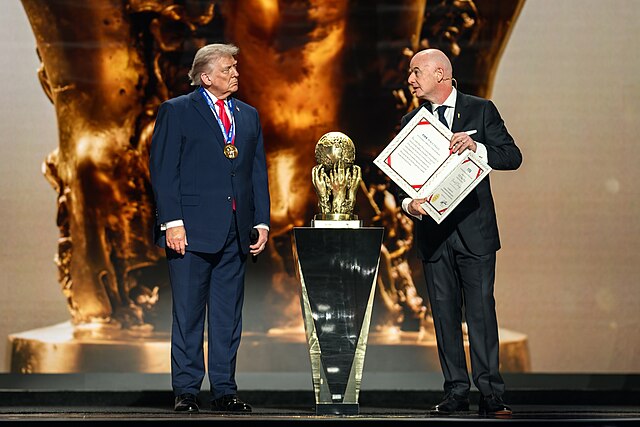
It would be remiss not to mention arguably the most obvious clash of politics and sport in the past year: Trump being awarded the inaugural FIFA Peace Prize by Gianni Infantino. Of course, in the following months Trump threatened to invade Greenland, launched airstrikes at Iran and Syria, and actually invaded Venezuela – not to mention ICE killings or neo-fascist rhetoric about immigrants ‘poisoning the blood’ of the nation. Consequently, there have been widespread calls for a boycott of the World Cup, amid fears that Trump will use the event to sportswash the authoritarian backsliding of his administration.
World Cup controversy is of course nothing new; the 2022 competition held in Qatar was condemned for its reliance on modern slavery to build the Lusail stadium. According to Amnesty International, migrants from Bangladesh, India, and Nepal were trapped in appalling conditions with minimal pay. The glitz and glamour was made possible only by a slew of human rights abuses, reflecting a wider issue within a country where migrant workers compose 90% of the workforce.
History is littered with examples of athletes making headlines for the right reasons
Sportswashing again came into the spotlight when the International Olympic Committee released shirts – now sold out – commemorating the 1936 Berlin Olympics, which were a centrepiece of Nazi propaganda at the time. In 2022, similar fears about sportswashing were behind the FIFA and UEFA’s barring of Russian teams – although Israel remains eligible despite levelling sporting infrastructure in Gaza to the ground and killing Suleiman al-Obeid, the ‘Palestinian Pele’, while he waited for aid. Clearly realpolitik, with its concomitant moral compromise and double standards, remains at play.
This year’s Winter Olympics haven’t exactly been free of controversy. American athletes have faced political pressure to remain silent about domestic affairs or, like freestyle skier Hunter Hess, be condemned by the president himself. It wasn’t smooth sailing for JD Vance, either, who was booed at San Siro. Meanwhile, ICE’s presence at the Olympics has been subject to scrutiny following the killings of Renee Good and Alex Pretti in Minneapolis. Milan’s mayor, Giuseppe Sala, posed the not unreasonable question: “Can’t we just say no to Trump for once?”
It goes without saying that sports rivalries often have their origins in politics, too. Take that of Celtic and Rangers, which has its roots in sectarian conflict between Catholics and Protestants in Northern Ireland. Pakistan also recently backed down from a boycott of its match with India, which it had planned in solidarity with Bangladesh, which had refused to play fixtures in India due to security concerns.
Commentators and international bodies like the IOC tend to gloss over sports’ long history of activism
To end on a lighter note, Bad Bunny’s performance acts as a reminder of the enduring power of activism within sporting events. History is littered with examples of athletes making headlines for the right reasons, from Tommie Smith’s Black Power salute during the 1968 Olympics in Mexico to Muhammad Ali’s tireless campaigning on civil rights, Vietnam, and Parkinson’s. After the murder of George Floyd, we saw footballers taking the knee and, more recently, Afghan refugee Manizha Talash using her platform at the Olympics to publicise the issue of women’s rights under the Taliban.
If Bad Bunny’s performance seems like an especially blatant intrusion of politics into sport, it’s because commentators and international bodies like the IOC tend to gloss over sports’ long history of activism and, conversely, whitewashing. There’s a reason why it’s always politicians who wax lyrical about sport being ‘apolitical’.
Comments