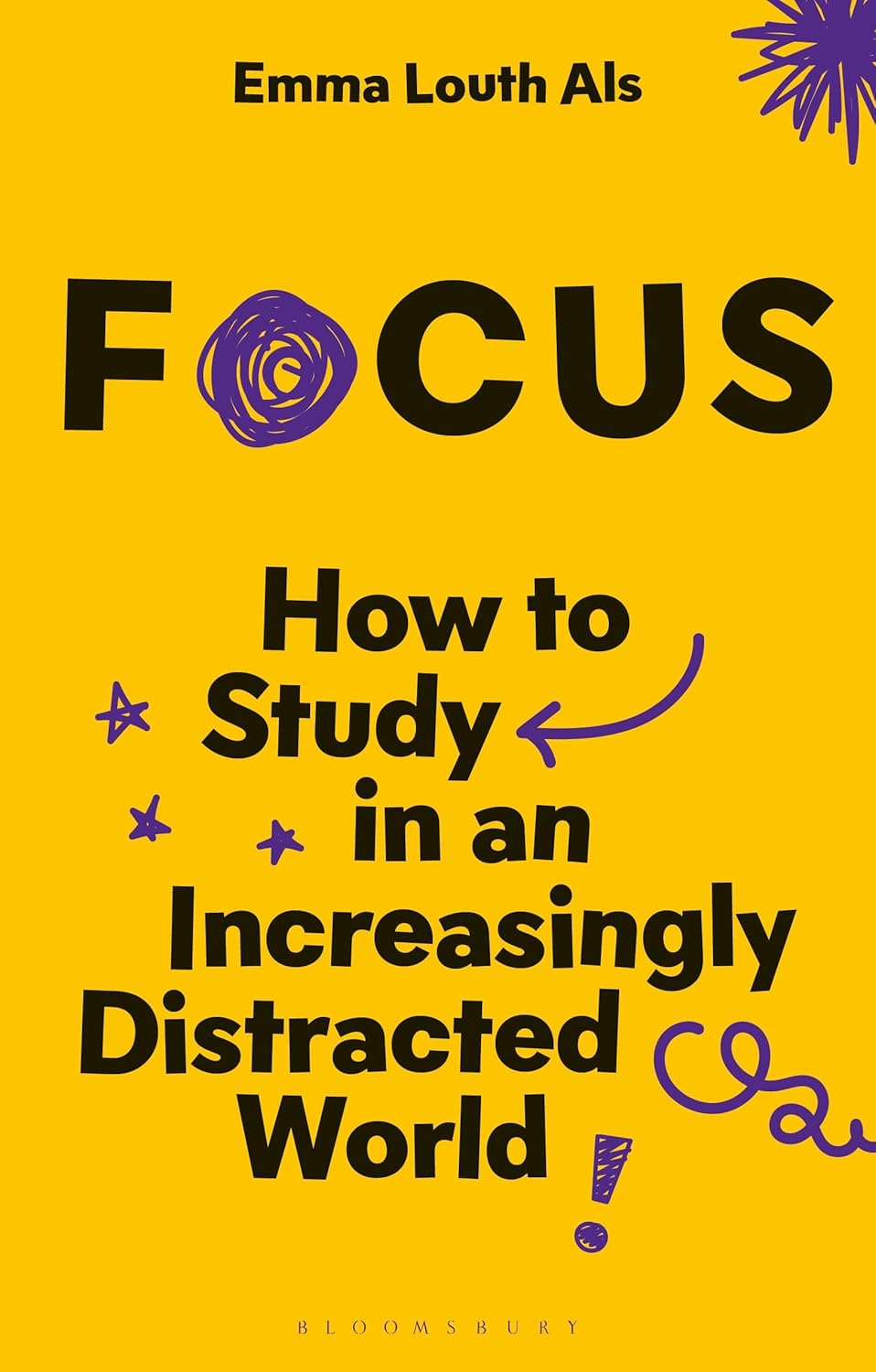
Focus: An interview with Emma Louth Als
I think it’s safe to say that, as students, the ability to focus is something that we struggle with from time to time during the course of our university experience. This is not surprising, as many things vie for our attention, from course readings, to answering messages, extracurricular commitments, and scrolling through social media. In her book Focus: How to Study in an Increasingly Distracted World, neuroscientist Emma Louth Als takes us through how focussing really works and what students can do to improve their focus. I recently had the pleasure of speaking to her about it. Focus is now available across the UK.
How did you come up with the idea to write a book about focus?
My research has mostly consisted of studying neurons – brain cells, how they communicate with each other, and what different drugs do to that sort of communication. Why do we want to know these basic mechanisms? How do they relate to behaviour? The pathways that I have always studied are related particularly to attention, so it’s always something that has interested me. But this isn’t useful if we just keep this information in the scientific community – it’s best if we can spread the word. I like talking to people, but if I talk to them about electrical signals from neurons, they would start to fall asleep instantly, so I talk to them about something a bit more practical, which is the neuroscience of focus.
I started researching focus during the pandemic when I had a small project of writing a short Danish book called Opmærksomhed, meaning attention, as part of a series. I then did a TEDx talk about attention spans, and from there, someone at Bloomsbury contacted me and asked me if I wanted to write a book about it.
What made you gear the book towards students specifically?
You have a lot more control over your own time and so it’s a big challenge for your intrinsic motivation and organisational skills
I think there are too many productivity books anyway for people in the workplace. The student experience is a little but unique: you come from a very structured world where you have your parents telling you when to wake up and school has very strict hours. Suddenly, at university, classes are not just in your normal nine to three schedules; they could be at all hours and all different lengths. You have a lot more control over your own time, and so it’s a big challenge for your intrinsic motivation and organisational skills. I think it’s exciting to think about what is actually happening in the brain when you’re trying to make these decisions and find that motivation.
You offer a lot of advice in the book. Did you speak from any personal experience whilst writing it? Did the research you did for it change the way you approach your own work?
I was thinking about when I was a student and had exams, some of the things in the book were intrinsic. I was never big on cramming for exams, and I was always determined to get a good sleep and a good breakfast in. So, I already had that one in, but it was nice to look at the research which backed up that approach.
And a lot of people know not to multitask, but by seeing the research, you can really understand the effect that it has; it’s not just a case of willpower or a skill you can develop. You really can’t practice it.
All this advice is also perfectly applicable to the workplace
I never considered getting your brain into work mode – the idea that you should just have an organised, quiet space ready for studying and having a specific goal in mind so that you don’t spend the mental energy wondering how to start. That’s not something I had done before, and I think I’ve implemented it a bit in my work. All this advice is also perfectly applicable to the workplace.
In Chapter Three, you talk about building better habits. Bad habits can be hard to identify, so do you have any advice on identifying them?
I think it takes a bit of self-reflection. And you can be really structural about it if you want to (I like to be structural, as you can see from the book). If you map out your time for three days, on a calendar or something like that, you can see where the time syncs are. Where did you get distracted with something? Did you have a plan to read for an hour but didn’t end up doing it? What distracted you? If you really want to have a heart attack, you can use that screen time app on the phone!
Maybe the thing that distracts you is that your mind wanders off. Do you need to have a notepad where you can write a list of things that pop into your head so that they’re not sitting there spinning?
Towards the end of the book, you talk about convergent (a logical thinking process) and divergent (a creative thinking process) thinking. Lots of people naturally lean towards one way of thinking, and sometimes they don’t use the right type in the right scenario. Do you have any advice for knowing when to use convergent thinking and when to use divergent thinking?
When I was teaching, I was reviewing people’s fourth year thesis. I found that many students got stuck on the issue of coming up with the topic. This is the time to have divergent thinking, in order to explore different ideas. But I think the key is that people need to set a bit of a time limit on it. For example, set a deadline that in two weeks, you’ll have maybe three ideas. That’s when you want to switch to convergent thinking so that you can narrow down the possibilities. Because in the end, it is just an assignment. I think it’s easy to pick a big scope, but you really need to narrow it down to something you can write in whatever word limit you have. So typically, you want to use divergent thinking at the beginning and then convergent thinking later on.
In Chapter Eight, you talk about the Eisenhower box – the organisational system that allows you to sort out tasks by urgency and importance. Do you have any advice for identifying the difference between urgent and important tasks?
For a student, planning that project early would be an important category task
Importance is something that gives you value. For example, something that gives you a lot of value is studying regularly. Thinking about studying for an exam really early in the semester, well before the exam, is very important but not urgent. The deadline is a long way away. For a student, planning that project early would be an important category task.
Urgent tasks are things that are just coming up. For example, if you have one of those classes where they give you some sort of test or assignment every week. These things just must be done.
If it’s both not urgent and not important, then maybe it’s something you should try and delegate or take off your list if you’re feeling a bit stressed. Things like tests don’t live in a box all the time; it obviously depends on the deadline. But usually, their importance is pretty static.
Many people say that they’re just bad at focussing in general. What would you say to people who think that?
It’s not a trait that you either have or you don’t. It’s more of a skill or habit. If you know that it’s something that you can change, I think that helps. But you need to train your brain to do it. It’s like if you don’t run and decide to get off the couch and do a 5k, you’re probably not going to be able to manage it. It’s the same as going through the semester not focussing on the studying and then deciding three days before the exam that you’re doing to study all day from nine to five. You won’t be able to hold your focus because you’ve not been training for a marathon study session. Whereas if you have regular study sessions then it’s easier to hold that focus over time. So, it’s really an issue of practising for your brain not to give in to the distractions.
But you should also have realistic expectations. It’s not a realistic expectation to sit there and study all day when you haven’t been practising that. That’s what can also make you think that you’re bad at studying.
Is there any one thing you want students to take away from the book?
Focus is a skill like anything else, that you can change and have an influence on. If I could have a favourite piece of advice, it would be just that you should practice focussing with a hobby or a passion. Whether it’s reading or painting, focus for at least an hour on something that you like doing. It will really improve your ability to pay attention. I think there are so many things that fight for our attention, and it’s so easy to get distracted by things, especially if you’re trying to do something boring like study organic chemistry. But if you’re doing something fun, then you don’t care about your phone pinging with notifications because you’ll be in the flow of it. That’s really what’s going to get your brain used to focussing for long periods of time.
This interview has been summarised.
Comments