“What’s in a name” in Hamnet?
Shakespeare once asked “What’s in a name?” Well, what’s in Hamnet? The only son of William and Agnes (Anne) Hathaway who died, aged eleven, in 1596 barely leaving a mark on the world. Did his name, as the eponymous film suggests, truly inspire The Tragedie of Hamlet or does this speculative rewriting resurrect a name, and a short life, that simply faded to silence?
As a complete outsider to the world of film-making, and an infrequent cinema goer at best, I see that these questions have consumed many a reviewer. If, however, Hamnet is thought to have inspired, at the very least, the title of Hamlet does it ultimately even matter if it actually happened in the way of the film at all?
There is no doubt, in my mind, that Hamnet is very well deserving of its large, and seemingly ever-growing, number of plaudits. The film is the exceptional product of Maggie O’Farrell’s 2020 novel Hamnet reimagined by Academy Award winning director Chloe Zhao and even in the early weeks of January, it looks set to be one of the top critically acclaimed films of the year.
The final product of the film bears all the marks of the artistic care for which Zhao is known
Drawing together the deeply touching performances of Jessie Buckley, Paul Mescal, and the too often overlooked Jacobi Jupe, Zhao artfully creates a portrait of loss that mourns both “for Agnes and William’s loss and for our own”. The final product of the film bears all the marks of the artistic care for which Zhao is known and while it is far removed from her films, The Rider and Nomadland, she proves an exemplary fit for a plot that requires such tender curation on the big-screen.
Kermode described the film as excellent, but leaning into being emotionally manipulative, a criticism I view somewhat disdainfully despite there being some truth to it. Indeed, Zhao at times strains the film to convince the audience that the writing of Hamlet was an exercise in grieving for William, an attempt to both seek finality to his loss and simultaneously immortalise his son. The scene in which Mescal delivers a sobbing rendition of “to be or not to be” from the banks of the River Thames would frankly have been better cut from the entire film, it is after all a little too on the nose.
Notwithstanding these flaws, Zhao excellently tells a story which is quite simply, at its core, one of devastating loss as the mischievous but caring Hamnet (Jupe) is wrenchingly torn from his parents and sisters. Much overlooked, largely a result of the fanfare surrounding Mescal and Buckley, is Jacobi Jupe (Hamnet) who is a fantastic casting alongside his older brother Noah Jupe (the Hamlet actor). Zhao described the younger Jupe as “having the essence of that character way beyond his age” who portrays all the painful emotions of a boy desperately wanting to be a man and at only twelve-years-old it is a remarkable performance. In an interview for Vanity Fair, Jacobi Jupe said that he “wished to live on for Hamnet” and that sense of respecting the short life of Hamnet is evident throughout his performance. He tragically longs for the return of his father, who, one day, he wants to work for but will never see again, and in death he painfully fights to “be brave”, to protect his mother, and his unwell twin-sister Judith (Olivia Lynes).
Buckley has, however, drawn the majority of the applause for a performance that has confirmed that “she will go down as one of the best [actors]” of this generation
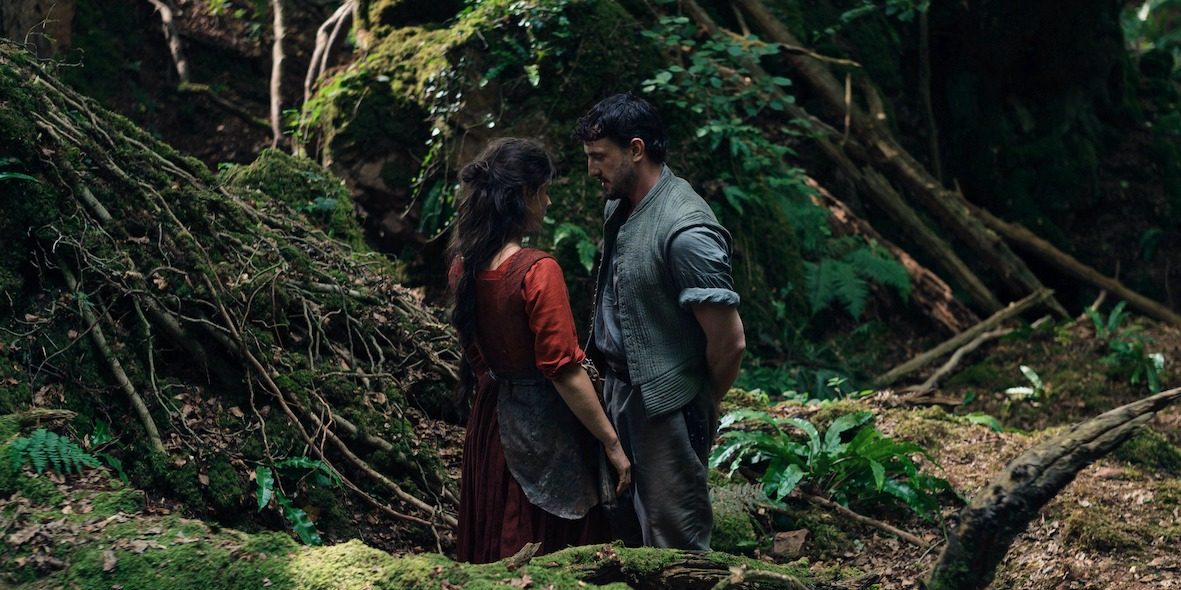
Hamnet is nevertheless, in all its facets, anachronistic to the extreme. The courtship between William (Mescal) and Agnes (Buckley), the curious latin tutor meeting the hawk wielding forest witch, is vastly removed from the little we know about the Bard’s real life but honestly what does it matter. The strangeness of their love is deeply endearing and Mescal excels in a role that is less subdued compared to his regular casting. Buckley has, however, drawn the majority of the applause for a performance that has confirmed that “she will go down as one of the best [actors]” of this generation, if not all time. She is very earthy, coming out of a rooted hollow in the first scene, with knowledge of herbal cures and the ability to control a circling raptor making for a sharp contrast to Mescal’s unsettled and ambitious Shakespeare. The howl of pain Agnes lets out as her son dies in her arms is piercing and, for an audience still at the scene of Hamnet’s excruciating death, it is near impossible not to shed a tear.
At the Critics Choice Awards, Buckley said of Mescal that “I could drink you like water, working with you every single day” and their close friendship off-screen imbues the on-screen partnership with a plausibility and relatability making their shared loss all the more viscerally uncomfortable. The strength of the duo is the foundation of a grief that is believable and that forces audiences to share the loss of a child in all its nauseating awfulness. It is certainly not an easy watch, but neither is it meant to be.
Underlying is Max Richter’s lilting score that could not come from a more highly accomplished film score composer. The “transcendent catharsis” of the final scene has been critiqued for utilising his much overplayed On the Nature of Daylight but so what. Apparently this was included at the request of Buckley herself and although the overall effect may have been better served using the new, and equally devastating, Of the Undiscovered Country it does not really matter. Unless you are looking to pick holes in what is fundamentally a highly accomplished film, what difference does it make?
The whole audience find themselves compelled to reach out and grasp at the figure of the dying Hamlet
The final scene has won over so many, and may well have won Buckley an Oscar. One must admit that she is extraordinary in this scene as Agnes is simultaneously able to reconnect with her son, brought back to life through Shakespeare’s Hamlet, while also letting him go as the tentative, and imagined, Hamnet treads gingerly into the darkness behind the curtain. Art is able to revitalise their son’s memory and heal their loss, and, while it is most acutely shared between Will and Agnes, the whole audience find themselves compelled to reach out and grasp at the figure of the dying Hamlet (Noah Jupe).
So, what is in a name? In Hamnet it is measured in the weight of a lost child. The consequent personal devastation supposedly proving to be the origin for Shakespeare’s The Tragedie of Hamlet that, if we are to believe O’Farrell and Zhao, has immortalised a boy with a story told a million times over. Hamnet is made of excellent acting, cinematography, directing, and music and will be well-deserving of the many awards that I am certain it will win. All this fanfare, while hard earnt, can obscure the most important kernel at the heart of the film. That is, we know very little about the real Hamnet and this film is not really about him at all. Yet, he is not some “faraway, unknowable person” as has been suggested, rather Hamnet works because of its immediacy. In the loss of Will and Agnes’ son we mourn their loss but also our own and it is this painful imagining that unites audiences in their, oftentimes tearful, responses to this tender masterpiece.
Comments