“What can you see? Tomorrow?”: A Review of the RSC’s The Boy Who Harnessed The Wind.
The Royal Shakespeare Company’s first preview of The Boy Who Harnessed The Wind tells the biographical story of William Kamkwamba who, at 14, built a windmill to bring electricity to his village using self-sourced components to construct the machine. The evening saw both the film’s writer and director, and the production’s creative associate, Chiwetel Ejiofor, as well as the story’s real-life hero, William Kamkwamba in the audience.
The production had a strongly defined sound through choral chants and dance, and the recurring motifs of the Baobab tree, the wind and the hyena grounded the action
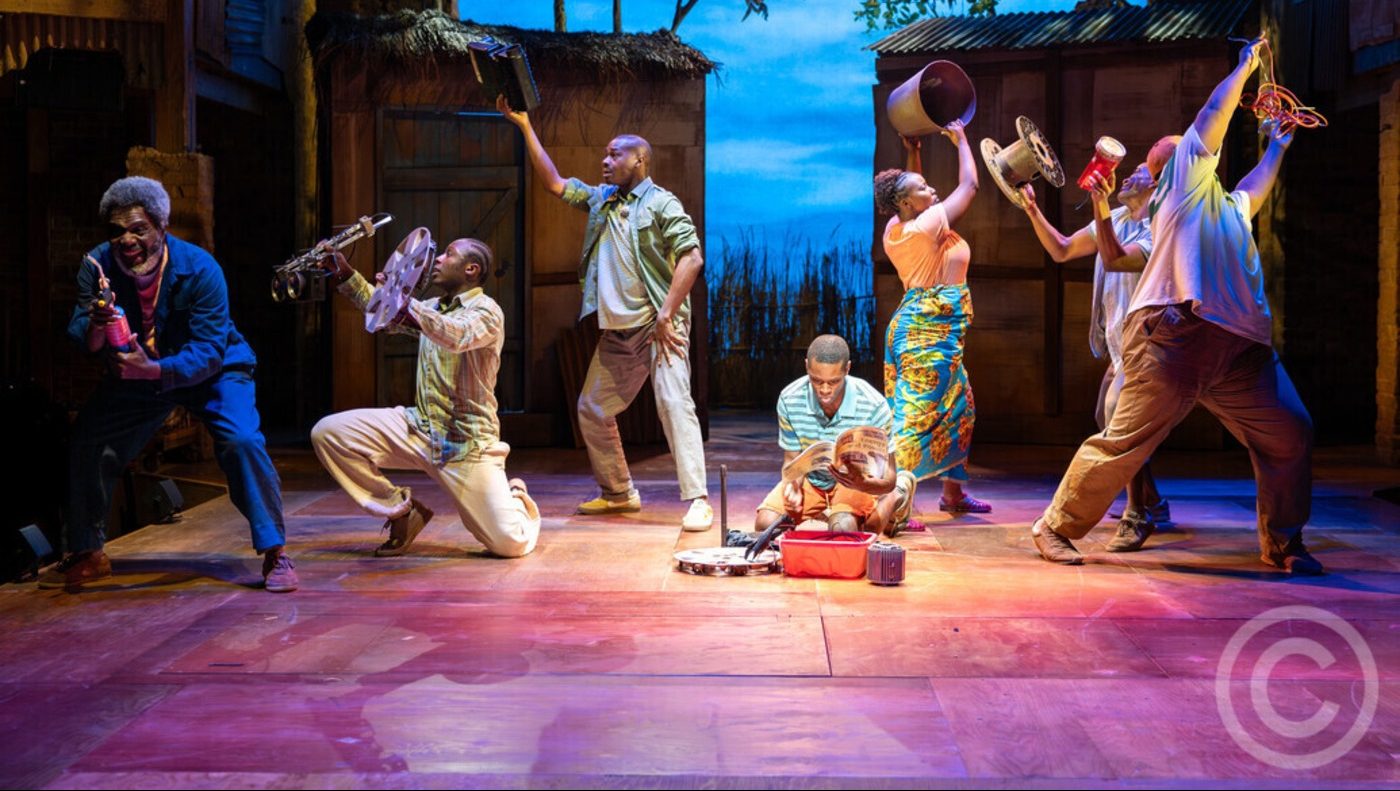
This story, one that is full of heart, rich in culture and vibrantly joyous in sound, maximised the space of the Swan Theatre. The use of a sandpit to symbolise the farming work and the use of balconies throughout the narrative, culminating in the final construction of the life-changing wind turbine, made for a spectacle that engulfed the audience in sound. This immersed them in the Wimbe Village, offering the audience a chance to engage and interact with the characters.
The production had a strongly defined sound through choral chants and dance, and the recurring motifs of the Baobab tree, the wind and the hyena grounded the action. Choolwe Laina Mutanga, who embodied the wind, used fluid stylised movement as well as phenomenal vocals which blew away not only the audience but drove the narrative forward, her power fuelling the scavenged creation. On the other side of the story, the embodiment of starvation and hunger came by way of the hyena. Shaki Kalokoh, through the use of animalistic physicality, arguably Frantic Assembly-esque, showed how the darkness of famine shrouded the village.
A notable sequence was the hyena’s solo presence on stage alongside the poetically narrated myth. Another included the use of physical theatre, a push and pull conflict saw famine striking villagers illustrate the scope of the disaster. The group moved across the stage as one body and at one point were confronted by the character of Khamba, a puppet-dog who was played and controlled by Yana Penrose. The dog comes face to face with the hyena and upon impact, a slow-motion ricochet with flashing lights and poignant music heighten the confrontation.
The projection illustrates the scientific conceptualisation of the wind turbine that slowly comes to fruition
The production uses mixed media as a central part of its storytelling, we see sketches of elements of tools and science projected and drawn against the stage floor and walls of the set when young William, played by Alistair Nwachukwu, sings ‘I Wonder’. The projection illustrates the scientific conceptualisation of the wind turbine that slowly comes to fruition. Later, as the story draws closer to the present, we see projections of tweets and other social media, as well as a TED talk that William Kamkwamba presented, which meld with the actor on stage speaking verbatim. In this way, the use of mixed media powerfully blends the real events with the compelling narrative of the production.
It is Lynette Linton’s clarity of vision in her direction that resulted in this feel-good, uplifting and truly touching production
The catchy song ‘It Won’t Work, William’ parallels intergenerationally in ‘The Girl in the Marketplace’, and the use of different genres and choreographic styles in ‘Impala Boys Superpower’ is impressive. Here, the production celebrates identity, culture and language proudly. Whilst the stage’s pre-set begins with a small black fire pit waiting patiently centre-stage and ends with an impressive wind turbine, the sense of community is established very early on. The use of music and dance especially showcase the cast in the construction of the turbine, with cast members revealing their musical prowess through solos celebrated by audience and cast alike.
It is Lynette Linton’s clarity of vision in her direction that resulted in this feel-good, uplifting and truly touching production which balanced comedy, truth and sentiment in a way that left you not only wanting to see the show again, but also wanting to research William Kamkwamba’s story further through other media.
Comments