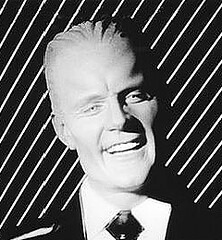
Weird Britannia: Max Headroom resurrected
How easy is it to define the eighties? Is it just the policies of Ronald Reagan and Margaret Thatcher? The star persona of someone like Tom Cruise? Or do fictional representations like American Psycho and Stranger Things better embody the decade?
Emerging at the height of the zeitgeist, whilst simultaneously positioned at a level of ironic distance, Max Headroom, with his cult following, surely captures some semblance of truth as regards a mythologised and oft misremembered time.
As a British creation, Max acts as the face of consumerism, and the corporate system, but always with a knowing sense of its own unreality. But is that all the eighties are? Moreover, with so many iterations, can the character truly coherently express an inherent eighties-ness?
Well, for starters, he wasn’t always the talking head we know him as today: debuting on Channel 4, Max began life as Edison Carter on Max Headroom: 20 minutes into the future. A journalist, in the pursuit of truth, David vs the Goliath of corporate culture in a cyberpunk Dystopian world, Carter is knocked from his motorcycle by a sign that reads ‘Max Headroom. 2.3m’. Out cold, his consciousness is downloaded into an A.I. persona to be used by the very corporation he wishes to expose… and so, Max Headroom is created.
His empty slogans and empty smile reflect an outwardly parasitic culture
And the irony here isn’t subtle. Max Headroom was conceived by creators Rocky Morton, Annabel Jankel, and George Stone, as a satire of American TV personalities for an MTV-style format. His empty slogans and empty smile reflect an outwardly parasitic culture. The intention, though, was predominantly to appeal to British youth.
It shows a great faith in viewership that Channel 4 believed a cynical, ironic takedown of eighties America was something that viewers could both handle and embrace. With his true debut on The Max Headroom Show on 6th April 1985, the character soon reached cult status in the UK, garnering Channel 4 a reputation for intelligent and original broadcasting in the process.
First appearances make all the difference, but Max Headroom’s continuing TV presence through the rest of the decade became far more sporadic and haphazard, spanning multiple networks.
Besides, Max would go on to have a far a stranger career beyond the small screen. The 1985 introduction of New Coke to markets was one of the strangest manifestations of the eighties. A mad cannibalised, neoliberal attempt at profit maximisation, there are certain parallels to the fictional creation of Max Headroom. It is fitting then that he should become its spokesperson.
The appearance of Max Headroom is nonetheless significant
As opposed to Pepsi’s celebrity endorsers like Michael Jackson, Coke’s decision to court the fictional Max Headroom has something of the hyperreal about it, when the character was created to satirise a misunderstanding of youth audiences. More than that, it blurred the lines between TV fiction and reality as Max was co-opted by corporate America in our own world.
And these levels of unreality go deeper: in 1986, also looking to Max’s cult status, the McDonald’s corporation used his image as inspiration for their far more successful ‘Mac Tonight’ promotional run. Here, the titular Mac resembled Max Headroom but with a crescent moon for a head. Singing a reworked version of Bobby Darin’s ‘Mack the Knife’, he promotes McDonald’s in layers of ‘50s nostalgia. In Reagan’s America, images and signs are reproduced in the name of consumerism, and it is the greatest irony (or greatest achievement) that Max Headroom became part and parcel of this.
Strangest of all, though, is his most famous (and enigmatic) appearance. During a 1987 re-run of Doctor Who’s ‘The Horror of Fang Rock’, a figure with an overly large Max Headroom mask appeared to make enigmatic pop culture references in a disturbing presentation. A mystery even today, the appearance of Max Headroom is nonetheless significant; seemingly, he had become a symbol of the culture he was created to mock. Is it a misinterpretation? Perhaps, but there is the sense that the ‘real’ Max was being channelled somehow.
Max Headroom was used not for advertising consumption but for public information
In a post-eighties afterlife, Max Headroom lives on in this manner, almost haunting. The Crazy Frog’s ‘Axel F’ features a sample from The Max Headroom Show in the beginning, a voice shouting ‘’What’s going on?’’. If you recognise it, it’s as if Max is trapped, a ghost in the machine. For a song that resurrects another lost item of the ‘80s in the theme for Beverley Hills Cop, this is no coincidence.
As our own culture continues to gorge itself on ‘80s nostalgia, Max is invoked as a symbol. It’s odd, even, that there have been no reboots of the character, although not for lack of trying.
Technically speaking, though, the character is officially dead. Appearing in a series of adverts for the Channel in 2007, directed by Rocky Morton, Max Headroom was used not for advertising consumption but for public information, promoting the switch to digital media. Now a decaying AI, he is cast off as a relic of the ‘80s in place of a new age.
This is far too optimistic an outlook. Like the AI in his first appearance, there is the sense of something that we have lost control of in this character. Rather than being a relic of a forgotten age, he lives on because the very concept of the eighties, too, is not entirely lost on us. Corporatism, consumerism, Media supremacy? If anything, that’s just the 2020s, and it’s worth remembering that too.
Comments