Weird Britannia: Blackadder and the new Millennium
As undoubtedly both disappointing and weird that the Millennium Dome experience proved to be (but that’s an entirely different story), strangely, it is still notable for providing the conclusion to a British comedy classic, Blackadder.
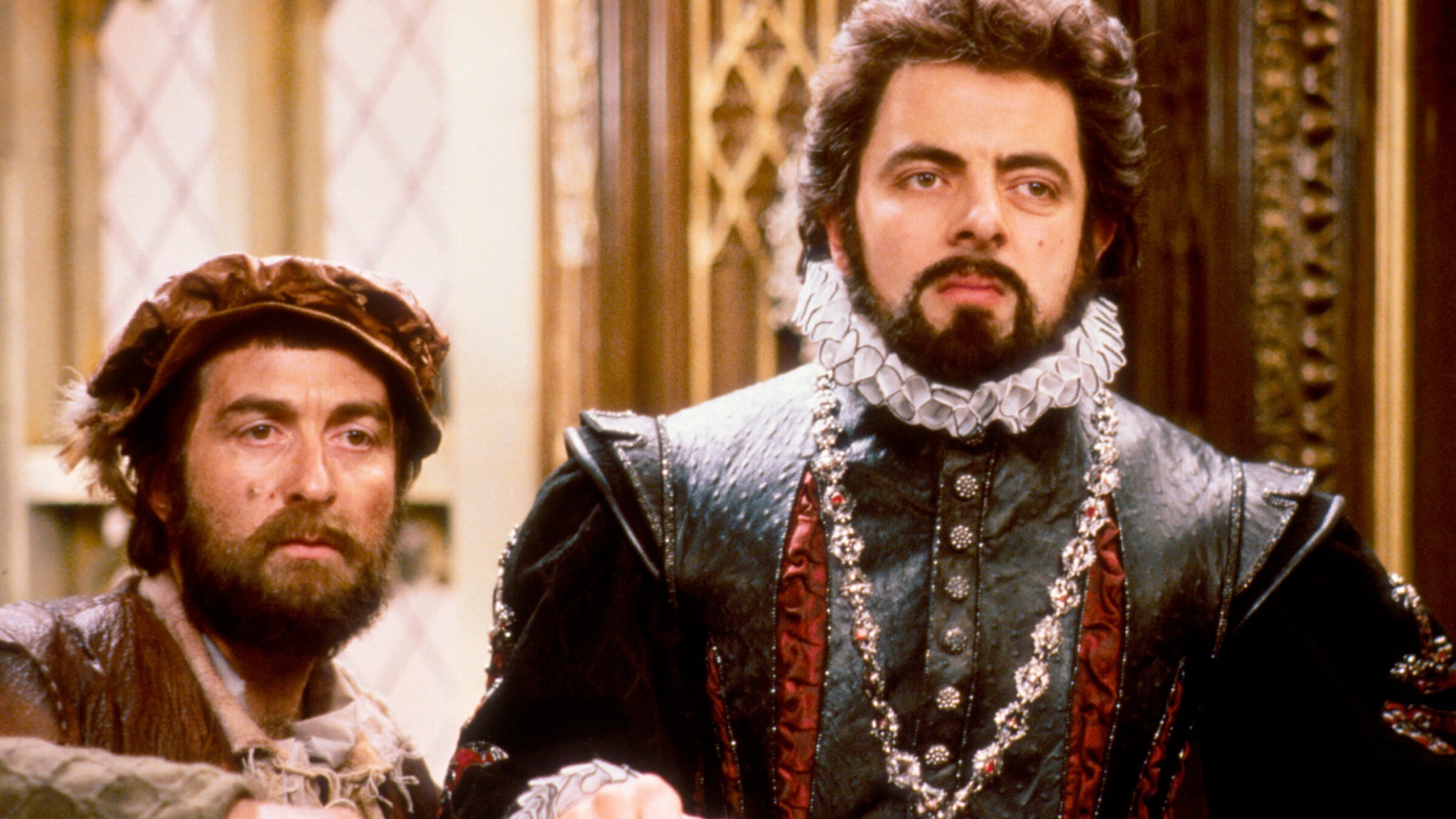
Ten years on from Blackadder goes Forth, Richard Curtis and Ben Elton ended the series with a time-hopping adventure through British history, encapsulating all its icons and iconography.
However, in wrapping up the series, keeping the same thematic and tonal consistency, much of the identity of the show became absorbed into a wider political project; if anything, Blackadder Back and Forth is entirely emblematic of UK Millennium-era nationalism and the result is a strangely politicised series finale.
There’s a comforting familiarity to the maintaining of the main cast
As per the series tradition, there’s a comforting familiarity to the maintaining of not only the main cast, now inhabitants of Britain in 1999, but their continued appearances throughout British history. Whereas the justification for the generational reoccurrences of characters has previous needed no explanation though, it finds one here or at least is reflected upon; suggested by Baldrick later on in the film, there has always been a Blackadder and a Baldrick (and therefore the rest of the cast). By this logic, human beings have always been the same.
What this represents is a rewriting of the show’s whole ethos, an attempt to apply a cohesive framing device around the show in its entirety. Now, the central conceit that has always defined the show, is applied in a wholly conservative manner.
Curtis and Elton conceive of Britain as writer Peter Ackroyd does: a place with its happenings pre-ordained. Recontextualising the show in this manner, Baldrick’s ‘cunning plan[s]’ and the repeated appearances of ‘Bob’ come to signify a logic of perpetual motion bound to the land of Britain itself.
Blackadder Back and Forth becomes a celebration of a Britain for the New Millennium
By extension, the inhabitants of this never-changing Britain become nothing but cogs in the machine, trapped in repeated occurrences. Take for instance the nature of the special; as a time travel story, Blackadder’s escapades differ markedly from those of the archetypal British Time traveller, the Doctor. Though the Doctor may travel in both space and time, Blackadder is constricted in terms of place, or so may it seem. Whilst never designated specific spatial mechanics like a TARDIS, Edmund’s machine can be seen travelling through a space-like vista, therefore implying movement through a liminal space. Why then is it that Edmund and Baldrick remain confined to the history of Britain alone?
And not just any history either. The audience is led to believe that the two men encounter only the icons and milestones within the history of the nation, offering not only a comprehensive history within a 30-minute slot, but a selective construction of Britain through its icons. This is a nation of Shakespeare, the Duke of Wellington, and Robin Hood, equating these figures, and what they stand for, with an essential Britishness.
In this regard, the film only compromises one small section of an entirely political and nationalistic project; as part of the Millennium Dome experience, Blackadder Back and Forth becomes a celebration of a Britain for the New Millennium as conceived by New Labour.
Britain exists as an essential culmination of its icons and their actions
As positioned outside the Dome, the film acts as a precursor to the exhibition it preceded; the intended effect is one of national optimism and indeed the ending of Blackadder Back and Forth fashions this response, albeit in a strange manner.
Blackadder’s final ability to change history as he sees fit seemingly breaks from the otherwise conservative presentation of Britain, suggesting the dawn of a new age, a new Britain. Granted, before doing so he has to rectify the damage he has caused: the erosion of Shakespeare’s plays, and the deaths of Robin Hood, and the Duke of Wellington respectively, precipitating the symbolic death of Britain, most notably through French invasion. Again, Britain exists as an essential culmination of its icons and their actions.
Come the conclusion, both Blackadder and Baldrick too join this long list through their selfish meddling. As both king and Prime Minister they are heralded as ushering in a new British Renaissance under dictatorial fashion and in the absence of democratic proceedings. Ultimately, this is a rather odd imagining of national revival.
Blackadder Back and Forth is haunted by the singular presence of New Labour
It brings to mind Doctor Who’s own conception of a Blairite renaissance under Harriet Jones during the show’s early revival. Her own rule similarly lacking in democratic credentials and bolstered by authoritarian tendency to an extent.
Then, what does this suggest of the Britons watching, the intended audience in 2000? Did people honestly think that Britain should be nothing more than a charismatic leader above his people? The implications are sinister.
With the ultimate failure of the Millennium Dome experience, its name tarred in history, it may be best to confine Blackadder Back and Forth to the same pile. For all its optimism and comedic flair carried over from the original, its nationalistic tendencies are premature at best and act as a stark reminder of a specific moment in British history.
Like the dome itself, Blackadder Back and Forth is haunted by the singular presence of New Labour and ‘Cool Britannia’. Rather than acting as a mere throwaway spinoff of the original series, it retroactively reshapes its entire legacy, and for the worse.
Comments