Weird Britannia: Advertising the uncanny at Alton Towers
Alton Towers has always been unique: situated within the grounds of the former country estate of the Earls of Shrewsbury, it offers a strange blend of the gothic architecture of the 19th century, and modern leisure entertainment.
When you take a look at its marketing however, things become altogether stranger. From 1992 to 2010, the park was responsible for some of the altogether weirdest, and downright surreal adverts on British TV. Combining British flair with American-style techniques indebted to Freud, the park seemingly discovered the perfect way of marketing the concept of the theme park to the nation.
In the Hall of the Mountain King
In spite of early advertisements featuring the warm and friendly tones of Terry Wogan, with the rebrand under the Tussaud’s group commencing in 1992, came a new wave of advertisement. For its inaugural TV appearance, happy families gave way to a Gothic presentation, significant for the first use of ‘In the Hall of the Mountain King’, now synonymous with Alton Towers.
Highlighting the gothic aspects of the Towers themselves, the piece has a duel effect, presenting a space where both the fantastical and the eerie can both exist. Through the advert, the very image of the park was altered as something enticing and mysterious. Like the Gothic motifs it builds upon, the marketing taps into the death drive of Freudian origin, engineering consent in the consumer through spectacle.
Don’t Look Down
Adverts would continue in the same vein through the nineties but for 1998’s ‘Oblivion’, the presence of psychoanalysis came to the fore. To appeal to the ‘adrenaline junkie’ of a new generation, by definition addicted to the prospect of their own simulated death, the marketing took on the aesthetics of late 90s rave culture but in a surreal environment.
In a TV slot that opens in an endless dark void and beads of sweat dripping from a man’s forehead, a strange man whispers the ride’s iconic slogan ‘Don’t look down’, a sort of mad look in his eyes, before the cart disappears into nothing, revealing the ride’s logo. ‘In the hall of the mountain king’ reappears but remixed, contemporaneous to the Chemical Brothers and the Prodigy.
Existential and somewhat eerie, both very of its time but nevertheless timeless, there is a definite appeal. More than that, there exists the very allure of ‘Oblivion’, the subconscious attraction to death as posited by Freud.
By contrast, the advert for ‘Air’, opening in 2002, reflects its Freudian opposite: desire, namely the desire to fly. Uplifting Y2K aesthetics evoke a sense of optimism not found in its predecessor but dulled by a muted palette and whispered tones; there is an eeriness and a suggested unknown somehow hidden within. The death drive once more.
Escape
Times change: from 2005-2007, ‘In the Hall of the Mountain King’ wasn’t used at all. The Park attempted a move away from its original branding and in turn, lost much of what made it once special, and what had worked so well. Major promotions became positively generic.
Though not for long. In 2007, change would come once again as control switched over to Merlin Entertainments. In an ad that makes full use of the iconic music, families are presented entering the park through gateways in the real world. In accordance with the literal mode of ‘’the weird’’, participants make an ‘’escape’’ to this other fantasy-like world.
The Gothic and the Freudian connotations are abandoned only to be replaced by the altogether surreal: the park is presented in an absurd fashion, rollercoaster track and waterslides coming out of the Towers themselves and pirate ships floating above the lake. Like Lewis Carroll’s Wonderland, it has the same air of the unreal that is simultaneously enchanting but also dangerous. On a deeper level, it recovers the strange fascination that the park had once been able to provoke.
You’d Better Not Go Alone
From two years later, the marketing for ‘Th13teen’ represents a marked perversion of the childlike innocence of the 2008 ad. A creepy girl walks through a forest barefooted, reciting verse while blurring the line between controlling and being controlled by nature. Borrowing from the aesthetics of horror, the ride bases its whole appeal on the thrill; there is ride footage but most prominently a glimpse of the car falling into a dark void.
The advert went so far into horror territory that it prompted a post-watershed version but it only highlights the strangeness of a family coaster that was marketed to the Saw generation. The resulting marketing failure signalled an end of an era: following another horror-orientated promotion for the disappointing ‘Nemesis Sub-Terra’, the park’s advertising soon after became relatively formulaic.
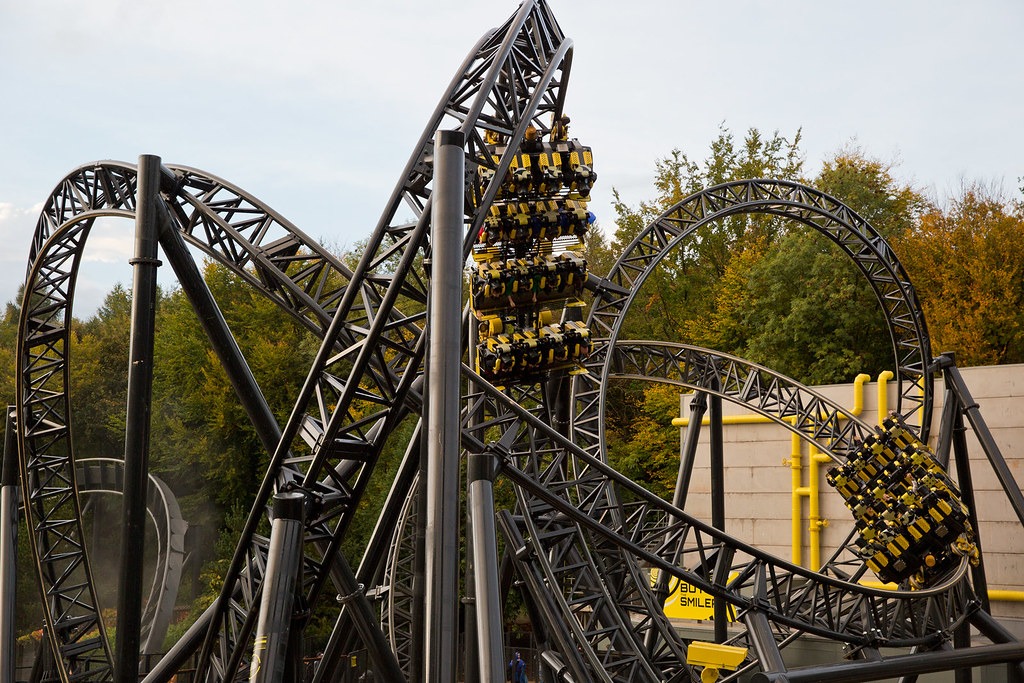
There may be a touch of the weird or the surreal in the ads for ‘The Smiler’ or ‘The Wicker Man’ but there’s a noticeable focus on the actual ride experience removing the stranger and more impressionistic aspects. In a bid not to mislead the consumer, once brilliant advertisements became boring, generic.
Whilst admittedly brief, Alton Towers’ flirtations with the uncanny define something that resonates on a subconscious level. Perhaps cynically so, as to appeal to consumers, there is nevertheless an identity and an artistry now missing in a sanitised landscape. For Alton Towers, its uniquely British character once so evident is now hardly traceable; something lost that we can’t recover, a signal of the times.
Comments