The Petri Dish – Extreme adaptation and the architecture of survival
Some argue that human existence is remarkable as the odds of our being here at all are so small. There is some truth in this perspective: Earth sits in a ‘Goldilocks zone’, a habitable region around a star where conditions are neither too hot nor too cold for liquid water to exist. A bit closer to the sun and the water would evaporate, any further away and it would be ice. It is estimated that there may be anywhere from hundreds of millions to tens of billions of potentially habitable planets in our galaxy alone, yet Earth is the only planet known to host life.
Generally speaking, the environment that surrounds humans is relatively moderate, but some places on Earth are largely inhospitable to us. What challenges human physiology, however, does not necessarily preclude life altogether
To some this points to our uniqueness, our idiosyncrasies, and extraordinary rarity. For me, this highlights life’s capacity to adapt. Organisms on Earth did not emerge due to pre-ordained conditions tailored to our needs; rather, life evolved as a result of the environmental conditions imposed on us. We’ve grown to meet the environment that surrounds us, and the diversity we see today reflects adaptation to the specific conditions our planet has presented, shaped over billions of years of natural selection.
Generally speaking, the environment that surrounds humans is relatively moderate, but some places on Earth are largely inhospitable to us. What challenges human physiology, however, does not necessarily preclude life altogether. The examples below illustrate extremophiles – microbes that thrive in environmental conditions that are detrimental to most life on Earth – that are finely tuned to more unusual ranges of environmental conditions (temperature, pressure, gravity). It’s worth noting that these ‘extreme’ conditions are anthropocentric, and whilst inimical for humans, they are optimal for the extremophiles who live there.
Tardigrades
Perhaps the most famous extremophile, the tardigrade (or water-bear, Figure 1) is a microscopic organism around 0.05 to 1.2 millimetres across. They are widely distributed, from the top of mountains to the deep-sea, from hot springs to polar regions – and even in your back garden. Scientists are so interested in them as they are the first species to survive outside Earth’s planetary conditions without any protection. They can live up to 10 days there, while it is estimated that humans could only manage two minutes.
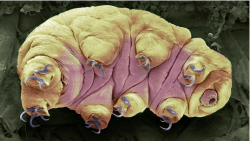
Figure 1: A scanning-electron microscope image of a tardigrade.
Their survival strategy is called cryptobiosis: they rid themselves of 97% of their own body water via anhydrobiosis (drying themselves up), going from an active state to a ‘tun’ (inactive) state. This enables them to perform incredible feats of survival: in the tun state, they can survive radiation 1,000 times higher than the lethal dose for humans, temperatures ranging from -236°C to 140°C, vacuums, and pressures six times that of the deepest parts of the ocean. There are a range of theories explaining this behaviour, including TDR1 (Tardigrade DNA Aamage Response protein 1) acting as a physical shield that binds to DNA, shielding it from radiation induced damage.
Deep-sea life
From Earth’s surface to its deepest oceans, extremophiles are scattered across the globe. The ocean poses a multitude of varying conditions – some areas are stone-cold, others above boiling point. Some microbes even live near hydrothermal vents (at nearly 400°C) like at the Mid-Atlantic Ridge or in the deepest part of the ocean (Challenger Deep, Mariana Trench).
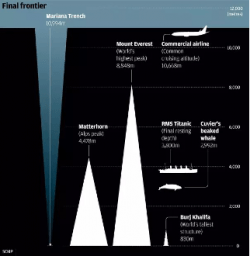
Figure 3: The depth of the Mariana Trench in comparison to Mount Everest, for reference.
In this Hadal zone – the deepest part of the ocean – the team identified unexpected strains of archaea (single-celled microbes similar to bacteria) that appear to descend from heat-loving ancestors, unusual considering the freezing temperatures at the trench floor
To withstand the weight of the entire ocean above them, deep-sea microbes need a specially adapted toolkit in order to survive high pressure. One strategy is forming chains to tie each other together, a possible strategy to help microbes communicate and save energy. Certain pressure-resistant proteins, like porins (channels in the outer wall of bacteria, helping to channel nutrients inside the cell), are highly concentrated in these organisms.
It would be rude not to plug my dissertation supervisor, Laura Lehtovirta-Morley, who was part of a team taking samples from 10,500 metres deep in the Mariana Trench to analyse the microbes living there. In this Hadal zone – the deepest part of the ocean – the team identified unexpected strains of archaea (single-celled microbes similar to bacteria) that appear to descend from heat-loving ancestors, unusual considering the freezing temperatures at the trench floor.
They also found a solute that stabilises proteins under extreme stress, and a duplication of a key enzyme suspected to have been snatched from nearby archaea to be shared. These findings are fascinating as they highlight how evolution is neither linear nor predictable. Life’s adaptive forces are broader and more inventive than we often assume.
Comments