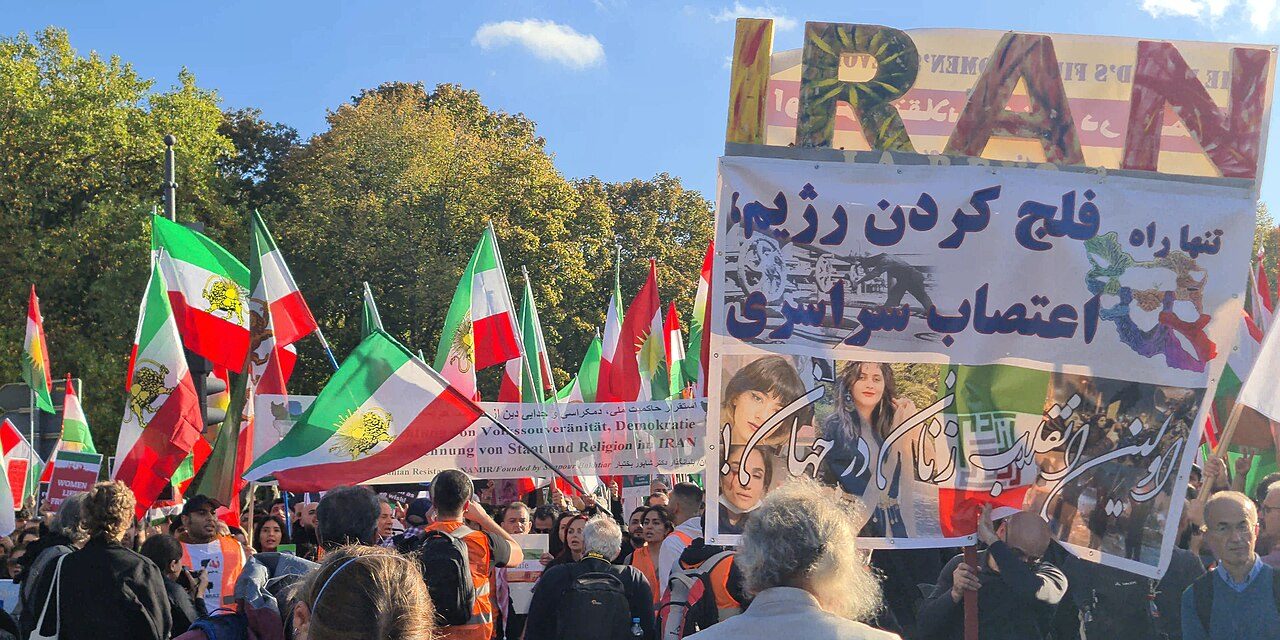
The Iran protests: Heralding increasing unrest
What started with simple demonstrations of bazaar owners closing their shops to protest the declining Iranian economy soon developed into a nationwide uprising with a confirmed death toll of almost six and a half thousand. According to other sources and doctors on scene, the number could have even reached 30,000, since communication has been impeded by an internet blackout since January 8.
The scale of brutality on show now is in an entirely different league
The brutality of the police crackdown on the most recent protests in Iran is on an entirely unprecedented scale. Violence has always been Iran’s reaction to stabilize protestors, and it has seen its fair share of protests, but the scale of brutality on show now is in an entirely different league.
To understand the escalation of Iran’s violent government response, we can observe the number of deaths by protest over the years. The 1999 student protests resulted in the deaths of 4 people, 2009 had 100 in the Green Protest, and the 2024 Mahsa Amini protests had over 500. Other demonstrations involved violence and deaths too, with a generally increasing number of casualties. But at a confirmed count of 6,373, the 2025-26 protests are the deadliest in Iran since the 1979 Islamic Revolution and perhaps even surpass it.
The Iranian regime is struggling to maintain its semblance of control
The horrifying scope of the recent violence is likely the result of the precarious position that Iran currently finds itself in. Having lost regional allies (the Asad regime in Syria), suffered losses in its proxies (Hamas & Hezbollah), endured (and still enduring) economic crisis, and been ravaged by persistent water shortages, the Iranian regime is struggling to maintain its semblance of control.
Iran, especially, cannot afford to appear weak in response to protests, and it absolutely cannot afford to allow protests to continue to grow in strength and reach. Already, the UN convened an emergency meeting to discuss the protests, the EU is considering further sanctions, and the US is searching for avenues to gain leverage over Iran to, once again, attempt to hamper its nuclear program. A crisis in the form of a potential revolution would open Iran to foreign intervention, which it desperately wishes to avoid.
The Iranian population is reaching its own boiling point, heated by decades of repression and economic stagnation
The Iranian population is reaching its own boiling point, heated by decades of repression and economic stagnation. There is a strong sense of frustration towards the oppressiveness of the Iranian regime, and it has exploded at certain points over time, as seen by the Mahsa Amini protests. Once again, it is exploding, much more powerfully than before.
However, the complete and total suppression of protesters likely means that the protests themselves will not result in a revolution or much meaningful change. In short, these protests are not another Nepal. There, the violent response from the Nepalese government was far less purposeful and reactionary, with lethal force used to prevent protesters from entering the Federal Parliament. With a much smaller death toll of 22 protesters, the loss of fellow protesters only galvanised others to take further action.
The same cannot be said of Iran. The huge death toll and the purposeful use of chemical weapons squashed the protestors far more effectively. To draw another comparison to Nepal, during its revolution, the internet culture played a huge role in organising protests and spurring young people to action. Almost as if recognising this, the Iranian government ordered an internet blackout and stopped what could have been a great tool for change.
It is likely that rival nations such as Israel and the US will take advantage of these tensions
However, the most recent protests have certainly contributed to the culture of unrest, and have continued to allow tensions and resentments towards the regime to continue to simmer. At the very least, the nationwide scale of the protests speaks to growing radicalisation and restlessness amongst the general population, which will inevitably explode once more in the future. To speak purely speculatively, it is likely that rival nations such as Israel and the US will take advantage of these tensions and will aid in feeding them to weaken and potentially overthrow what the US has called “the [Middle East]’s chief destabilising force”.
Already, the Iranian government has begun issuing statements claiming that the original protests’ escalation to violence was caused by “organized terrorist groups, backed by the United States and the Israeli regime”. They’ve also condemned the European Parliament resolution that accused them of severe human rights violations in their response to protests, responding with counter accusations that the EU has “the least credibility for their claims concerning ‘human rights’ and ‘the rule of law”.
It’s easy to tell from these kinds of statements that the current Iranian government is accustomed to protest and dissent, and well-versed in how to manage the fallout for their consistently violent responses. This strategy, of brutal violence followed by rhetorical justification, has worked thus far, but it is rapidly approaching its expiry date.
Comments