The Eurocentric fashion capitals of the world: Are they outdated?
When talking to any fashion-fanatics in your life, you will notice their reverence for the European cities of Paris and Milan, the traditional fashion capitals of the world, exalted as unrivalled sources of style and luxury goods. Fashion historians, such as Bonnie English, describe the broad societal impact of high fashion, stating that “we can step back in history or step forward into the future merely by changing what we wear”. The Eurocentrism of the fashion sphere cannot be denied, but in recent years there has been more and more cause to question whether these antiquated notions of European dominance still hold true, or whether the twenty-first century will witness the dethroning of old powerhouses by the rise of new, non-European fashion capitals.
The “Big Four” Fashion Capitals does now include one non-European city, but remains firmly entrenched within the confines of the global West; Paris, Milan, London and New York. The French capital Paris has arguably been the historic heart of European fashion and is home to luxury houses like Chanel, Dior and Louis Vuitton. The city hosts the most highly anticipated Fashion Weeks that promise spectacle and splendour, and runway shows attended by celebrity guests. From the sleek stencil engravings published in the 1920s journal Très Parisien, to the continual prominence of Elle magazine since its founding in 1945, Parisian media has amplified fashion journalism and global involvement in debate surrounding Haute Couture.
For the Italian city of Milan, its modern role within the world of fashion echoes its historical significance; the site of production of high-quality textiles, garments and luxury goods. The twentieth century witnessed how Milan-based designers produced a legacy to rival Paris’ and the rise of a number of Italian fashion houses such as Armani, Versace, Prada, Dolce & Gabbana, Gucci, and many others. While the early Renaissance period had seen Milan overshadowed by Florence’s fashionable sway, Milan had become known as the best place to purchase luxury goods, a flourishing trade hub due to its geographical location.
The English Capital’s fashion influence was borne out of a thriving, energetic youth scene following the conclusion of the Second World War. Fuelled by rebellious spirit and a longing for change, the vibrance of London’s increasing diversity was fostered by a number of world-class fashion schools and resulted in the rebellious, punk-influenced works of McQueen and Westwood as well as the Mary Quant’s Mod subculture-inspired garments. The New York fashion scene captured a similar feeling of restlessness about conventional fashion, and challenged the status quo since the 1940s when New York designers introduced high fashion sportswear. Much like the city itself, New York fashion grew synonymous with aspiration and innovation, becoming the founding location of the legendary fashion magazine Vogue in the early twentieth century. Following the first event in 1948, New York has continued its relevance and innovation through the iconic annual Met Gala fashion show, to fundraise for the Metropolitan Museum of Art’s Costume Institute.
In the 1930s and ’40s, Japan suffered vast economic deprivation as well as the physical and psychological effects of war. It did, however, inspire avant-garde designers like Yohji Yamamoto to fuse fashion expression with intellectualism in order to reflect on the psychological state of the population
More recently, however, many other global cities have shown huge potential for overthrowing or expanding on these traditional four. I will highlight a few that I personally believe have already indicated their potential to challenge the Eurocentrism of high fashion culture. The fashion history of Tokyo, Japan’s capital city, is one of a phoenix rising from the ashes. In the 1930s and 40s, Japan suffered vast economic deprivation as well as the physical and psychological effects of war. It did, however, inspire avant-garde designers like Yohji Yamamoto to fuse fashion expression with intellectualism in order to reflect on the psychological state of the population and find beauty in the broken and withered. Similarly, from the 1970s, Japanese designer Issey Miyake utilised new technology to advance pleat-making and worked in both Paris and New York to facilitate a fusion of traditional Japanese style elements with Western design. Miyake approached his ‘anti-structuralist’ reworking of the kimono with the meticulous precision of an architect. More recently, the youth-fuelled Harajuku street fashion rebelled against the constraints of typical fashion like the British punk designers had done, and were rewarded with global attention. The subcultural dress combined traditional Japanese garments with babydoll accessories, bright colours, almost-disposable plastic jewellery, and challenged societal boundaries about gender, expression of sexuality and the force of urban change.
GQ China’s ‘Heat Stroke’ themed June 2024 issue, a viral online success, is indicative of the global desire for fashion to incorporate more fun, experimentation and story-telling
From China, Shanghai presents another impressive option for a global fashion capital, hosting Fashion Weeks to display China’s innovative new designers and creatives. GQ China’s ‘Heat Stroke’ themed June 2024 issue, a viral online success, is indicative of the global desire for fashion to incorporate more fun, experimentation and story-telling. Its accompanying shoot depicted a summer theme through the clever use of makeup to recreate the effect of a fresh suntan, outlining the pale shadow of tank tops, chains and sunglasses on the models’ skin. LVMH Prize Special Prize winner Rui Zhou is just one of the many Chinese designers who have been recognised for their creative and abstract approaches to design, and now markets globally. Her abstract and geometric designs use thin knitted fabrics that cling to the body and gather to reveal circular negative spaces of skin. In her Spring/Summer 2025 collection named “Lingering On”, she experimented with elasticated materials interrupting gaps she called “liminal spaces” by synching together fabric, symbolically repairing the distance.
Her collection ‘Dual Mandate’ proves that sustainability belongs in high fashion, and Nigerian designers will be pioneers in achieving this, especially since Lagos Fashion Week won the Earthshot prize in the “Build a Waste-Free World” category
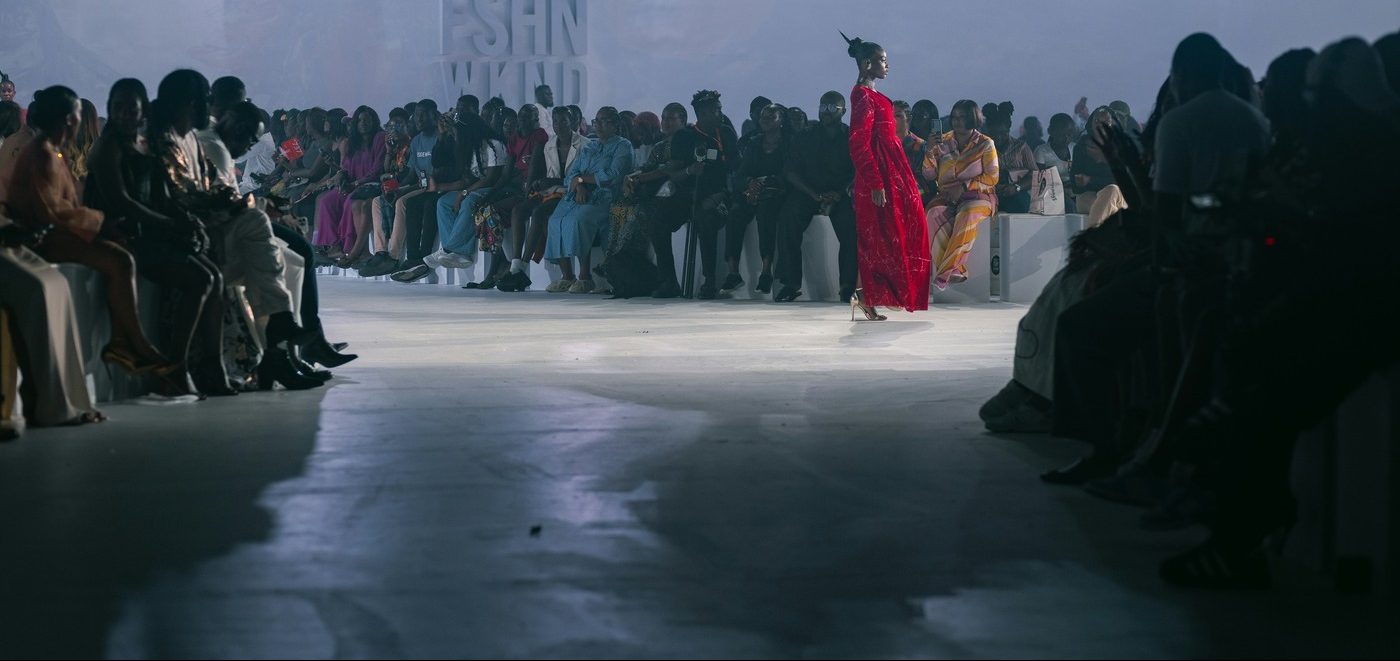
An even more recent development is the impressive rise of Lagos, Nigeria, in the high fashion landscape, with its Fashion Week only founded in 2011. Nicknamed the “New York of Africa”, the West African coastal city of Lagos has acted as the springboard that launched designers from across the continent onto the global stage. Since Lagos’ population of 20 million is relatively young, the city is characterised by rich colour and pattern, resulting in a streetstyle that contrasts futurism with tradition. Sustainability-conscious Nigerian designer Bubu Ogisi (of Iamisigo) transforms recycled materials and wasted fabric into dramatic and sculptural designs. Her collection ‘Dual Mandate’ proves that sustainability belongs in high fashion, and Nigerian designers will be pioneers in achieving this, especially since Lagos Fashion Week won the Earthshot prize in the “Build a Waste-Free World” category. Furthermore, young Lagosian designer Adebayo Oke-Lawal created Orange Culture, a gender-neutral brand that celebrates individuality and combines sheer flowing lines with sharply-cut, structural elements. He describes his designs as possessing “universal silhouettes” that “confront societal norms”, displaying passion and energy evocative of the youthful energy that powered London’s rise to fashion prominence, and making Lagos one to watch.
The shifting of the locations of our global ‘Fashion Capitals’ is directly and inextricably tied to the shifting nature of the society that they belong to. The traditional “Big Four” may not be obsolete yet, however as the world continues to change it would be unsurprising if these (and many other non-European cities) grew exponentially in prominence as the 21st century progresses, bringing with them fresh ideas and desire for change.
Comments