Sun, sea and student budgets: A Greek island odyssey
Island hopping sounds dreamy in theory, but between ferries, accommodation, and choosing where to go, it can get complicated fast. This is a no-nonsense guide to Greek island hopping for students, to make logistics less overwhelming and keep the chaos on land, not in your itinerary.
First of all, I recommend island hopping in June. May and June offer summer temperatures, lower prices, and a lively atmosphere without peak crowds. July has the best weather but gets busier and slightly more expensive, while August is peak season across Europe. September is calmer and cheaper, but wind can be an issue, especially in the Cyclades.
Long ferries and constant moving can get exhausting, so don’t make your itinerary too ambitious. Also, ferry tickets are surprisingly expensive! An ideal trip is 1–2 weeks, with 3–5 days spent on each island.
I would recommend choosing 2-3 islands in the Cyclades, the group of islands closest to Athens. This also gives you the chance to spend 1–2 days in Greece’s culture-rich capital. In peak summer though, Athens gets extremely hot and the beaches are quite far; it’s best to visit for a short stay on arrival or departure or go in May or September when it’s cooler and more affordable.
The big questions of “which islands should I pick?” depends on who you’re travelling with and whether you prioritise parties, beaches, or budget. Prices vary mainly by popularity and season.
It is my favourite island of all time, and I would recommend staying anywhere in Naoussa, going to Kolimpithres beach by bus in the day and clubbing near Barbarossa at night
For the main Cycladic islands:
Santorini/ Mykonos – peak party, expensive, iconic
Paros – balanced, social, youthful
Naxos – more affordable, great beaches, laid-back
Ios – young, party-focused, Mykonos with a more ‘backpacker style’ atmosphere
Milos – scenic, serene, beautiful beaches
If you’re unsure, Paros is the best and safest choice. It has a bit of everything without the extremes. It is my favourite island of all time, and I would recommend staying anywhere in Naoussa, going to Kolimpithres beach by bus in the day and clubbing near Barbarossa at night.
Whilst there are many guides for Greek island hopping out there, they are often catered towards older people. For example, to tour Crete (properly) it is an unspoken rule you need a car as it is such a huge island, however, to rent a car in Greece, you must be 21 with some companies requiring you are even 25!
The best way to get around an island is by using the bus network, which can be surprisingly efficient. Getting the bus is also quite social as it is how most of the young tourists get around. Bus tickets are very cheap too, usually 2 euros.
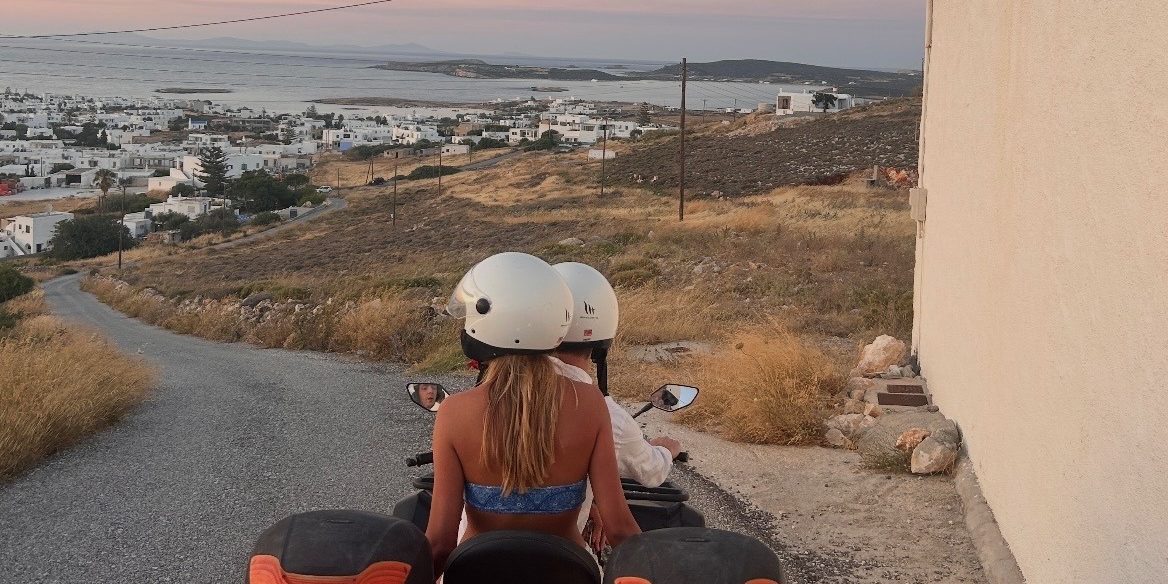
You can also rent an ATV for around €30–€50 per day. You can even rent one for just 1-2 days, to discover the areas not accessible by bus, for example the beautiful hidden beaches of Milos such as Tsigrado Beach. That said, Greek drivers are infamously chaotic and reckless, so unless you are a confident driver, I would stick to the bus or a taxi.
The best place to stay on a Greek island is the ‘Chora’ (main town), where you’ll find the most transport, food, and nightlife. It definitely pays off to stay here, even if its slightly more expensive.
Be wary that awkward arrival times can mean reception into accommodation most likely isn’t open, and you can be left stranded
However, it is still important to do some supplementary research. For example, there are two main towns on the island of Paros, Parikia and Naoussa, with Parikia being the official Chora. However, Naoussa has become the ‘hotspot’ of the island, where all the young people stay and where you will find all the clubs and food, while families tend to stay in the (much quieter) Parikia.
Here is a step-by-step guide to planning your route:
Decide which 2-3 islands you want to visit
Decide whether you want to fly into Athens and get a ferry, or directly into an island, and start looking at flights
Sometimes flying between islands or to/from Athens can be cheaper and faster than ferries, so it’s worth checking both
Go on Ferryhopper to find ferries to and from each island depending on your itinerary
There is often some variation in ferry times reflected in prices. Be wary that awkward arrival times can mean reception into accommodation most likely isn’t open, and you can be left stranded.
Using booking.com or Airbnb, find accommodation you want to stay in (in the Chora or main town on the island)
I recommend doing this after choosing your most suitable ferry, as you may need to adjust your dates based on arrival times (for example, an 8pm arrival might warrant an extra night)
Also try to make sure you are near a bus stop as walking for long in the heat, often hung over, is not fun!
Check all the dates line up and get booking!
Often for more touristy islands, prices of sunbeds can be massively inflated. Bringing a beach towel and laying on the sand is often a much better option
And finally, here are some extra tips:
You do not need a sunbed every time you go to the beach! Often for more touristy islands, prices of sunbeds can be massively inflated. Bringing a beach towel and laying on the sand is often a much better option
Bring some cash or physical card as, though most areas are cashless, this is not always the case
Make sure you have checked and understand the bus itinerary, which you can find online
Drink prices are high, so I would recommend going to a small, local supermarkets to get pre-drinks
Comments