Stage Plays: The fascination with performance of spectacle
Although literature is in itself an irreplaceable art form, it becomes transformative when translated onto the theatrical stage. From New York’s Broadway to London’s West End, theatre, often adapted from literature, is a widely enjoyed performance medium, even by those unfamiliar with the source material. My personal favourite stage adaptation is Andrew Lloyd Webber’s The Phantom of the Opera, adapted from Gaston Leroux’s novel by the same name. The Phantom of the Opera is an epitomic gothic romantic tragedy which follows a young soprano in the Paris Opera House, Christine Dae, who becomes haunted by the Phantom’s obsession, the disfigured “angel of music” who lurks beneath the opera house. Through its grandiose set design, emotionally vibrant soundtrack, and melodramatic character portrayals, Webber’s theatre production vividly brings Leroux’s words to life.
In the original text of The Phantom of the Opera, the narrative is presented as a journalistic investigation conducted by a detached narrator who shifts focus between various characters, particularly Raoul, Christine’s love interest, as he attempts to understand Christine’s change in behaviour. The stage adaptation eradicates this element of mystery, instead primarily following Christine as the audience watches her navigate the torrid love triangle between the Phantom and Raoul. By centralising Christine, the play immediately invests the audience in her character’s internal journey and, by extension, her turbulent romantic arc. In this way, Webber constructs the production as a gothic love story rather than a thriller, one that is driven by emotional conflict and dramatic tension, which intrigues the audience through its characters rather than suspense. Although the play reduces Leroux’s original story, I believe this alteration is highly effective on stage, as unlike a novel, a theatrical production has limited time to engage its audience and communicate its narrative. By streamlining the plot, the play maintains clarity whilst sustaining the audience’s intrigue.
In each version, her character development is realised through her role as a bridge between the Phantom’s dark, isolated world and the lighter human world of the Opera House
In a similar fashion, Leroux’s original text has the capacity to portray Christine as a multifaceted character, while Webber’s play positions her as a romantic lead while preserving the integral aspects of her character intact. Throughout both narratives, Christine develops from a naïve, grieving young girl into a resilient woman who takes liberty over her life choices. In each version, her character development is realised through her role as a bridge between the Phantom’s dark, isolated world and the lighter human world of the Opera House. However, this transition operates in subtly different ways due to the contrasting characterisation of the Phantom. In accordance with the differing genre conventions of each narrative, the novel’s Phantom is a genuinely terrifying and an inhuman entity, whom Christine kisses at the conclusion only out of pity for his suffering. On the other hand, the play’s Phantom is reimagined as a broken and enigmatic musical genius, whom Christine comes to understand, driving her desire to draw him into the light through an act of compassion.
Leroux’s eerie descriptions of the Phantom serve as a masterclass in gothic characterisation; yet I argue the stage humanisation of the Phantom allows the audience a greater chance to connect with his character. By granting him a potential redemptive arc through his disappearance rather than death, the production preserves an element of the novel’s mystery and culminates in the striking visual of his mask left behind. This ending is both symbolically resonant and narratively satisfying, as the abandoned mask represents his transformation without sacrificing the ambiguity primal to his character.
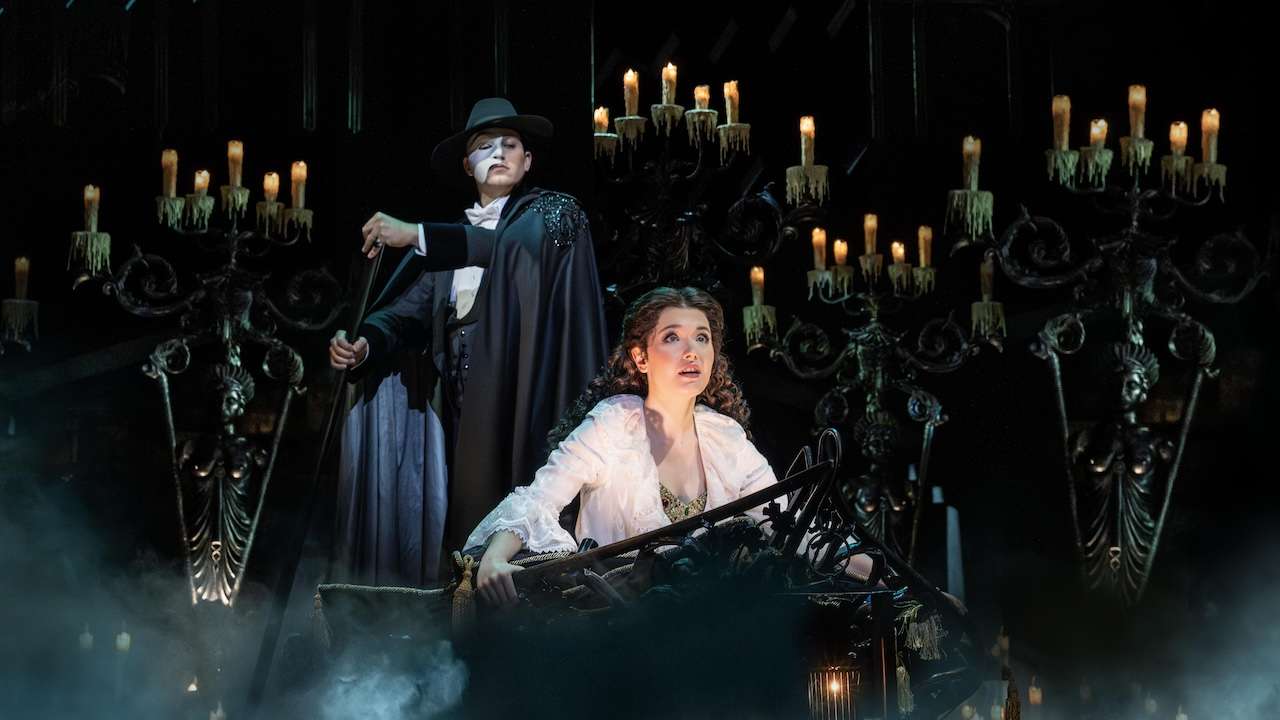
Finally, the production components of The Phantom of the Opera stage adaptation elevate the literary story into a visually and sonically spectacular theatrical experience. From the play’s outset, the opulence of the Paris Opera House set and intricacy of the accompanying costumes captivates the audience, immersing them within this vivid historical setting. In particular, the chandelier arguably delivers the play’s most iconic visual moment, rising to a tense score at the opening of the play before crashing dramatically into the Opera House at the climax of Act One, accompanied by the Phantom’s ominous threats. This motion is not only stunning but also symbolic, reinforcing the novel’s portrayal of the Phantom’s sinister nature in this moment.
Webber’s whimsical production makes this scene a feast for the eyes, blurring the line between reality and illusion
Additionally, my favourite moment of the play is the Phantom’s introduction and first interaction with Christine, as he emerges from her mirror, draws her through it, and silently guides her by boat to his underground lair. Webber’s whimsical production makes this scene a feast for the eyes, blurring the line between reality and illusion to create a visual manifestation of Christine’s liminality between contrasting worlds, thereby establishing the bond and conflict at the heart of the narrative. Even so, the incredible staging is rivalled by the power of the iconic soundtrack that underscores the scene. The Phantom of the Opera theme, forged through a fusion of pipe organ and percussion, is absolutely unforgettable. Its hypnotic quality almost seduces the audience as profoundly as the Phantom does Christine, intensifying the immersive atmosphere that defines the production.
As someone who, more often than not, prefers the literary source material to its adaptations, The Phantom of the Opera stands as a proud exception. Although each version illustrates the story through a different lens and even concludes differently, I thoroughly appreciate both for their unique artistic features, offering equally compelling explorations of liberation and love. Webber’s play in particular pays homage to the conventions of Gothic literature seen in Leroux’s through both his storytelling and production design, whilst remaining accessible to a modern audience. Ultimately, when executed thoughtfully, adapting literature for the stage allows timeless stories to connect with a wider range of people through the power of theatre.
Comments