Getting Lost In “Translations”: A New Take On An Irish Classic
Brian Friel’s Translations is one of the most significant Irish plays of the 20th century. Written at the height of The Troubles, but set in the 1830s, it mourns the loss of the native Irish language whilst raising a much-deserved middle finger at Ireland’s former colonial occupiers.
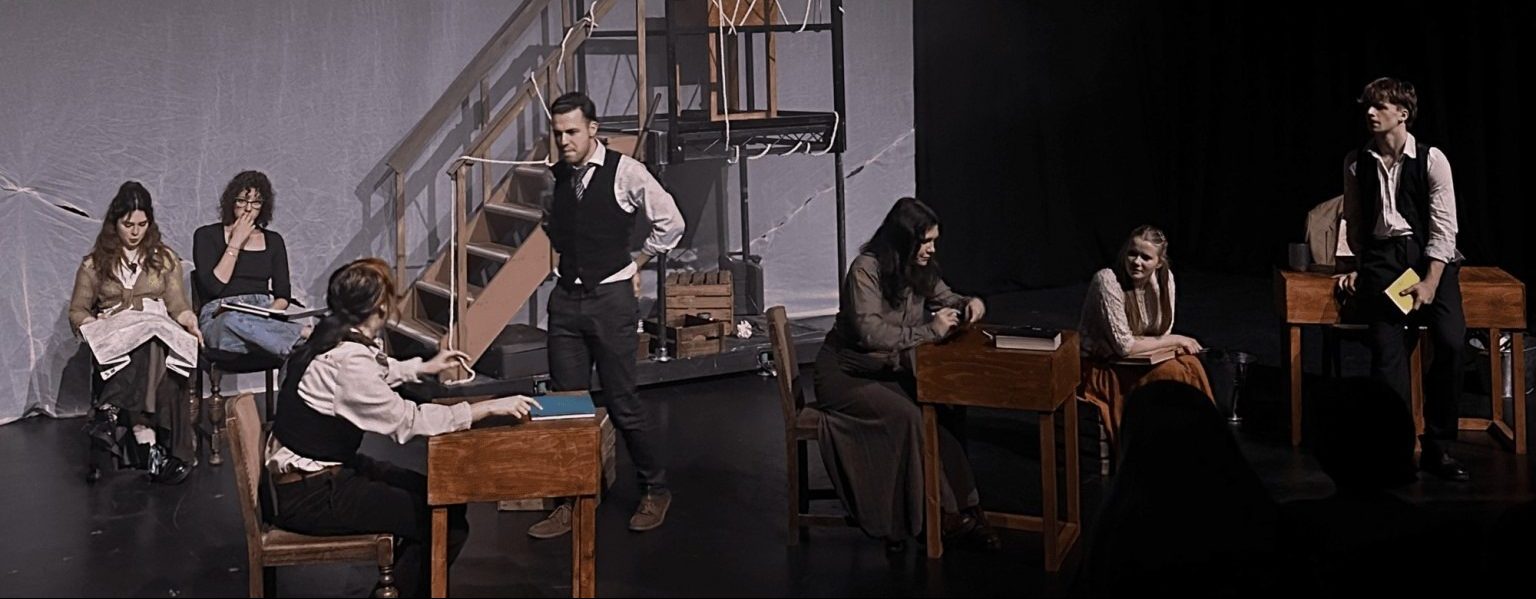
Nearly fifty years on from its premiere, emerald lighting now hovers over the Warwick Arts Centre stage. Featuring a soundtrack that mixes the Northern Irish punk of Stiff Little Fingers and The Undertones with Dublin heavyweights Fontaines DC, the music adds to a sense of patriotic ambience. Sparsely scattered furniture of the period adorns the space, with bonus points for the inclusion of a wagon wheel, a fantastic reference to a rural 19th century stage trope.
Opening projections of recent violent Irish protests and scenes from the Free Palestine movement, suggest that director Matthew Mullan’s production is only masquerading as being set in the 1830s; and is in fact desperate to assert its relation to a modern context.
Oddly merged with the decor is the all-electric band, not wearing any outfits of the time. They are, incidentally, incredible and this reviewer would definitely go see one of their gigs. Their inclusion, coupled with the opening projections of recent violent Irish protests and scenes from the Free Palestine movement, suggest that director Matthew Mullan’s production is only masquerading as being set in the 1830s; and is in fact desperate to assert its relation to a modern context.
After that preamble, we can settle into the play’s action. A rolling cast of loudmouth, eccentric male Irish characters are revealed, delivering their respective beer-soaked monologues as they each join a loose school setting. Each monologue is anchored by a focus on etymology. The best of these is Toby Anderson’s Jimmy Jack, who leaps around the far more grounded Manus (Fred McGahan), offering absurd proclamations of love to the Greek goddess Athena. As daft as this slightly deluded character (and all his Homeric quotations) may seem though, his role is a crucial one in getting us to consider language, communication and hierarchy – arguably the play’s three biggest themes.
Eventually, the crux of the story is revealed. Manus’ brother Owen (Max Green) returns from extended leave to reveal the contents of his mission – helping the visiting English colonial troops anglicise the names of the local Irish towns. Indeed, the true conflict of the play may not even be an Anglo-Irish feud but a fraternal one, with Manus and Owen clashing over the necessity of English intrusion
We are soon introduced to the nervous but endearing Lieutenant Yolland (Monty Claydon), a sort of Georgian Hugh Grant. Alongside him is a predictably buffoonish English Captain, Lancey, excellently caricatured by Ethan Palmer, who strikes a balance between a sneering yet foolish patronisation of the natives – the only way this part should be played. For, in a bold directorial move, a production of one of the most quintessentially Irish plays ever written, contains not one Irish accent. Claydon and Palmer must make us believe that they are in an entirely different world from the rest of the English actors. In fairness, they make a good effort at it.
Bergin deserves a great deal of credit for making a not particularly memorable character (Friel is clearly not as adept at writing female parts) entirely watchable.
One person who does not need the accent to offer us a crystal vision of Irishness is Laura Bergin, who plays Maire, the subject of a controversial cross-cultural romance with Yolland. She picks up the natural inflections and mannerisms of the Irish with excellent flourish. Bergin deserves a great deal of credit for making a not particularly memorable character (Friel is clearly not as adept at writing female parts) entirely watchable.
For the first half, it is a delightfully funny production, as some of the regulars in the WAC audience are keen to remind us, laughing so loud we miss half a scene’s worth of dialogue! There does, however, come a point where the comedy perhaps becomes a little too physical though the drunken slapstick is no doubt ramped up alongside the audience’s enthusiasm. In almost all Irish plays, it is compulsory to have at least one perpetually drunk character, but that doesn’t necessarily mean that they automatically have to be an idiot. Sometimes, in fact, they have the most interesting observations, so their depiction does not need to be defined simply by falling over a lot.
A sense of physicality persists after the interval, but in a complete stylistic contrast to the first half. Gone are the drunk stumbles and in comes a moody Frantic Assembly-like sequence. Gone too are the sharp one-liners we’d been seeing from the likes of Claydon and Anderson. This leaves our ensemble altogether more angry, or simply more miserable. The fact that the production veered into a deliberate farce at one point makes the transition to the harrowing element of the plot all the more difficult to pull off. This, though, may very well have been Mullan’s ploy all along – deliberately throwing us off the scent.
Despite all of the drastic changes in characters’ emotional levity, the stars of the stage remain constant.
The situation is made more complex by a mixed bag of technical choices. Having Irish translations of key phrases scrawled out as projections behind the actors was a lovely, tasteful touch. The lighting states are a little less appealing. There is an odd juxtaposition between the dark lighting in the first half, offering us little of a sense of the outdoor Irish countryside, and the stark brightness of the second act. These choices aren’t a problem in and of themselves, but they seem to go against the increasingly sinister trajectory of the play. The moment where pink disco-like lighting appears during one of the most emotionally poignant scenes of the show shall be swiftly glossed over.
Despite all of the drastic changes in characters’ emotional levity, the stars of the stage remain constant. Arguably the most impactful scene again comes courtesy of the magnificent Toby Anderson. He portrays Jimmy Jack at a crushingly vulnerable stage, when he is under the illusion that he is to be married to Athena. It’s a gut-wrenching allegory for the doomed love and misplaced faith in authority, experienced by the play’s protagonists. The other standout is Ethan Palmer, whose Captain Lancey becomes a suddenly vicious, horrifying vision of the true, evil entitlement of the British Empire. As sweet and charming as Claydon is as Yolland, Palmer’s fierce and downright petrifying performance matches it.
One of Captain Lancey’s final actions is to drape a union flag across the set. It is a blatant parallel to the present-day ‘stop the boats’ crowd. The production seems to be telling us that, though their opinions may be laughable these right wing groups when mobilised, pose a very real threat to the fabric of our society. Whilst it may not be perfect, this interpretation of Translations is effective in reminding us that we must listen to a broad range of cultural perspectives. If we do not, our own language, land and identity will cease to be something we can be proud of.
Comments