Corsets vs Facts: How Netflix’s The Empress Served Historical Fiction Goodness on a Plate
Unlike the other television series covered in Corsets vs Facts so far, Netflix’s The Empress (2022) is the first not based on a book or play; in fact, it is a brilliant piece of historical fiction, plucked straight from Austria in the 1850s. It recounts the union of the 16-year-old Elisabeth von Wittelsbach (Devrim Lingnau) and Emperor Franz Joseph I (Philip Froissant), placing a free-spirited Bavarian duchess into the rigid heart of the Habsburg court. From the outset, The Empress leans hard into emotional truth and modern pacing, setting itself apart from being a retelling of imperial history.
I recently began The Empress as it had been sitting in my watchlist for a few months, and I’m annoyed that I didn’t start it earlier. Within its first episode, I went from having no prior knowledge about the history of these characters to being completely immersed in wanting to know more than just who they were, but to catch a glimpse into the inner workings of an Austrian court life in a time where the threat of war was quite literally at their doorstep.
Elisabeth – aka “Sissi”– is portrayed as a headstrong and delightfully outspoken person, much to the dismay of her mother, Ludovika, Duchess of Bavaria (Jördis Triebel), who plans to marry her off to a rich nobleman failed due to Elisabeth’s undeniable free nature. Her zeal for independence and individuality is a defining feature that made her intensely popular with the Austrian public, as well as her husband, Emperor Franz Joseph I. However, Elisabeth finds trouble with the rigid protocols required of her in Vienna, as the tension between her spirit and the court’s expectations becomes the series’ emotional engine.
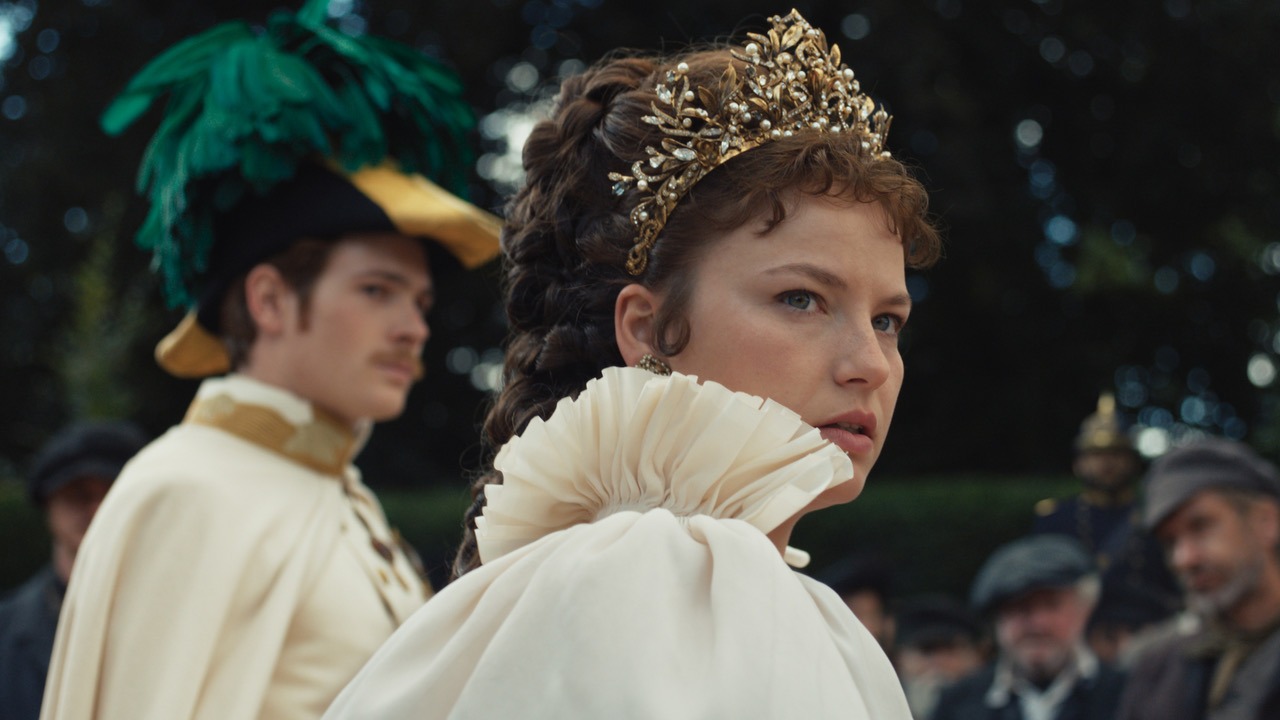
The Empress is sumptuous in its hair and costume design
The show’s greatest strength lies in how it humanises historical figures without sanding off their flaws. Elisabeth is not a saintly victim nor a purely romantic heroine; she is stubborn, impulsive and often politically naïve. Likewise, Emperor Franz Joseph is neither a tyrant nor a lovesick fool. He is trapped by duty, shaped by his domineering mother and struggling to reconcile personal desire with imperial responsibility. The show accurately displayed the quick pace of their relationship, as the pair were engaged in 1853 and married the year after. However, constrained by its six-episode format, the series fails to show that Franz Joseph was far more immediately smitten with Elisabeth than she was with him, as her affection actually developed over time, rather than at first sight. But despite this slight difference, the series made every effort to highlight that their relationship felt less like a fairy tale and more like a collision between two young people trying to breathe inside an institution that does not care for happiness.
This is why I believe that the series takes historical liberties—and proudly so. Political events are streamlined, timelines are compressed, and character motivations are shaped for dramatic effect. But this is where The Empress earns its place in historical fiction rather than historical drama. It aligns more with emotional authenticity than factual precision, which prioritises a vivid imagining of lived experience, setting aside a supposed need for archival footnotes.
The Empress proves that historical fiction does not need to be shackled to perfect accuracy
In the fashion department, however, one character’s wardrobe stands out in a way that really caught me off guard: Sophie, Archduchess of Austria (Melika Foroutan), Elisabeth’s aunt and mother-in-law. Unlike the relatively grounded costuming used for Elisabeth and the court, Sophie’s outfits feel wildly out of step with the 1850s setting. Her gowns combine elements of later Victorian fashion with bold, modern abstract prints, creating a look that seems to collapse multiple eras into one. While this may have been an intentional choice to visually separate her from the younger characters and signal her authority, it repeatedly pulled me out of the illusion of the period whenever she appeared on screen. Instead of reinforcing the period, her costumes often felt like a conceptual fashion statement layered onto a historical drama.
In this light, the argument surrounding historical accuracy concerning costuming became one of the central debates about The Empress. And more broadly, the entire genre of historical fiction. When a series roots itself in real history, drawing its narrative based on events part of global antiquity, there is a glaring focus on both the accuracy of its retelling and overall visual aesthetic. In many ways, The Empress is sumptuous in its hair and costume design, choosing intricate ornaments and patterns for several characters. For example, Elisabeth’s wedding dress featured an elaborate array of pearl beads and sequins on delicate lace fabric, yet there were no official portraits or paintings of Elisabeth in her wedding dress. The only part of the dress that remains is the court train, which was heavily embroidered with gold thread. The original wedding attire was replicated by museum director Dr Monica Kurzel-Runtscheiner in 2021, where gold remained a key motif.
It transforms history into something intimate and alive
Despite this, the costume design team for the series decided to completely restructure their own interpretation of Elisabeth’s dress, favouring a design that reflected her bold, unconventional nature rather than strict historical replication. The reimagined gown leans into delicacy and sparkle, visually reinforcing Elisabeth’s emotional vulnerability while also setting her apart from the rigid formality of the Viennese court. This choice aligns with the show’s wider aesthetic strategy, which privileges character expression over period precision. In The Empress, clothing becomes an extension of personality and characterisation that dialogue and world-building cannot reach.
This symbolic approach to costume becomes even more pronounced when contrasted with the wardrobe of Archduchess Sophie. Where Elisabeth’s dresses suggest softness and individuality, Sophie’s gowns feel deliberately severe and anachronistic, combining later Victorian silhouettes with modern abstract patterns. While Elisabeth’s reworked wedding dress enhances her narrative role as a spirited outsider, Sophie’s costumes fracture the historical illusion altogether. Her clothing visually removes her from the emotional world of the younger characters, positioning her instead as a figure of control and dynastic authority. Ultimately, the argument that historical fiction must reflect the time period it is set in does not always hold, and The Empress is proof of that.
Ultimately, The Empress proves that historical fiction does not need to be shackled to perfect accuracy to feel truthful. By prioritising emotion, symbolism and character over strict period realism, it transforms history into something intimate and alive.
Comments