Childish Things review: Exploring the Joys of a Younger Past
At the Leamington Spa Art Gallery and Museum, the Childish Things exhibition prompts a reflection on childhood and its intricacies. Through the variations of settings, the use of tactile imagery and nostalgia, the pieces encourage us to reconnect with those memories and activities we consider to be ‘childish things’.
I wonder whether imagination is truly childish, or simply abandoned too soon
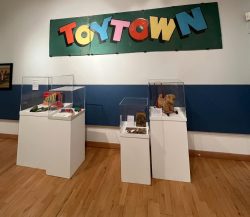
Anticipating a childlike frolic, the exhibition stops you right in your tracks with a bible verse at the very start. In bold blue print, 1 Corinthians 13:11 announces, “When I was a child, I spoke and thought and reasoned as a child. But when I grew up, I put away childish things”. Instead of sounding didactic, its intention becomes a trigger for reflection. What are those childish things that have been put away and relegated to memory? One of these memories is Toytown, the beloved miniature model village displayed at the Leamington Spa Art Gallery and Museum since the mid-twentieth century. Originally crafted to capture the charm of interwar British high streets, its tiny shopfronts and figures once drew crowds of local children. Beneath the antique fairground placard rests an old horse-racing game, Escalado, a train set, an unfinished puzzle and a worn, stuffed dog. Encased in glass, they echo how inaccessible these joyful memories can feel.
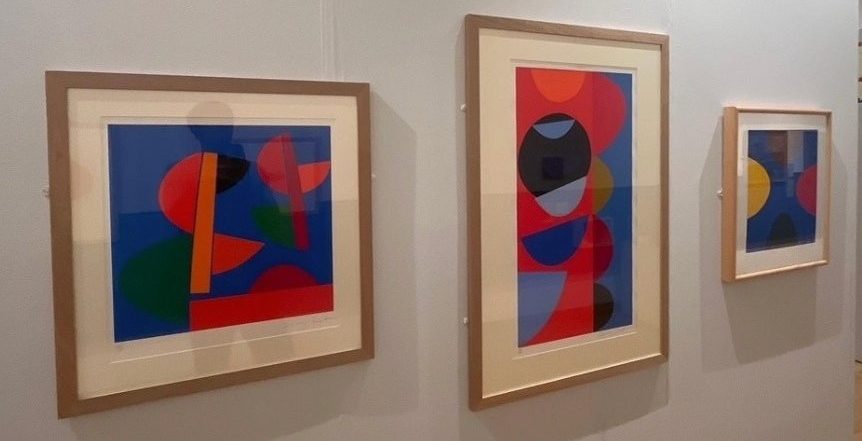
Crucially, engagement and play sit at the very centre of the exhibition. In fact, a miniature theatre and board game station occupy the very centre of the gallery space. Small satchels titled ‘explorer bags’ contain colour paddles. When lifted to the eye, they refract and transform the paintings on display. Holding the red lens to a suite of Terry Frost’s abstract works recalls the rose-tinted hue through which childhood often renders the world. The bold contrasts in Black Sun, Diaper and Swing Red Newlyn shift in mood through the filters. One ‘mini curator’ remarks that the purple lens makes the colours “pop…like pop music in my ears”, a vivid, synaesthetic response encouraged by the exhibition’s design. At the theatre, families craft puppets and perform. Watching a toddler and his mother wave goodbye to an imaginary bunny, I wonder whether imagination is truly childish, or simply abandoned too soon.
Childhood, the exhibition suggests, is shaped by the roles children are encouraged to perform
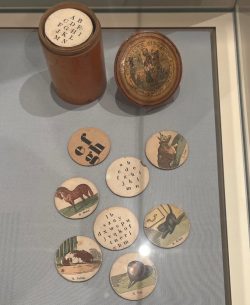
Additionally, childhood, the exhibition suggests, is shaped by the roles children are encouraged to perform. The inscription of an 1830 alphabet game, The Picture Alphabet – For a Good Child, foregrounds this expectation. Here, a ‘good’ child is one who behaves like a miniature grown-up. The artefact provokes a counter-question: if childhood goodness lies in acting like an adult, what then constitutes a ‘good’ grown-up? Across contexts, societies mould children into assigned roles. Thus, a good adult is one who dutifully performs the role assigned for him and does nothing more or less. This is exactly what takes our rose-tinted glasses off, what breaks our creativity and imagination. A good adult is a person subordinate to society’s expectations.
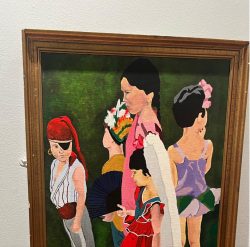
However, Margo Singer’s ‘The Fancy Dress Party’ offers a vivid counterpoint. In brilliant colour, the children are dressed as pirates, ballerinas and fictional characters. Singer taught at the Leamington School of Art, where her passion for textile history and costume making shaped both her teaching and artistic practice. She established a fabric printing studio and showroom on Avenue Road and later held exhibitions of her costumes at the Loft Theatre. In a costume party, the children get to pick what role in society they wish to inhabit that day, what culture they want to experience, which life they want to imagine and explore that particular afternoon. This, perhaps, is why the painting anchors the exhibition’s promotional material. It masterfully highlights the wonder of imagination associated with childhood.
The exhibition urges [people] to reclaim that creative, curious, hands-on joy once embodied in childhood
Amid the blistering pace of modern life, the child playing with his toys, imaginary characters or dressing up in costumes feels far removed from contemporary capitalist cityscapes. Yet, the exhibition urges those distanced from them to reclaim that creative, curious, hands-on joy once embodied in childhood, even if it takes new forms today: playing scrabble, Forza Horizon 4 or Connect Four. If it means stealing an hour each weekend to play a game, paint freely, try on a new outfit or gather around a board game, the invitation stands. Endeavour to revel in those ‘childish things’.
Comments