Can Zohran Mamdani make New York affordable?
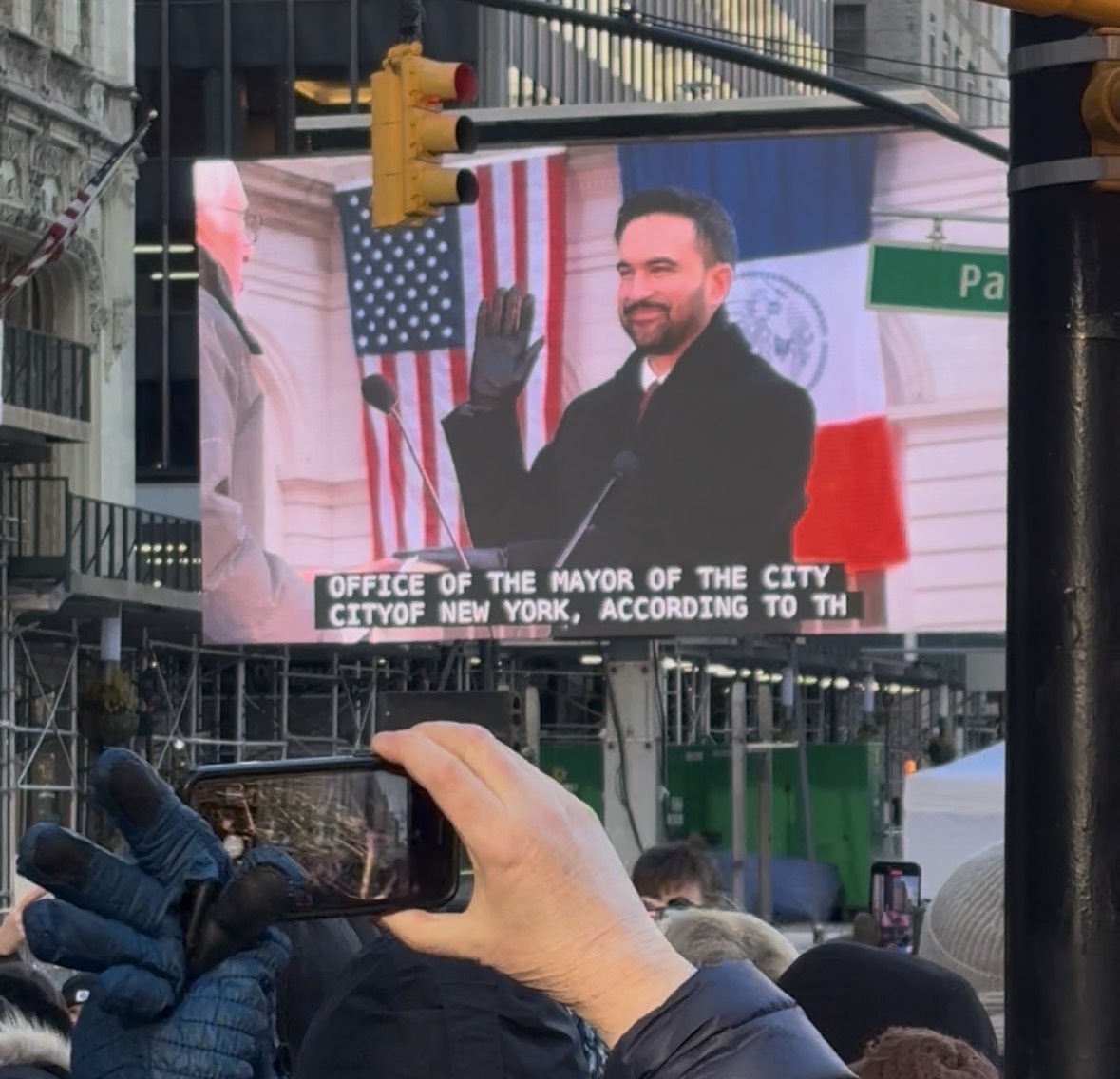
On January 1, Zohran Mamdani was inaugurated as the next mayor of New York City, making history as the city’s first Muslim mayor and the first South Asian to hold office in a century. In his inaugural speech, he vowed to govern “expansively and audaciously” and has since built up a coalition of working-class people ready to improve the quality of life for the city’s 8.5 million residents. With fresh policies designed as a direct intervention to the affordability problem, the question for New York is no longer whether they are popular; it’s whether they are feasible.
For working-class New Yorkers, the city is becoming increasingly unliveable. Inflation has recently hit a 40-year high of 8.6% as a result of increasing food, gas, and housing costs, with 85% of New Yorkers reporting that food prices are surpassing their incomes. Around 52% are currently rent-burdened, with a typical minimum wage worker spending more than 30% of their income on housing and around 10% on bus fares. Mamdani’s victory highlights a shift toward economic populism: a rejection of free-market capitulation and a refusal to work in moderation, both developments of which are actively threatening powerful industries and the status quo.
The question of feasibility is conditional on sufficient political will to break through institutional limits and actually improve the lives of whom these policies are designed to serve. Much of the discourse around the mayor’s policy platform begins from the assumption that it is fundamentally impossible. A pipe dream. His critics argue that New York is already on its last legs, that the city cannot fund new social programs, and that such changes will relocate businesses, investment, and jobs elsewhere. All familiar arguments, and ones worth testing against the evidence.
New York City has recently approved a $115.9 billion budget for the 2026 fiscal year, one of the largest municipal budgets in the world. The most expensive policy on the table is universal childcare. Estimates suggest that providing childcare for children aged six weeks to five years would cost around $6 billion annually. Yet in 2022 alone, New York City lost an estimated $23 billion in economic activity because parents were forced to leave or downshift work because of childcare responsibilities. Universal childcare would make up this cost while increasing the labour force, particularly among women, as well as increasing household incomes, and producing long-term returns. Is this what is being described as fiscal recklessness? Or a wider institutional consensus that childcare is a cost before it is a worthwhile investment?
Mamdani’s policy response is based on a wider principle that, for inelastic goods like housing, the priority should be getting resources to people rather than making a profit
In his first days in office, Mamdani rolled out free childcare for children aged up to two, with funding, bipartisan support and a solid plan, proving it’s the latter: not too expensive, too risky, or too impossible at all. Additionally, free public buses, contrary to popular belief, are a far smaller fiscal demand. Making buses fare-free would cost just over $650 million annually, according to the City of New York Independent Budget Office. Economists have suggested that every dollar spent on fare-free public transport produces around $4 in local economic activity, as people are actually able to get to work, shops, and services.
To add to this, removing fares speeds up boarding times, saving several minutes per stop, amounting to 36 million hours a year, improving efficiency across the network. Cities like Laguna Beach, California, already provide a free bus service, demonstrating that this “undoable” policy is indeed doable. New York currently runs free or reduced-fare services, but these are only experienced by a smaller section of eligible riders. Universal free buses would help every person, increasing both social and economic benefits. As Mamdani himself said, fast and free transport is the “vitality” and health of the city.
Housing is where Mamdani’s platform has attracted the most ideological contestation, particularly from landlords and economists, and especially on his signature proposal for a four-year freeze on rent increases. But it is also where the critiques of “infeasibility” dissolve. Nearly half of New York’s 2.3 million rental homes are already rent-controlled or rent-stabilised, and this system has existed since 1943. During the Covid pandemic, rent freezes were widely accepted as a reasonable response to prevent displacement, so if such arrangements could be activated during a public health crisis, why not during a housing crisis?
Opponents argue that rent stabilisation prevents maintenance and investment, but this argument obscures the specific structures of New York’s housing system. Landlords with rent-stabilised units are eligible for significant tax abatements if they renovate their buildings, and additional tax benefits are available for further improvements. Despite regulation, landlords with at least one rent-stabilised apartment still enjoy average profit margins of around 37%.
Rent stabilisation is not a radical or new practice; it’s an existing policy that has allowed many people to stay in the city. Mamdani’s policy response is based on a wider principle that, for inelastic goods like housing, the priority should be getting resources to people rather than making a profit. Therefore, rent control partially de-commodifies housing and makes sure the city stays liveable for its residents.
Meanwhile, even small reductions in costs for low- and middle-income households can materially change living standards
It’s a principle that extends to his policy of city-run grocery stores. In many neighbourhoods, private grocery stores have withdrawn as a result of low profit margins, with residents seeing higher prices and limited access to healthy food. Mamdani argues that when corporations retreat from serving these communities, the city should, and polling suggests that more than 66% of New Yorkers support this. Cities like Atlanta have already explored and implemented publicly owned grocery stores, and studies have found that such developments are highly effective. Critics often fixate on the likelihood of thin profit margins, but this critique is more indicative of a prevailing market ideology than of feasibility. Public services are not intended for profit-making.
Funding is the mayor’s biggest challenge, and it is where he is experiencing the most resistance. He has proposed a 2% tax on individuals earning over £1 million a year and a 2.5% increase in the corporate tax rate, arguing this could raise up to $9 billion annually. Too often, excessive empathy is reserved for the wealthy, despite their economic excess, which means that extra income does little to improve their quality of life.
Meanwhile, even small reductions in costs for low- and middle-income households can materially change living standards. Higher corporate taxes alongside targeted credits and write-offs could also incentivise reinvestment locally, instead of shifting profits into buybacks or offshore accounts, improving the city’s economy. As well as this, corporations benefit hugely from the city’s infrastructure and social programs, which sustain both workers and consumers, keeping them productive and active.
Still, the mayor can’t make these changes alone. Tax policy needs approval from New York State, where Democratic Governor Kathy Hochul has already indicated her reluctance to support his plans. So, with the state experiencing its own fiscal pressures and Hochul running for re-election, will his model fully play out? As Columbia University professor Robert Shapiro noted, “the political willingness of the governor” is necessary, but backing Mamdani might be exactly what she needs to increase her chances. Furthermore, many city council members, responsible for approving mayoral policy, have shown their support for Mamdani, suggesting more cooperative legislative conditions at City Hall and a higher likelihood that his proposals will pass.
But Mamdani must also navigate Washington. During his campaign, President Donald Trump repeatedly and publicly slated him off to the world as a “communist lunatic” and even threatened to withhold federal funding from the city. Although their first post-election interaction was unexpectedly cordial, their policy positions are still fundamentally different, particularly on immigration.
The real difficulty will come from political resistance from opposing interest groups
Business opposition is yet another challenge. Mamdani’s primary victory greatly threatened Wall Street and the real estate sector, with some executives daring to leave and bankrupt the city. Since then, he has met with business leaders like JPMorgan Chase CEO Jamie Dimon and developer Jeffrey Gural, both of whom described him as “personable” and “smart”. Finance and real estate are central to New York’s economy, meaning that any mayor will need to secure some of their support. Whether Mamdani and these powerful interests can meet in the middle on higher taxes and power redistribution, however, is uncertain.
Finally, there is public safety. As expected, Mamdani will be closely scrutinised on crime and policing. Contrary to the popular narrative that his reforms amount to either “defunding the police” or increasing their budget considerably, he has largely refrained from touching the NYPD at all. Instead, he will be “sustaining” current force levels, but this may seem counterintuitive, particularly given the NYPD’s history in resisting reforms that threaten its funding.
He has further proposed a Department of Community Safety, which would redirect investment toward restorative justice measures, including community advisory boards, expanded mental health services, and youth programs designed to be preventative instead of responsive solutions.
So, are Mamdani’s policies feasible? If he can secure his desired tax revenue, his plans are substantial and practical. Rent freezes will likely not crash the economy, free buses will not turn into shelters, and universal childcare and food services are already standard features of lots of wealthy societies. The real difficulty will come from political resistance from opposing interest groups. On top of balancing a budget, the mayor’s next task is to build even more coalitions to work through restrictions.
His victory already suggests that many New Yorkers are ready for something new. Whether Mamdani can really turn his mandate into practical policy will demonstrate whether his guarantee of economic justice will withstand the pressures of the system that is against it.
Comments