Weird Britannia: Coming to terms with Blobbymania
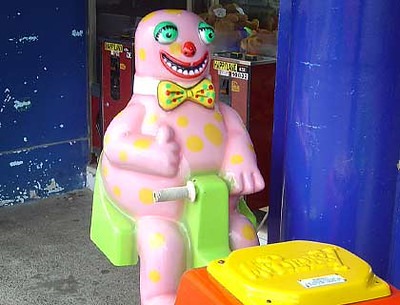
Since peaking in popularity in the nineties, the character of Mr. Blobby has seemingly never left the public consciousness. With steady appearances on daytime TV and light entertainment shows, he injects a sense of controlled anarchy missing from an increasingly sanitised landscape.
He appeared in Peter Kay’s now infamous ‘Is this the way to Amarillo’ video, although he hardly stands out amongst the far more disturbing inclusions there; he also made a highly memorable appearance on the Big Fat Quiz of the ‘90s where a terrified Jack Whitehall compared him to a ‘’Fat Jaundiced Baby’’, and, even in 2023, he got the chance to slime Simon Cowell on Britain’s Got Talent.
All in all, whilst associated with and confined to a very weird section of TV history, there is no perceived issue with invoking Mr. Blobby from time to time as a relatively safe ‘icon’ of an era. Critically, whilst used as something of a punching bag, a mockery of a past time, Mr Blobby evidently still has some level of appeal.
The character possesses an inherent uncontroversial nature
In a similar vein, in 2018, he made such an appearance on ITV’s Loose Women to discuss Noel Edmonds’s recent stint on I’m a Celebrity… Get Me Out of Here! By Mr Blobby’s standards, this appearance is markedly tame: the controlled panel environment presents a watered-down version of the set-destroying, endlessly unpredictable character that first debuted on Noel’s House Party in 1992, and the character does little to alleviate the sense of tedium that pervades this sort of daytime programming.
However, though the discussion is brief, there is an odd moment toward the end: without prompt, the conversation moves sharply toward the discussion of Brexit; in pure trademark gibberish, Mr. Blobby is made to respond to questions about the complex issue of EU tariffs, the benefits and drawbacks of a trade deal, and the Brexit situation at large.
Rather than merely popping up as a nostalgic reminder then, perhaps Mr. Blobby is representative of something far more sinister?
‘Blobbymania’ spread through Britain like the plague
Certainly, the character possesses an inherent uncontroversial nature; you cannot say anything wrong if you say nothing at all. In a world of endless political opinions, Mr. Blobby is representative of an unwillingness to listen or to even care, like clamping your hands round your ears and making endless noise.
When the British public embraces the apolitical, the media and the establishment repeat this essential nothingness. In Mr. Blobby, Britain can be seen to cling to a regressive man-child when their political lives have long since ceased to make sense…
Back in the nineties, however, a collective ‘Blobbymania’ spread through Britain like the plague: from 1992 to Christmas 1993, he took on genuine world conqueror status as his career peaked with a Christmas number one single.
Whilst oft-hailed as one of the worst songs of all time, Mr. Blobby still remains a platinum-selling artist, with lyrics ranging from the basic (‘’as far as he can see, he’s the same as you and me’’), to the oddly sinister (‘’your influence will spread throughout the land’’).
1993 was a transitional period in British culture
In a music video that features Jeremy Clarkson as his chauffeur, a children’s choir, and parodies of other music videos such as Robert Palmer’s ‘Addicted to Love’, the character is praised almost as a coming Messiah with undertones of dictatorial aspirations. Come Christmas day, Blobby would be king and ‘Blobbymania’ cemented as widespread psychosis.
As a ‘metaphor for a nation gone soft in the head’, Britain still has a lot to answer for in regard to ‘Blobbymania’. The cultural empire that Noel Edmonds created with the character encompassed TV appearances, merchandise, music, and even theme parks. It’s strange to imagine nowadays but he had a true stardom about him.
The nineties were strange times, however. 1993 was a transitional period in British culture, cast in the long shadow of Thatcherism (her being three years out of office), but before the cultural domination of Britpop and Cool Britannia. Under the ever-boring tutelage of John Major, Britain lacked identity or even purpose.
Mr. Blobby is no ghost of the nineties
Even so, as Mr. Blobby was first appearing on our screens, it’s interesting that Francis Fukuyama was, at the same time, postulating the ‘End of History’, theorising the inevitability of neoliberal democracy as reflected in Britain and the US.
Whether this is true or not is still up for debate but there is one point Fukuyama makes that is of particular interest here: namely, that truly great art is a product of a sense of political dissatisfaction which begs the question, if a neoliberal society is deemed the most politically satisfying, then what becomes of our culture?
In this sense, Mr. Blobby is a product of Nietzsche’s ‘Last Man’, co-opted by Fukuyama, and becomes the epitome of neoliberal culture. It’s truly a sign of the times when an oversized ‘jaundiced baby’ can become a cultural icon, but for neoliberal Britain, representation of the nonsensical, the bizarre, and the anarchic, evidently has a certain draw.
As our sense of cultural boredom continues then, Mr. Blobby is no ghost of the nineties. Instead, he remains a part of our culture, but more than that, he reflects Britain’s inability to escape its own cultural psychosis. Whilst ‘Blobbymania’ may be confined to the past, that’s not to say the memory does not live on in the Britain of today.
Comments