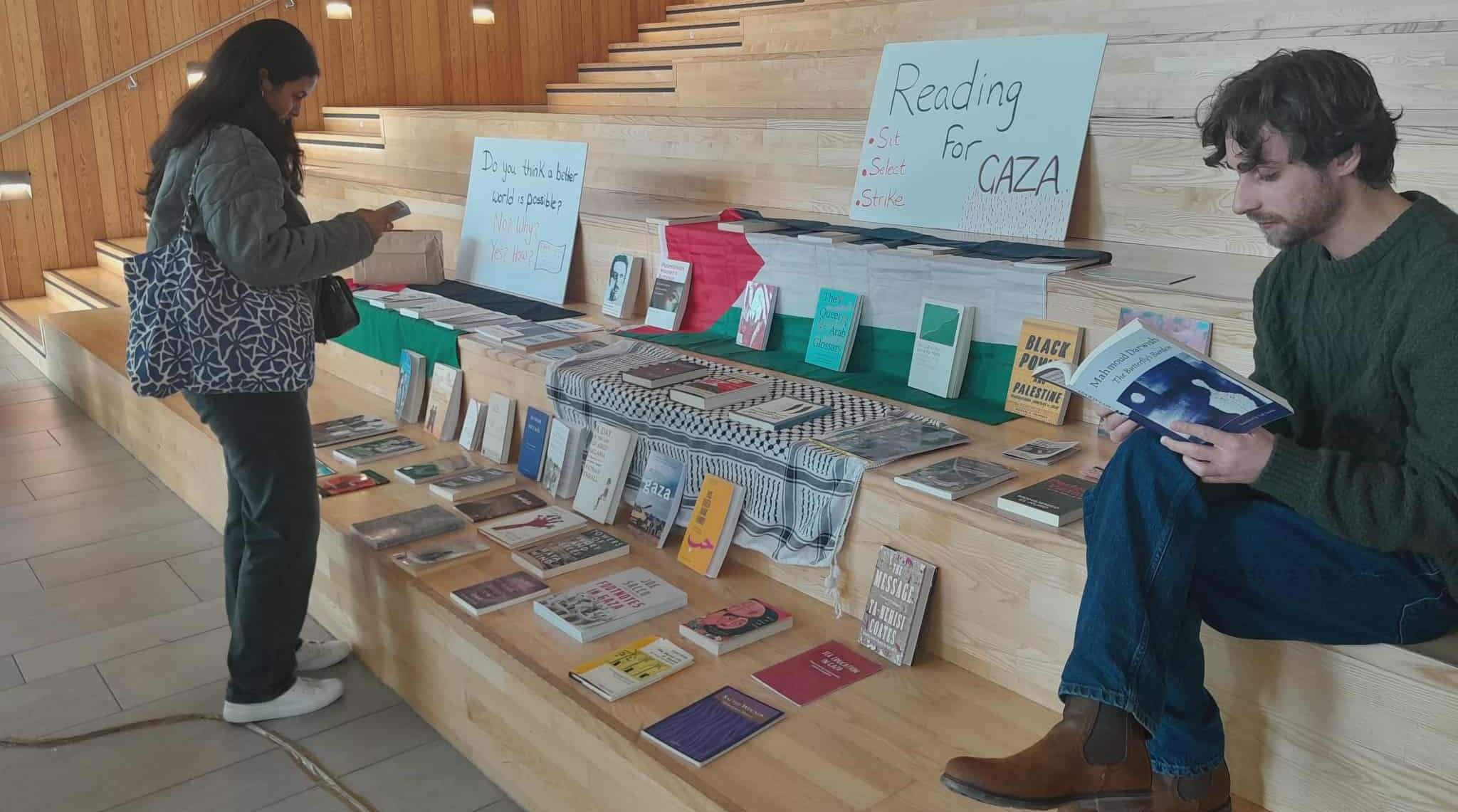
The importance of Warwick’s Palestinian Literature and Culture Reading Group: An interview with convenor Nadia Hajal-Backleh
Nadia Hajal-Backleh is a PhD researcher at the university’s English and Comparative Literary Studies Department (ECLS), examining peripheral migration and world-literature in the age of global modernity. She convenes the Palestinian Literature and Culture Reading Group (PLCRG). I interviewed Nadia to discuss the PLCRG and its impact through literary discussion.
- How did the reading group start? What does it aim to achieve?
PLCRG started in 2024-25 as a departmental initiative, requested by some English students curious to learn about Palestine, mainly in light of the livestreamed genocide. Students’ request coincided with a similar proposal I had made to our Head of Department, Paulo de Medeiros, to initiate a convivial, open space to read/discuss Palestinian writings and learn about history, culture and society beyond parochial and complicit media coverage.
So far, PLCRG has organised six events last year, and two in Autumn 2025, reading foundational texts including criticism and novels, inviting Palestinian novelists for conversation, cooperating with SU Societies, and co-convening seminars with Warwick’s Social Theory Centre, inviting professors from Palestinian universities to share their ethnographic research.
PLCRG is open to students and professors from all departments. We had students from history, modern languages, sociology, economics, law, politics, etc.
For potential ‘achievements’, these can be multiple:
i. On the socio-historical level, engaging with Palestinian writings brings us closer to Palestinian lives in the colonised homeland and diaspora. We discuss what they have experienced since before the 1948 catastrophe, comprehending the causes of their torments, and drawing comparisons with other world geographies to reveal how colonial structures and systems of control and erasure in Palestine are part and parcel of a global regime.
ii. On the literary-cultural level, we learn the richness of Palestinian culture and its ingrained universal values of humanity, liberation, steadfastness, labour, sacrifice, and internationalism. We appreciate the multiple aesthetic sensibilities of Palestinian poetry, novels, and artworks. How Palestinian literature – including diasporic writings – mediated and negated the brunt of colonial violence on people’s lives. We learn the relation between Palestinian literature and the liberation struggle. And we experiment with literary-critical frameworks that properly analyse it nationally or comparatively.
iii. Contributing to building a collectivity that is supportive of PLCRG and its objectives.
iv. An academic ambition would be that students consider researching the texts in their essays, and that professors incorporate more texts in their syllabi. Palestinian literature can be approached as world literature, for example.
- As we are a Western institution, how does reading Palestinian literature develop our cultural and moral awareness?
It’s crucial to expose ourselves to (semi)peripheral literatures, colonial and postcolonial literatures, writings about/from the dispossessed masses, the exiled, the poor, the damned, the wretched, and the dispensed, in Palestine as in other countries like Sudan, Kashmir, Nigeria, Myanmar, India, and even here in the UK.
Reading Palestinian literature in Western institutions becomes crucial to protect our moral awareness and free speech, as well as our commitment to social love.
The challenge we face in academic institutions here is not because they are ‘Western’ per se, but because they have become increasingly market-driven, with profitability outweighing critical pedagogies and academic freedom. The invading global cultures of neoliberalism and conservatism, like individualism, racism, entrepreneurship, and indifference to imperial wars, social inequalities and injustices, would nurture selfishness and fear and would threaten our moral commitment to stand in the face of precarity and in solidarity with the oppressed, regardless of nationality, class, race, gender, and/or age.
Within this framing, reading Palestinian literature in Western institutions becomes crucial to protect our moral awareness and free speech, as well as our commitment to social love. The Palestinian poet Tawfiq Zayyad once wrote: “I would give half of my life to whoever makes a crying child laugh, and the other half to protect a green flower from withering.”
- How is the group discussion structured? Which themes typically arise?
Usually, we start with history, context, literary theory, the writer’s biography, and an overview. Then, we either discuss collectively or split into groups to read excerpts. Sometimes, we invite Palestinian novelists for a conversation and professors to give a talk.
For example, last April, we had a conversation with Adania Shibli as we discussed her modernist novel Minor Detail (2017), which narrates the colonial violence against people and land by tracing the rape of a poor Palestinian-Bedouin girl by Israeli soldiers in 1949. We discussed literary language, scenery, acts of subversion, aesthetics and history, as well as potential readings of the novel as a ‘road novel’ and a ‘ghost novel’, for example.
We also invited Suad Amiry to discuss her historical, yet Kafkaesque, novel Mother of Strangers (2022), which she dedicates to her father and all the displaced who yearn for the return to Jaffa after their mass expulsion in 1948. A brilliant PhD researcher from Lancaster University gave a talk on modernity and mnemonic practices in the novel and shed light on the rich Palestinian cultural life and festivals before the Nakba.
- Do you discuss literary forms other than novels?
Last time, we played the recital of Mahmoud Darwish’s poem ‘The Earth is Closing on Us’ and Ismail Shammout’s 1980s artworks, alongside Edward Said’s After the Last Sky: Palestinian Lives (1986). Hopefully, we will read poetry in our next meetings, including writings from Gaza.
I suggest replacing the term ‘decolonising’ with ‘liberating’, ‘emancipating’, or ‘socialising’. This clarifies the end and the means towards achieving that end.
- ECLS students are exposed to diverse literature at Warwick, like Mahmoud Darwish’s poetry. How does the PLCRG contribute to ‘decolonising the curriculum’?
‘Decolonising’ is about diversity and inclusivity. So, reading Palestinian literature diversifies. However, I suggest replacing the term ‘decolonising’ with ‘liberating’, ‘emancipating’, or ‘socialising’. This clarifies the end and the means towards achieving that end, including critical pedagogies.
- Could you give two Palestinian literature recommendations, perhaps for a beginner reader of Palestinian writing, and explain your choices?
I would suggest readers start with what they relate to. It can be poetry, prose, or perhaps a film or a webpage. They can visit the Palestine Festival for Literature website (PalFest) and take it from there. There is an archive of writings, talks, and recitals to start with.
Or perhaps they start with Edward Said’s After the Last Sky, which was our reading in November. The book was published in 1986 and is a collaboration between Said and the Swiss photographer Jean Mohr, whose photographs capture the everyday life of displaced Palestinians in refugee camps inside and outside Palestine. He captures the unevenness of their realities and the smiles of their children. Said’s reflections are insightful and expressive. And the book mediates a particular modernist aesthetic that speaks to the tonality of defeat at the time, but in dissonance and restlessness. The book is brilliant, easy to read, and meaningful, mainly as we witness the still-going genocide in Gaza and the misery of the whole population.
- Would you consider expanding the PLCRG to connect with other universities?
PLCRG is a departmental initiative. The potential exists as long as there is support from students and professors, but steps forward should be discussed with the department first.
- Finally, how can Warwick students and staff get involved in PLCRG?
Read The Boar interview! They can contact the department, contact me, or Google the web. All are welcome to join. “There is a place for all at the rendezvous of victory,” quoting Aimé Césaire.
Thank you, Nadia, for telling The Boar about the incredible PLCRG. For interested students and staff from any department, you can contact Nadia at Nadia.Backleh@warwick.ac.uk to get involved.
Comments (3)
really interesting and enlightening read!
Good article from a good journalist
Thank you, courtesy of Nadia for giving such insightful answers 🙂