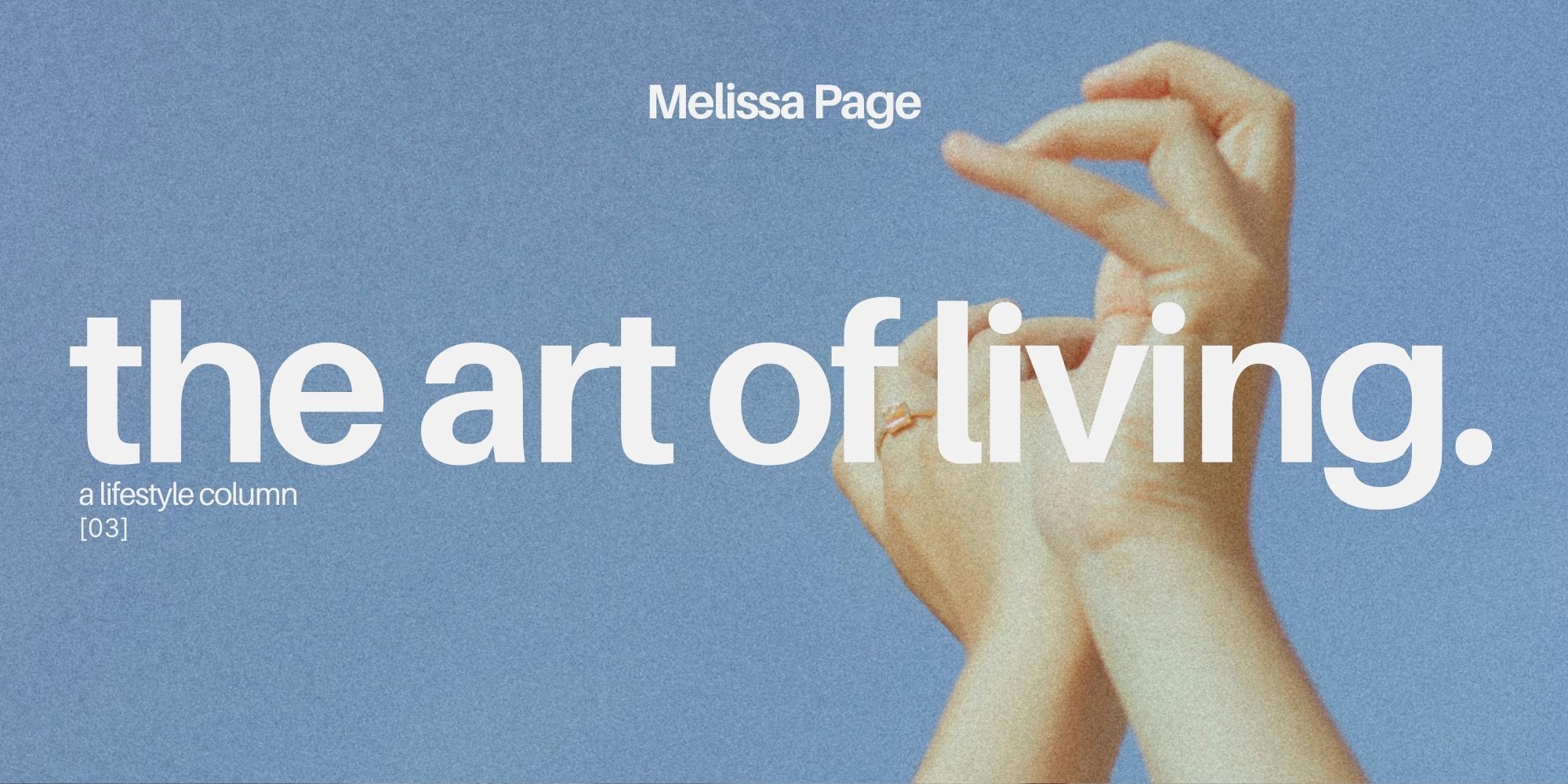
The art of living a slow life: debunking ways to slow down time.
What did you do yesterday? Or last week? Or even 30 minutes ago?
More often than not, it seems as though we’re all struggling to remember. It’s as if each day blurs into the next, briefly paused by what feels like a single blink. And it’s not that nothing is happening, because quite frankly, so much is happening, but everything is occurring too quickly to fully register. It may sometimes feel like life is moving on without us, before we have the chance to sit with it.
In trying to save time, we often erase the very moments that make it meaningful
This is where the idea of slow living becomes both compelling and even necessary. Slow living isn’t about doing less, achieving less, or opting out of responsibilities. Rather, it’s about becoming present again – about allowing yourself the time to experience your life as it unfolds, instead of rushing through it in anticipation of what comes next. It’s the conscious decision to move with intention, to make time for reflection, creativity, rest, and connection.
Modern life can often seem, at times, structured to deny us that space. Time feels fast, compressed, commercialised. We are often encouraged to view time as something to optimise, to turn into efficiency. Even rest is often repackaged as something productive – sleep to perform better, exercise to beat goals. In trying to save time, we often erase the very moments that make it meaningful. In a society that moves so fast, slow living asks us to pause.
For me, slowing down began as a small experiment. In an attempt to distinguish one day from the next, I decided to “slow down” my brain. One of the simplest ways I did this was by returning to reading – something I had quietly abandoned over time. And by reading, I don’t mean academic articles or JSTOR PDFs, but actual books. Physical pages, dog-eared corners, sentences that provoke thought and feeling rather than assignment content. I picked up a collection of poems by Mary Oliver, a writer whose work is rooted in attentiveness, nature, and quiet self-trust. It was through this slow, deliberate act of reading that a particular line stayed with me. In her most well-known poem, Wild Geese, Oliver writes: “You only have to let the soft animal of your body love what it loves.” The line is deceptively simple, yet it felt quite radical to me. It reminded me that life is not something to be only optimised, but something to be felt. It prompted an unsettling question: What is life without time? What is life without time to process our thoughts, emotions, aspirations, relationships, grief, or joys?
I find that even university life can exemplify this tension. One moment it’s week one, full of fresh starts and good intentions; the next, it’s week nine, and the term exists only as a blur of lectures, pub trips and stagecoach bus rides. There is a quiet pressure to sacrifice slowness. Hobbies fall away, walks become functional commutes, and reflection begins to feel indulgent. Meditation, rest, and creative pursuits are often the first things to go – not because they lack value, but because they are difficult to justify in a culture that prioritises output. Yet these are the very practices that ground us, regulate us, and remind us that we are more than what we produce.
So, how can I slow down time?
Slowing down time doesn’t require a dramatic lifestyle overhaul. It’s the small, deliberate choices that invite presence back into the day! One of the simplest ways to begin is by creating moments of intentional stillness. Perhaps by setting aside ten or twenty minutes in the morning or before bed to sit quietly – whether through meditation, journaling, or simply breathing. These pauses don’t waste time; they stretch it, giving shape to thoughts and emotions that would otherwise pass unnoticed.
Progress doesn’t need to be immediate or measurable; the value lies in the act itself
Another way to slow time is to resist constant stimulation. Walking without music or a podcast may feel uncomfortable at first, but silence has a way of returning us to ourselves. Without distraction, we become more aware of our surroundings and our inner dialogue. Time feels fuller when we aren’t trying to fill every second (and I type this whilst listening to music, so this may not be for everyone…) So, alternatively, choosing to be present in small everyday moments – like sitting in a café without scrolling, people-watching on a bench, or taking a longer route home – can transform ordinary routines into something grounding.
Reconnecting with hobbies is another powerful way to slow down. Returning to activities we loved as children or maybe always wanted to try, like drawing, dancing, reading, and learning an instrument, reintroduces curiosity rather than pressure. Importantly, slow living asks us to accept being bad at something. Progress doesn’t need to be immediate or measurable; the value lies in the act itself. By investing time in something purely for enjoyment, we can reclaim time as something personal rather than productive.
Ultimately, slowing down is about choosing to live for yourself. About permitting yourself to move at your own pace, to linger, to feel, and to let moments unfold without rushing towards the next. In doing so, time no longer slips away unnoticed – it becomes something to inhabit fully, one day at a time!
Comments