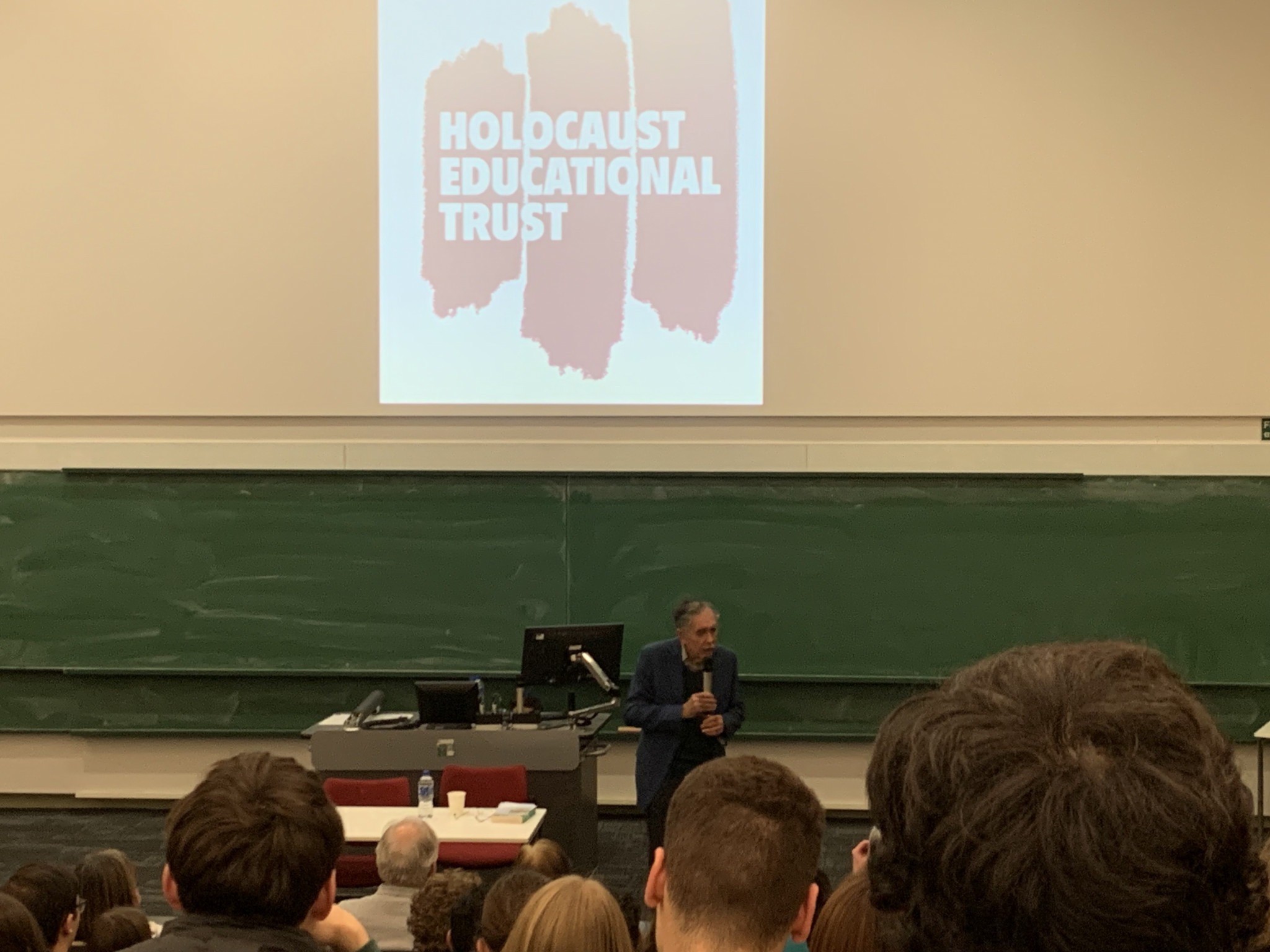
‘Each generation has to learn anew the lessons’: Holocaust survivor Uri Winterstein speaks on campus
To commemorate this year’s Holocaust Memorial Day, Warwick Jewish Society invited survivor Uri Winterstein to share stories of his family’s experiences under the Nazi regime during the Second World War.
Among those in attendance at the fully booked lecture theatre were University of Warwick Provost Caroline Meyer, several Students’ Union officials including President Alijah Taha, and members of Coventry’s Jewish community.
82-year-old Winterstein recounted the experiences of his extended family as they were shared to him after the war, him being only 19 months old when the conflict ended.
The Slovak-born survivor spoke with honesty and wit, at one point pausing to joke about his first spoken word – ‘coffee’
Born in October 1943, Winterstein’s parents put him in the care of a non-Jewish woman when he was one month old, and he was not reunited with his family until after the war.
Nine of Winterstein’s wider family were deported to Auschwitz-Birkenau, were they were killed, while his father, mother, and sister were sent to the Theresienstadt concentration camp, which was liberated on 8 May 1945.
The Slovak-born survivor spoke with honesty and wit, at one point pausing to joke about his first spoken word – “coffee”, the result of constantly eating bread soaked in the drink.
Central to the stories Winterstein narrated was the theme of random kindness, focusing on the small acts of humanity from German soldiers and citizens that allowed his family to survive and reunite after liberation.
A German soldier said to Winterstein’s sister after noticing her on the street: “Little girl, don’t be afraid, I have a little daughter too.” He then allowed her to return to her family.
Genocides do not happen from one day to another – it’s a process that starts with language
Uri Winterstein, Holocaust survivor
Winterstein’s talk was one of hope and generosity, which took care to emphasise that “it wasn’t people” that perpetrated the horrors of the Holocaust. “It’s extreme ideologies of hate that we have to beware of.”
However, the talk concluded with a warning from Winterstein when asked about the return of antisemitism in Europe. “It’s not just antisemitism, it’s all kinds of prejudices.
“Genocides do not happen from one day to another – it’s a process that starts with language.
“It’s only education that can help people understand how they’re being manipulated,” Winterstein concluded, explaining why he gives talks about his experiences, typically speaking to secondary schools. “Each generation has to learn anew the lessons.”
Comments