Diplomacy unfiltered: What the capture of President Maduro tells us about America
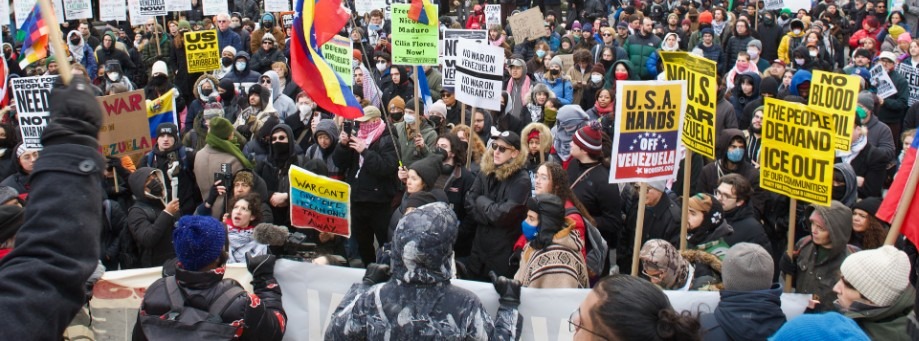
On January 3, the United States brought the world back to a different age. President Donald Trump and senior members of his cabinet captured and detained Venezuelan President Nicolás Maduro and his wife, Cilia Flores, before sending them on a ship bound for New York to be tried in the US court system on drug trafficking charges. With the whole world hanging on Trump’s movements as 2026 was ushered in, the dominant American foreign policy narrative of the 21st century has now been entirely rewritten by Trump and his cabinet.
A poll from Reuters, taken a few days after the removal, showed that only one in three Americans approved of US military intervention in Venezuela
The event was reminiscent of the United States at the start of the 20th century, the last time that unchecked American imperialism was the dominant mode of American foreign policy. The 1904 Roosevelt Corollary to the Monroe Doctrine, over a hundred years ago, under US President Theodore Roosevelt, was the most recent echo of America asserting a ‘police power’ in the Western Hemisphere. “[Trump] has lost the plot”, said John Michael Horvath, a 24-year-old Nevada resident with family in Mexico, told The Boar. “It is very disappointing to see … disappointing to see the fall of a country. America lost its grip on its people and its mission,” he added, reflecting on how he believed the attack on Venezuela was affecting America’s international standing.
A poll from Reuters, taken a few days after the removal, showed that only one in three Americans approved of US military intervention in Venezuela. This is far lower than the typically high approval ratings that US presidents achieve after the completion of a successful military operation with minimal US casualties. The genuine shock and surprise of the event were felt not just in America but across the globe. The difficulty in figuring out how to react reverberates across allies and foes of the US alike.
The potency of American military might and threats to use the US Armed Forces in Mexico, Colombia, Cuba, and Greenland have alienated the majority of the American public, whose support continues to ebb away from US intervention
Commenting on President Maduro’s removal during a parliamentary question time, Prime Minister Keir Starmer said: “Maduro was not a legitimate president … No one will shed tears at his removal”. Starmer has become notorious for trying to pursue UK preferences without treading on US national interests. His response to the event is a signal that the government will not challenge the president on something that the deputies, ambassadors to the UN from France and Denmark, Jay Dharmadhikari, and Sandra Jensen Landi, called: “A dangerous precedent” and “counter to the principle of peaceful dispute resolution.”
The potency of American military might and threats to use the US Armed Forces in Mexico, Colombia, Cuba, and Greenland have alienated the majority of the American public, whose support continues to ebb away from US intervention. A further Ipsos poll taken at the end of last year showed that six in ten Americans disapproved of US intervention abroad; less than two months later, the numbers remain largely unchanged.
Marco Rubio, Secretary of State and one of Trump’s most senior cabinet officials, has been largely absent from his own department, in favour of trying to play to Trump on his personal foreign policy goals and interests
“I am really worried. As much as I would like to be able to do something, I know I can’t,” a 25-year-old Peace Corps official and American national currently based in the Dominican Republic told The Boar. “I don’t see how his intervention could really be sustainable, direct US intervention,” she added. When asked about further imperialist rhetoric and intervention in other countries, she said that something would need to change soon in the country. She also said she was surprised at the concerted response from international powers to try to curb the overreach of the US government.
Marco Rubio, Secretary of State and one of Trump’s most senior cabinet officials, has been largely absent from his own department, in favour of trying to play to Trump on his personal foreign policy goals and interests. “He’s invisible at the State Department. He spends no time there whatsoever,” said Eric Rubin. Rubin is a long-time US ambassador and a former colleague of Rubio who spends a lot of time with him.
In an ‘economy of attention’, we are seeing more and more that those in Trump’s cabinet are leveraging self-interests and ideological motives above the national interest. “The old generation, they don’t look at the consequences … the next generation, my generation, we know what this means,” said Steffani Gomez, a 32-year-old Venezuelan American, to The Boar. “Trump could invade because Venezuela was weak,” she said, adding that in other countries “the government is much more stable, the economy is much more stable”. Gomez talked further about the willingness of Millennials and Gen Z Venezuelans to more openly confront and challenge Trump’s policies. She also said that whilst she was not sure how much of Trump’s rhetoric would lead to direct action, she does not think the president and his cabinet will stop at Venezuela.
The checks on executive power in the United States have grown muted to the point where they can barely be heard. The rest of the world is in a state of genuine apprehension about what Trump might do next
January 20 will mark one year since the beginning of Trump’s second term in office. It has been a year in which the entire world has been gripped by the volatile and highly unpredictable decision-making of one nation, one party, and one man in the White House. As the president says that Europe “is playing a dangerous game” in trying to stop him from acquiring Greenland, we have reached a stage where the whole world is watching for the next domino of American imperialism to fall.
The checks on executive power in the United States have grown muted to the point where they can barely be heard. The rest of the world is in a state of genuine apprehension about what Trump might do next. The American public, in large part, has become more than disaffected. With this said, the question is – where does America go now? As the world braces for yet another turn, only time will tell.
Comments