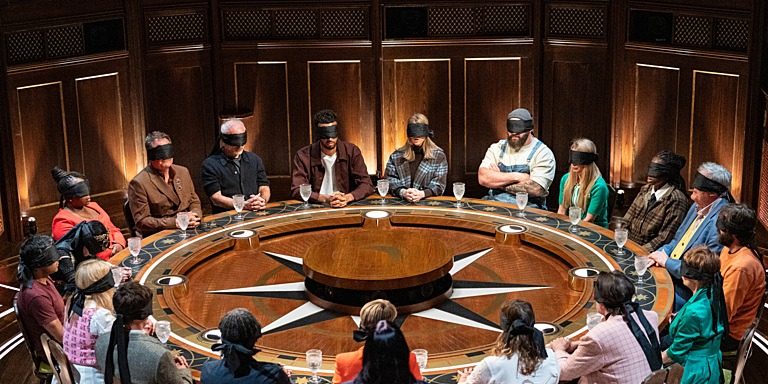
The Traitors: How good are we at spotting liars?
Since the success of the first-ever UK ‘Celebrity Traitors’, and in anticipation of series four of the regular ‘Traitors‘ TV series, due to air on BBC One in 2026, many people have been interested to see whether or not they would be able to spot a liar as they do on the show. Particularly considering that the faithful celebrities were especially unsuccessful at sussing out the traitors in their midst this series. But how easy is it to spot a liar? Is there a good technique to it?
There have been many theories on how to uncover deception, leading to us all having our own preconceptions as to how we would approach finding traitors. Studying body language, eye contact, and behavioural changes are all methods we may employ to take on ‘The Traitors’.
Looking closely at these characteristics may seem like a promising technique on the surface, but when applying it to a situation such as ‘The Traitors’, it becomes problematic. Analysing behavioural changes relies on having some level of understanding of what the ‘normal’ behaviour of the suspected liar constitutes. On the regular Traitors show, a group of complete strangers (with the exception of the odd relationship or familial connection added in to heighten the drama for viewers) are thrown together for the first time. They have no prior understanding of each other’s typical behaviour and so have no foundation from which to make claims about ‘behavioural changes’ that may or may not indicate a liar.
These signs may be coincidental, and reading too much into them may lead to someone being incorrectly identified as a traitor
‘The Celebrity Traitors’ shook this up, presenting a group of public figures who both the audience, and the other cast members, were familiar with. Even, and to his shock, Stephen Fry admitted to having preconceived ideas about YouTuber Niko’s ‘normal’ behaviour based on his career. One might assume this would enable them to utilise behavioural changes more effectively in detecting deception, yet they were entirely unsuccessful.
They tended to focus more on the fact that they felt they categorically knew who a person was, for example, Niko as prankster and Mark Bonnar as someone who plays villainous characters. Therefore, they must be traitors. Similarly, someone like Alan Carr, who, as a comedian, always comes across as exhibiting slightly unusual behaviour, can get away with more than the regular participant by virtue of this, with fellow contestants often dismissing his behaviour as ‘that’s just Alan for you’.
Clearly, focusing on behavioural indicators cannot categorically uncover a liar. Simply Psychology notes that these signs may be coincidental, and reading too much into them may lead to someone being incorrectly identified as a traitor. Of course, if someone is uncomfortable, they may fidget.
So, is there a scientific method to uncovering traitors? Or are we delusional in our confidence that we could spot a liar?
We are, in fact, so over-confident that we can scientifically catch liars – it has led to incorrect criminal convictions on multiple occasions. 17-year-old Marty Tankleff was judged to be feigning innocence upon being considered “too calm” when finding his mother and father murdered. 16-year-old Jeffrey Deskovic was convicted of strangling his classmate after being judged “too emotional” after the incident. Both boys were innocent. Psychologist Maria Hartwig explains that the two boys were victims of the societal misconception that you can tell that somebody is lying by the way they act or react.
Stephen Fry, on this series of ‘The Celebrity Traitors’, stated: “Nobody can spot a liar. At least if you do it’s through a slip – through reason, not this ‘gut instinct’ we put so much value on.”
There is still evidence that today we judge people based on perceived adherence to current ideas of attractiveness
In 1995, Richard Wiseman of the University of Hertfordshire conducted the Megalab Truth Test, designed to test whether the UK public could successfully identify deception across three different mediums: a radio interview, a television interview, and a newspaper interview transcript. He found that: “radio listeners detected the lies 73.4% of the time, newspaper readers 64.2% and television viewers 51.8%. This supported the prediction that visual cues would reduce individuals’ ability to detect lying.”
This study undermined previous theories such as physiognomy, which was the belief that deceitful characters could be read through their faces. Despite this theory having long been disproved and largely considered a product of racist stereotypes at its height of popularity, there is still evidence that today we judge people based on perceived adherence to current ideas of attractiveness. Chartered psychologist and lecturer at Coventry University, Rachael Molitor, said on this: “What is beautiful is good. That’s the assumption […], if you see someone and you find them attractive, you assign all of these positive qualities to them.”
So it seems, to successfully identify a liar we must somehow bypass all societally ingrained values which we have accumulated throughout our lives, largely ignore the things we can see and instead focus more on what we can hear and discern from speech patterns and ignore the ‘gut instincts’ that we would usually rely on when we have little evidence. Spotting a liar successfully asks us to relearn how to analyse each other. ‘The Traitors’, then, seems to be a difficult game to play strategically and scientifically, given the deeply ingrained sociological aspects to our characters. Ultimately, there seems to be no good way, as of yet, to play ‘The Traitors’.
Comments