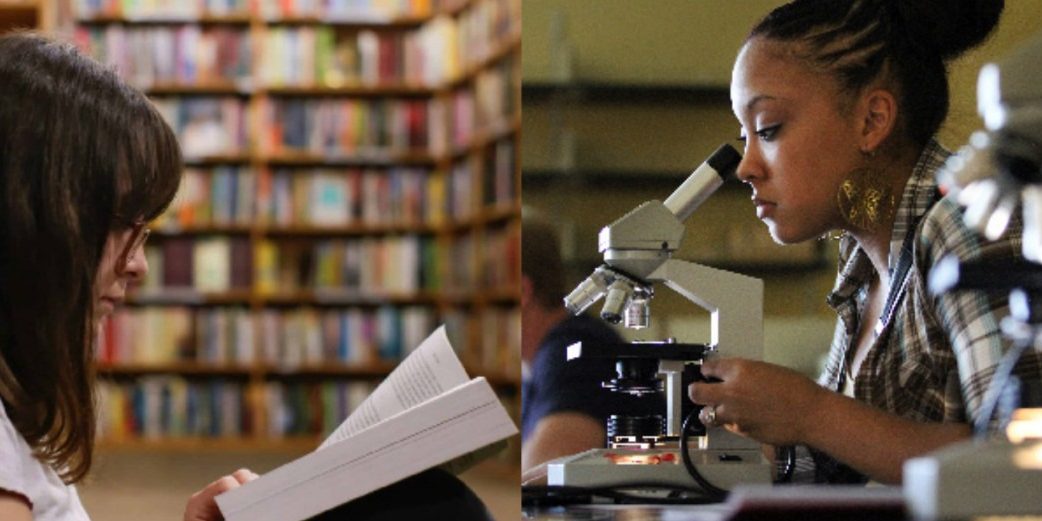
STEM vs Humanities: A pointless debate
With lectures in full swing and library seats becoming scarcer, Warwick campus is once again dividing into two tribes: STEM vs humanities. Every academic year, the debate reignites – which degrees are “harder”, which are more “useful”, and which students are going to be more employable after graduation.
Is there truly a side doing ‘harder’ degrees, or are we simply failing to recognise the value of different academic routes? Are STEM graduates more employable, or are humanities graduates developing a broader range of skills and awareness about the world? And what about students who don’t fit neatly into either camp? Where do they belong in the age-old debate between STEM and humanities?
One of the biggest questions about STEM and humanities degrees is the debate over which is more difficult. Part of the problem is that we often treat “difficulty” as a straightforward, measurable concept when, in reality, a challenge can look very different depending on the individual. STEM students juggle busy timetables, lab reports, and constant assessments, but does this necessarily make their degrees more difficult? Humanities students could argue that their workload is just as heavy, only less visible – mountains of reading, complex theories, independent thinking, and a constant stream of essays.
What about the degrees that don’t fit neatly into either category? Subjects such as Linguistics, Business, and Politics sit awkwardly on the fence between STEM and humanities, borrowing workloads, theories, and skills from both categories
For some, the thought of memorising equations or preparing an experiment is a nightmare. For others, the idea of writing a 3,000-word essay on a 19th-century French novel is much worse. The demands of both STEM and humanities vary from one another and differ between degrees in each group. One side discusses equations and experiments, while the other explores arguments, ideas and people – both involve deadlines, a heavy workload, and the potential for success. But, when directly comparing the two groups, it appears that neither necessarily has a ‘harder’ degree – both are just being tested in entirely different ways.
What about the degrees that don’t fit neatly into either category? Subjects such as Linguistics, Business, and Politics sit awkwardly on the fence between STEM and humanities, borrowing workloads, theories, and skills from both categories. Students undertaking these degrees often balance the many contact hours, long essays, independent research, and frequent exams faced by both groups, and therefore, the argument can be made that this makes their degrees the toughest of all.
As a Modern Languages student, I often find myself with mountains of work to prepare for seminars, an intense schedule of small group classes and lectures, numerous exams to study for each term, and whole books’ worth of grammar rules to memorise. Yet, despite balancing the challenges experienced by both humanities and STEM students, my degree is still regularly dismissed as ‘pointless’ or ‘soft’. But these types of degrees often rely on the unification of technical skills, critical thinking, and human perspectives, and consequently provide a well-rounded educational experience, developing both ‘soft’ and ‘hard’ skills.
The STEM vs humanities debate is probably more of a reflection on student identity than it is on degree ‘difficulty’
When one considers the real-world problems our society is facing – climate change, misinformation on social media, AI regulation – it becomes apparent that no single group has all the solutions. People working on these issues require a combination of facts, data, and formulas with cultural perspective, ethics, and an outlook on history. Consequently, it would seem the rivalry between STEM and humanities is an unhelpful way of understanding degrees, and it is vital that all routes of academia are combined to prepare young people for the challenges of today’s world.
Ultimately, the STEM vs humanities debate is probably more of a reflection on student identity than it is on degree ‘difficulty’. STEM students have valid perspectives on their intense workload and academic challenges, but humanities students are also under immense amounts of pressure to produce original thinking and balance the constant reading and essay deadlines. Treating the two categories as a rivalry is a shallow way of thinking and denies the immense value of both ‘sides’.
Each degree subject involves different sets of skills and information, all of which can be challenging and provide opportunities for great academic and personal development. The real question should not be which side is more ‘difficult’ or ‘employable’, but how they can work together to find solutions to real-world challenges.
Comments