Snowdon (almost) conquered: Warwick DofE’s near-summit experience
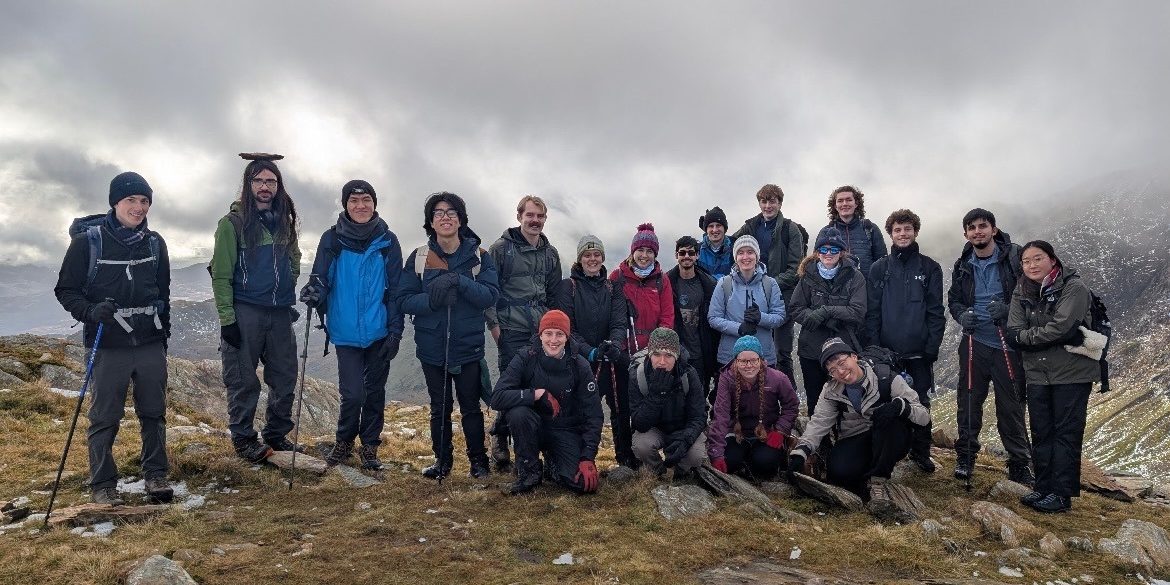
Returning from my year abroad, I rejoined Warwick’s DofE Society just in time for one of their most anticipated traditions: the annual Snowdon trip. From the 21st-23rd November, a group of 21 students and alumni set out for North Wales, nearly double the number who came on my first experience two years ago.
Cannon Park was our meeting point, where kit was checked, food was frantically bought last-minute, and cars were packed with tetris-precision. The three-hour journey passed quite quickly. Hazel realised she’d forgotten her woolly hat, which is pretty essential when climbing Snowdon in late November, and proceeded to knit herself one on the spot. It was genuinely impressive.
We arrived at Lon Dryll Outdoors, our accommodation for the next two nights. Although we had to consult the bunkhouse map several times just to locate our rooms, the place was well-equipped. We had real duvets (a massive upgrade from our usual sleeping bags), a games room, multiple showers, and, best of all, not one but two dishwashers.
The next morning, we were up bright and early for our ascent. When we reached our starting point, we were surprised, and slightly alarmed, to discover from a small information panel that we were about to take on the most challenging of Snowdon’s six main routes. One section of the route was even highlighted in red. We looked at each other, shrugged our shoulders, and began the climb up the Watkin Path.
Created in the late 19thcentury by Sir Edward Watkin, it is also one of the most historically significant trails, passing old mining ruins and waterfalls before rising sharply before the summit ridge
The Watkin Path is known as one of the most demanding routes up Snowdon (which we are now fully aware of), particularly due to its steep and loose scree section near the very top. It begins at a relatively low elevation, meaning it has one of the greatest total height gains of all the routes. Created in the late 19thcentury by Sir Edward Watkin, it is also one of the most historically significant trails, passing old mining ruins and waterfalls before rising sharply before the summit ridge.
The lower part of the route felt almost too easy, and I remember saying something along the lines of “this is too good to be true.” We passed several sheep, a lone camper, a handful of other hikers, and of course the spectacular views of open hillside. We stopped briefly at Gladstone Rock, a memorial marking where Prime Minister William Gladstone addressed a crowd during the path’s inauguration. Everyone’s spirits were high, and most importantly the weather was on our side…for now.
However, as we reached the upper section, the dreaded red section, we quickly understood why this path is considered one of the tougher routes. Every so often, professional-looking climbers descended past us, offering a cheery “good luck!” We’d smile back, but each encouragement was followed by a round of slightly worried glances within our group. The cloud cover was extremely thick, and we couldn’t actually see the summit at all, so it was becoming increasingly difficult to tell where the path was supposed to go. I think we were all secretly hoping a clear trail would magically appear out of the mist and guide us neatly to the top. But no such thing was going to happen.
The visibility was not improving and the path, if it could still be called that, was increasingly difficult to follow
After a quick lunch in the snow, it became clear that an unspoken decision was forming among us. The visibility was not improving and the path, if it could still be called that, was increasingly difficult to follow. It didn’t help our confidence that we could also see other climbers attempting to descend the very route we were supposed to go up with some even sliding down in the snow because of how steep it had become. By the end of lunch, many of us admitted we didn’t feel experienced enough to safely attempt the final section.
In the end, a small, confident handful chose to continue. The rest of us, myself included, made the decision to turn back. It didn’t feel like failure, just the right call. The day ended on a high despite the change of plans. Back at the bunkhouse, we warmed up with dinner and an evening of games. A few hours later, the summit group returned with their success story. Those of us who’d turned back enjoyed a much earlier bedtime, resting up for another full day of hiking ahead.
The next morning, we split into two groups: those wanting to visit the isle of Anglesey and those who preferred a walk around Aber Falls. I found myself in the latter group. The waterfalls were impressive and we’d finished exploring them surprisingly quickly. With plenty of time to spare, our group somehow ended up climbing yet another mountain. Don’t ask me how; I genuinely couldn’t retrace the route if I tried. All I know is that we reached a height where we could clearly see Anglesey in the distance and had definitely used up all of our spare time.
Interested in going on a DofE trip? Head on over to their Instagram or join their WhatsApp group where all updates and information about future trips will be posted
After descending, a crazy bunch of us decided it was the perfect time to swim in the waterfall. I opted to remain an observer and was immediately grateful for that decision when it began to pour with rain. Meanwhile, the Anglesey group enjoyed a far more relaxed day, complete with a visit to the famously long-named train station.
Both groups reunited at our final destination, the pub. We arrived in a wonderfully staggered fashion, to the point where one person was ordering their first drink while someone else was already halfway through a slice of fudge cake. After a round of goodbyes, those of us returning to campus made our way back to where it all began, Cannon Park, before heading our separate ways.
Interested in going on a DofE trip? Head on over to their Instagram or join their WhatsApp group where all updates and information about future trips will be posted. We hope to see you there.
Comments (1)
An entertaining read! 🙂