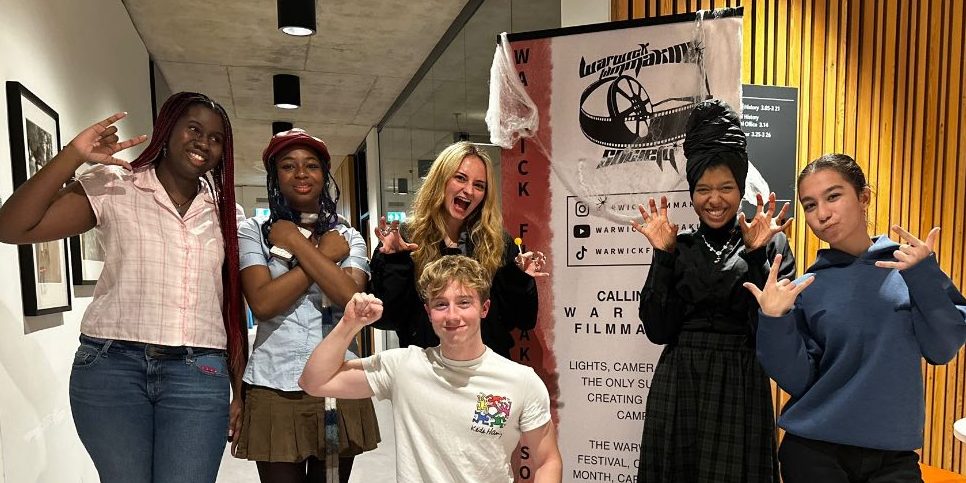
‘Pursue your creativity and don’t be afraid to embrace it’: Warwick Filmmaking Society on empowering the next generation of filmmakers
Warwick Filmmaking Society, founded only a couple of years ago, is already making waves as one of the most innovative and creative societies on campus. Teaching students skills like directing, editing, writing, sound design, and acting, as well as showcasing the power of filmmaking, this society ensures that students feel like they can be part of the future of creative media.
Legendary directors like Martin Scorsese and Christopher Nolan started out with student films, and with Hollywood becoming more reliant on existing IP, now more than ever, we should look to support the young creatives here at Warwick.
To gain an insight into the only filmmaking society on campus, I spoke with three members of the exec: Madinah, the President who oversees the workings of the society, Maya, the Vice President, and Lola, the Media and Publicity Officer responsible for raising the visibility of the society on campus.
We began our conversation by discussing the many ways to get involved with the society and the student filmmaking community. From informal challenges to more serious events that equip you with new filmmaking skills and techniques, there is truly something for everyone.
It’s not about creating a masterpiece. It’s about putting yourself with a group of friends or a group of strangers and collaborating
“Coming up in Term 2,” Maya explained, “we have Challenges Month, where you’re given loads of different challenges, such as directing or writing, with short deadlines. It’s not about creating a masterpiece. It’s about putting yourself with a group of friends or a group of strangers and collaborating. We then screen those films and have little awards for the aspects we liked in the different films.”
Madinah was keen to draw attention to one of the society’s biggest events: its career panels. These panels feature around five speakers from across the industry discussing their careers, experience, and advice on entering the industry. “It’s a chance for students to ask professionals face-to-face questions that they might have, breaking down the large barriers between professionals and aspiring filmmakers,” said Madinah.
Filmmaking society also host your classic Warwick socials, pub crawls and circles, yet with a unique twist. Lola told me about one of their recent pub crawls in collaboration with Film and TV Society, which involved a silent film challenge. “Not only can you have fun around Leamington Spa getting a little bit drunk, but you also collaborate and work on a piece of interesting filmmaking,” she said. “Considering silent film is the starting point of what we now understand as filmmaking, it’s pretty important to incorporate all sorts of concepts.”
Outside of socials and events, Madinah shone a spotlight on a brand-new initiative enabling students to create their own film through student-funded applications, which are currently open. Madinah shared the details: “This entails creating a film concept with your crew, and we’ll read them. Then we hold interviews where you pitch your ideas, and we’ll act like producers in the real world. If we like the idea, we’ll give you some funding.” The three funded films will then be showcased alongside other submitted student work at the Warwick Film Festival at the end of Term 2.
Warwick Film Festival is accessible to everyone, even if your film is not selected for funding: “We don’t want to close the doors to anybody”
Speaking about the premiere night at the festival, Madinah said: “It’s a great way to show your work to people.” She added: “We invite the professionals back in so they can watch films alongside us. Hopefully, one of the pros thinks that soundtrack, for instance, is really amazing, and wants to get in touch with that student. This is how connections and friendships are formed.” Madinah also wanted to make it really clear that the Warwick Film Festival is accessible to everyone, even if your film is not selected for funding: “We don’t want to close the doors to anybody.”
Networking in the film industry is notoriously difficult and a daunting process. Aspiring filmmakers are regularly faced with the problem of ‘it’s not what you know, it’s who you know’, so I asked the exec if they had any networking advice. Madinah’s main suggestion would be to go to as many networking events as possible. “It’s usually a very informal occasion, but it’s a great way to meet people in the industry and start building up those connections slowly.” Madinah stressed that building your network “doesn’t need to be a rapid thing” and Warwick Filmmaking Society is here to help support the process.
Lola encourages everyone to follow the Warwick Filmmaking Society Instagram account, which is where students can find all the information about upcoming events. On the Instagram page, there is also a cast and crew database for students to sign up to. “This means you can easily find a crew or cast to make your short film. It’s a more low-key version of the wider industry database, which we will help students to get into at one point in the future,” said Lola.
Maya offered a sneak preview of the upcoming Warwick Filmmaking Society tour, declaring: “It is the event you want to attend to network and get into filmmaking.” Whilst she wouldn’t reveal the exact location of the tour, she did say it would be in a big city in the UK. Maya also assured me that prices will be kept fair and reasonable for society members.
When asked about what people can expect from the tour, Maya revealed: “Hopefully, we can go to a few film festivals and networking events. There will be an opportunity to make friends, network with people, and maybe work with them on a future film. This will be an amazing chance to branch out, get some good contacts on your phone, and have people remember your face. It will be a really fun trip!”
I then asked the exec what their most important piece of advice would be for someone looking to make their own film, and what they wished they had known before starting. Maya was quick to share the importance of not being afraid to make mistakes. “I was extremely afraid, and I am still getting over this fear. Don’t be afraid to pick up a camera just because you don’t know something. I knew nothing about cameras; I still am learning. Make mistakes. Make as many as you can, because you learn from those.” Maya also recommended checking out free filmmaking courses on YouTube, emphasising that you don’t need to splash the cash on a premium course to become proficient in filmmaking.
Lola drew from her personal experience as a writer-director, and she advised writing down your ideas constantly, whatever they may be. “I think we’re always coming up with something new. And you don’t want to let go of anything that comes into your head. Write it down, and I promise that you can turn that into a short film, a music video, maybe even a feature one day.” Allowing your mind to be creative is “probably the most honest and authentic way you can hopefully make a film one day of your own,” Lola declared.
Something so beautiful comes out of working with other people within our filmmaking community here at Warwick. It creates a more beautiful piece of work, a more informed piece of work
Madinah’s advice was to “pursue your creativity, stand by it, and don’t be afraid to embrace it.” Madinah also shared that she wished she had fully embraced the possibilities for collaboration. “Something so beautiful comes out of working with other people within our filmmaking community here at Warwick. It creates a more beautiful piece of work, a more informed piece of work. You’re in a community where everyone is pursuing their own creativity. So, when that comes together, hopefully it will create one amazing film.”
After learning all these tips and tricks for making a film, I was intrigued to find out what happens to the final product and how students can go about showcasing their creations to an audience on campus or beyond. “Send it to us!” Madinah instantly replied. “We run screening events. So, if students send us their work, we will find a place on campus. We’ll get the community together. We’ll sit down and watch their movie and share our thoughts. This also really strengthens that community aspect of our society.”
For those of you wanting to have your work recognised beyond campus and in the career field, Maya offered some really key advice. “Send it to as many people as you can. You’ll get a lot of people who won’t even respond to the email – I won’t sugarcoat it – but hopefully there will be nice people who will either look at your film and give you feedback, and you’ll be on someone’s radar.”
Maya urged any aspiring filmmaker to keep emailing, even if you hear nothing back. “Even though you get hit with a wall, it’s like applying for a job: at least you’re applying. So, I’d say, just try your luck everywhere, being as annoying as possible, like a bug they can’t get rid of. Persistence goes a long way and not being afraid to just send that email goes a long way as well.”
Our conversation turned to discuss some of the biggest misconceptions about student filmmaking. “I think there’s a myth that you need to just do one thing or have one speciality, but a lot of the time specialities or interests overlap,” said Madinah. “You can be a writer-director, director-actor, sound designer-composer – there are so many different things you can do. The idea of restriction and barriers is completely anti-creativity.”
Maya was also keen to stress that you don’t need to be an expert in filmmaking or have lots of experience, and everyone is welcome. “I remember at the Societies Fair lots of people came up to us and said, ‘I’m a total beginner. Can I join?’ Of course you can. I was a total beginner when I joined,” said Maya. She added: “If you don’t know how to hold the camera properly, that’s absolutely fine. We do workshops and careers events, so there are plenty of opportunities to learn. Also, with the challenges, whilst they can be silly and fun, they are actually a really good way to hone your skills, think on the spot, and be creative.”
Arts education has faced cuts across the board, sparking concerns that we are now facing a ‘creativity crisis’. Hollywood has adopted a risk-averse approach, opting for remakes and sequels, with critics noting the industry is lacking creativity and losing originality. I was therefore interested to hear the exec’s perspective on why student filmmaking is so important.
It’s just a lovely way to look inside a young person’s soul and see how they view the world. Youth films have always got a special place in my heart because they’re so raw. They’re not so skilled with the camera, and it captures the moment
Maya explained that when people think of films, they typically default to big names in the industry like Scorsese and Nolan. However, Maya holds a special place for indie and smaller creative films. “It’s just a lovely way to look inside a young person’s soul and see how they view the world. Youth films have always got a special place in my heart because they’re so raw. They’re not so skilled with the camera, and it captures the moment.”
“The mind of a young person is absolutely fascinating and so beautiful in so many ways,” said Lola in agreement. “I made a film that I released this year called Floor 5, which takes place on the fifth floor of Warwick library. It is a very short film with no dialogue. It is a pure expression of my mind now and my cast’s. The film shows how we’re feeling at this time of our lives and the beauty of the young student mind.”
Maya added: “I think it’s so important that student films get the love they deserve, because these are our future creatives, and if we give them the love that they deserve, they won’t get discouraged.” In such a cut-throat industry, it can be easy to get discouraged, so Maya urges everyone to get behind and support young filmmakers.
Madinah wanted to take a moment to reflect on the power of youth voices for creating change and offered a preview of an upcoming event. “One of our projects that will be starting after reading week will be our documentary workshop in collaboration with Warwick Action for Palestine. This workshop will focus on the importance of activism in documentary work. We want to use our platform as artists to talk about those whose voices are being silenced and use our art as a form of activism, and young student voices are so pivotal for this.”
“In the world that we’re living in right now, there’s so much to say, and our experiences have become more compounded into quite a complicated world. And because of that, I think creativity is flourishing even more, and that’s why filmmaking is so important to embrace and pursue. Not only is it an accessible art form, but it’s saying something. Filmmaking that has something important to say should always be supported,” Madinah powerfully shared.
As our conversation drew to a close, I wondered what we could expect from Warwick Filmmaking for the rest of the year. “More filmmakers, bigger names on campus, more screenings, more events, and more challenges,” Lola enthusiastically replied. “Expect to make friends, have fun with the exec, and be worlds away with the fantastic nature of filmmaking,” Maya added. In a final remark, Madinah noted: “We want a stronger community of filmmakers on campus with creatives working together to create magic on screen.”
Some of my fondest memories at Warwick have come from acting in student films at Filmmaking Society. Whether you are a seasoned filmmaking pro or a total beginner, Warwick Filmmaking Society is clearly a magical place to be.
Comments