Mexico, machismo, and morale: Gendered-violence in Mexico
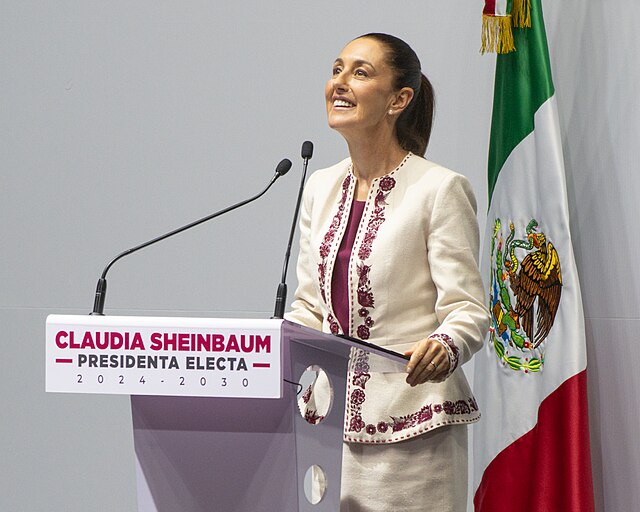
In 2024, President Claudia Sheinbaum was elected to office as the head of state of Mexico, the first female president of the country. To the people of Mexico, a country that is applauded for female representation across legislative bodies (approximately 50% in the Senate and 48% in the Chamber of Deputies), the president announced, “It is time for women”. Sheinbaum, much like her mentor and predecessor, President Andrés Manuel López Obrador, refused the presidential guard in order to prioritise proximity and closeness to citizens.
[Sexual harassment and violence] is happening even to the president of the Republic
– Veronica Cruz from the feminist collective Las Libres (The Free Ones)
Almost a year since her investiture, the president was groped by a man, inebriated with alcohol, in public. A video of the incident shared on social media shows a man trying to kiss her neck and his hands attempting an embrace from behind as she greeted citizens. She proceeded to remove his hands and later indicated her decision to press charges. The incident amplified the cries of women, many of them sharing sentiments about their diminished or absent immunity towards sexual harassment and violence considering the head of state (who is often protected by security) was subject to such an act: “It is happening even to the president of the Republic.” Sexual harassment and violence against women are not new facets of the country. However, this incident, coupled with Sheinbaum’s vocal resistance and calls for legislative action, has taken the narrative beyond borders, illuminating the existing plight of women in Mexico and hopefully forging a new path for them.
70% of women above the age of 15 have experienced some form of violence
Violence against women is prevalent in the country. 70% of women above the age of 15 have experienced some form of violence or other. Women live with the fear of being harassed, stabbed, kidnapped, and killed to name a few, and the amplification of anxiety is uniform across everyday aspects of life, for example, taking the bus to work. Mexico ranks highly on the list of countries with the highest rates of femicide. Femicide is the murder of a girl or a woman on account of her gender. The country has innumerable unsolved cases of missing women, and the families of victims go as far as to say that finding the body of the victim is where the terminal point in the fight for justice lies. The concentration of these offences is comparatively more prominent in certain locations such as Estado de México, Chihuahua, and Colima.
The very support system or authority framework that is responsible for the safety of women and the delivery of justice is deeply rooted in these toxic masculine values
Femicides are heavily attributed to the machismo culture or toxic masculinity that prevails within the population. Many cases of gender violence in Mexico are domestic, and this contributes to the minimal reporting of these instances. Women fear speaking up or seeking help due to the additional negative consequences associated with bringing the cases to light. The very support system and authority framework that is responsible for the safety of women and the delivery of justice is deeply rooted in these toxic masculine values. In many cases, the families of victims feel the need to take matters of justice into their own hands; their lack of faith in the criminal justice system is evident. The impunity of these offences breeds discouragement, a lack of hope, and helplessness. Almost half of the states in Mexico have not criminalised sexual harassment. The eradication of gendered violence, which is often born in hardened stereotypes and notions of inferiority associated with a particular gender, requires a grassroots approach. Realignment of policy and erosion of impunity could uncover the roots hidden under sharp blades of grass.
The groping of President Claudia Sheinbaum holds up a mirror to the everyday conditions of women across the world and, in particular, Mexico
The existing legislative policy expresses itself as a ‘shrugging of shoulders’ to the victims of this crime. President Claudia Sheinbaum has instigated a thorough review of the laws that exist to protect women in the country and initiated the restructuring of current frameworks to aid victims and the public. Her predecessor, President Andrés Manuel López Obrador, had promised action and support towards the resolution of violence against women and femicide during his election campaign. However, his term was embellished with budget cuts to women’s shelters operated by NGOs and the Federal Women’s Institute, institutions that contribute to the wellbeing of women in Mexico, particularly the victims of female-centric attacks.
As case files tower on the desks of criminal justice officials, female-targeted violence has become an everyday occurrence; the cries of affected families and the general public are muffled and drowned in the chaos of the government’s attempt to navigate cartel violence, which leaves no room for addressing this issue. The government in Mexico is often overwhelmed by the battle against drug cartels that pervade the country, and femicides and gendered violence are seen as issues external to the scope of the cartel war. However, these cartels often use female-centric violence as a pawn to demonstrate their domination and to foreshadow the fate of those who resist them. The targeting of women also reinforces their machismo. Women are often assigned roles of a disposable nature within their networks and subjected to violence and subsequently discarded to reflect an interpretation of women as submissive, passive, and the ‘inferior’ gender.
It undoubtedly is ‘the time for women’. It is the time to call for change, to organise the restructuring of century-old perspectives of gender, to pull up more chairs at tables to catalyse impact, to dissipate impunity, and to create a time for women that is devoid of fear
As the feminist movement marches on, it is crucial that we acknowledge the varied paces of different communities (owing to cultural mindsets, legality, economic and deep-rooted social structures), create dialogue, and inculcate empathy and support for every branch of the march. The groping of President Claudia Sheinbaum holds a mirror up to the everyday conditions of women across the world and, in particular, Mexico. Whether the eradication of machismo culture, femicide, and gender-based violence (through feminist action and policy changes) can be achieved in Mexico is yet to be seen. Hopefully, the president, carrying the torch of this emancipatory resistance from femicide and gender-based violence, will be able to shine a light on increasing the visibility of these crimes, reorganise government policy and support to fight it, and lower revictimisation and new cases. The call for a paradigm shift, protests, communal action, and support for the cause from the existing government, with Sheinbaum at its head, brews hope for the present and future generations of women in Mexico. It undoubtedly is “the time for women”. It is the time to call for change, to organise the restructuring of century-old perspectives of gender, to pull up more chairs at tables to catalyse impact, to dissipate impunity, and to create a time for women that is devoid of fear.
Comments