Frankenstein: A newly adapted tale eternal
Guillermo Del Toro’s newest project this year has sparked the interest of every gothic and sci-fi enthusiast, with his ambitious new film adaptation of Mary Shelley’s most revolutionary book, Frankenstein. It birthed a new generation of literature, a new genre of gothic and sci-fi never before seen. With Shelley only being 19 years old when her book was published, her ungodly tale of life in death became simultaneously popular but equally as taboo, with many condemning her narrative as demonic. Now, it has become the face of gothic literature, a staple in the academic sphere whether one was forced to study it at school, or simply picked it up in a bookshop, intrigued by what it promises to offer. Frankenstein, both name and book, has transcended itself – one does not need to have read the book to know what the story entails, or even what the creature looks like, with the popularised green skin and nuts and bolts protruding from the neck, grimly keeping the parts together. For a book so shrouded in mystery and depth, Del Toro has not picked an easy task for himself, and for the actors who have been chosen to bring this book to life.
With trepidation, but an open mind, I sat and watched Frankenstein, and I can say that this film did not fall into the trap its other classic counterparts did
With many classic novels being adapted into film, we have seen a trend of failed renditions such as the 2009 The Picture of Dorian Gray, which seems to miss the mark by miles, seemingly moving away from the crux of what Wilde intended. And with the news of the newest Wuthering Heights adaptation, there was little hope for a proper adaptation of a classic done right. With trepidation, but an open mind, I sat and watched Frankenstein, and I can say that this film did not fall into the trap its other classic counterparts did. It was, in short, beautiful. Del Toro truly did share Frankenstein’s madness when creating this chillingly sorrowful film.
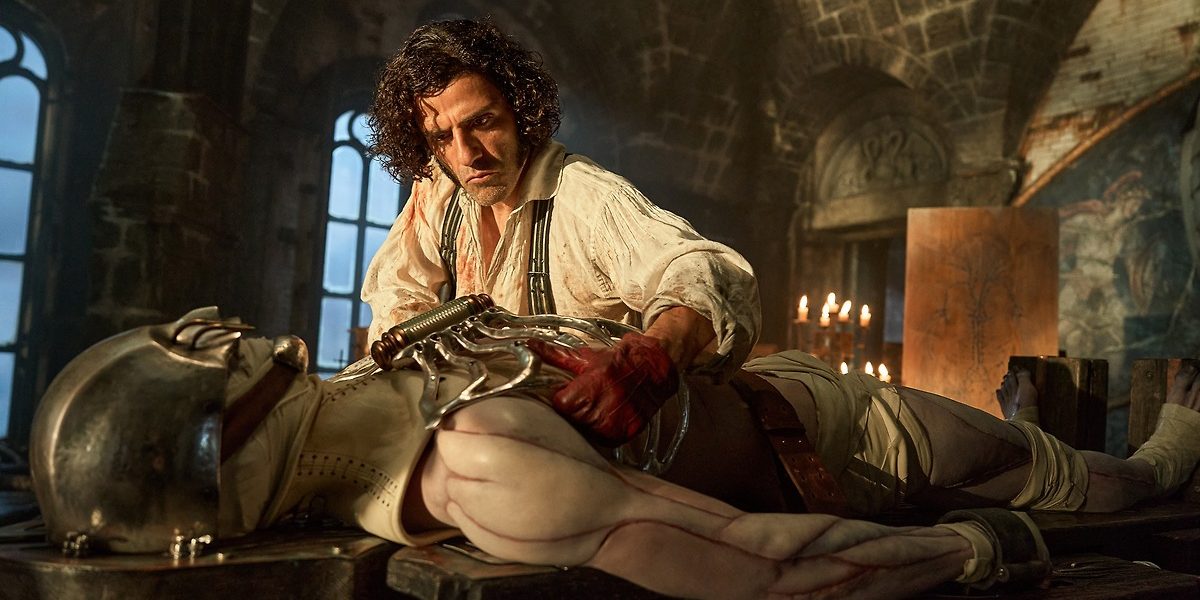
I wish to begin with the costume design, an ode to Del Toro’s other gothic films such as Crimson Peak. He seems to have a knack for stylistic, patterned clothes. But once one understands the story he is portraying, the costuming takes on another semblance. The colourful, bug like patters on Elizabeth, played by Mia Goth, reflects her own affinity to science and the strange. Her white dress and red crucifix on her wedding day are an ode to Victor’s mother, played by Goth herself, who wore red, thus adding to the layers of Elizabeth and Victor’s complex relationship, as well as the white bandages on her arm which are reminiscent of the Creature’s own bandages. Elizabeth is shrouded in silhouettes and, bit by bit, with the Creature, she reveals herself – showing him that she is like him, an oddity. With Victor Frankenstein, played by Oscar Isaac, his costuming is dark, almost stylistically modern, a way to show how his mind works: ahead of its time. He is splashed with red, his gloves starkly bright red, bloody after creating the Creature and defying the impossible. As the film progresses, we see Victor lose his humanity, becoming more dishevelled in his appearance, while the Creature seems to become more human with his words and countenance. It was exciting to see what the characters would say, with Del Toro adding his own macabre dialogue, while including some of the famous quotes from the book, giving the film a breath of fresh air.
The stark red of the blood and bodies all made the sci-fi aspect of the film come to life, evoking emotions that sidle alongside what the characters are feeling
The film does parallels exquisitely, with Elizabeth and Victor’s mother, and equally Victor and the Creature, who trade places as monsters throughout until right at the end, in which they both become unified under forgiveness. The colours of the film were a cinematic masterpiece. The icy cold of the snow, the green lighting in the laboratory, the stark red of the blood and bodies all made the sci-fi aspect of the film come to life, evoking emotions that sidle alongside what the characters are feeling. Not to mention the setting in of itself being a work of art – the ship at the beginning being a fully constructed piece that was thoroughly researched and designed. The most impressive piece of built set I believe is of course Frankenstein’s laboratory, which was real, and not CGI. It was exactly how one would picture his workspace: dark and dangerous with mysterious technology unknown to us that had us watching with bated breath as the disaster of creation took place. Amongst the set we could see many allusions to religion, Del Toro having grown up in a strong Catholic household, which he has said inspired a lot for Frankenstein, such as the allusion to crucifixion when the Creature was created, and most obviously the parallel of Master/Creator and the Creation – an ungodly act of defying death into life.
I cannot begin to elaborate on the actors themselves, and how perfect they were for their roles. Guillermo Del Toro had true vision with the film, with Oscar Isaac playing a delightfully charming yet chillingly mad Frankenstein, Mia Goth as a peculiar yet strong willed Elizabeth, and of course Jacob Elordi’s phenomenally stunning rendition of the Creature. Out of all actors, Elordi’s enactment of the Creature is nothing short of award worthy. As an actor typically type casted as quite shallow, not-so-well-written characters, this role made me, as a fan of the book, quite nervous, as the Creature is a complex, fragile and monumentally important figure in the novel. But after seeing him, his make-up and in costume, there was no doubt about it – he really was the epitome of Shelley’s creation. Elordi truly encapsulated the essence of innocence and ruin, and that innate urge to find human connection and meaning, his performance bringing me and many to tears as he learns what he is, and how the world will treat him because of it. He was absolutely amazing, his eyes constantly shining with emotions that made me truly feel for him, unlike his creator.
A director’s choice to cut and rearrange is part of the beauty of making an adaptation
Of course, to many lovers of the book, it is always a fear when it is transformed and translated into a new medium. I had to remind myself to keep an open mind, and that a director’s choice to cut and rearrange is part of the beauty of making an adaptation, and despite being nervous to see my favourite book being re-born, I had utter faith in the production. For the most part, in terms of music, colour scheme and visuals, it was exactly as I imagined Shelley to have described. The outfit choices for Victor were different, modern, but suited him well, much like Elizabeth, whose character was starkly different. For one, she marries Victor’s brother William instead. And, instead of dying by the hands of the Creature, it is by Victor who misfires. The narrative about Victor’s childhood is grim compared to the book, an unhappy one filled with abuse, which triggers his obsession with death. Of course, the biggest difference was the fact that not only did we see how the Creature was created, infamously left vague by Shelley herself, but the fact that he couldn’t die, which made his need for companionship more tragic.
Overall, this film was spectacular, and as someone who has lived, breathed and loved Frankenstein, I can say that it was put into the right directors’ hands. Although there were changes and shifts to the narrative, it made for an overall thrilling watch and beautiful story to see on the screen. My only wish was to have replaced the Byron quote at the end with that of Shelley, the true mastermind of the story and a woman beyond her time. This film was something special, and a testament to human connection, for as the Creature said, “let’s be monsters together.”
Comments (1)
The story deviated from Shelley’s work by miles and as such lost its effect
This adaptation stunk