Bugonia: Humanity’s murky morals
The internet is brimming with misinformation and, ostensibly, Yorgos Lanthimos’ Bugonia serves as a cautionary tale against dangerous conspiracies and ideological pipelines which sweep up vulnerable individuals looking for comfort in delusion. However, Lanthimos’ extraterrestrial tale is far more nuanced than a simply satirical take on conspiracy culture. Bugonia asks the fundamental question of what it means to be human, confronting the lasting scars of trauma as well as the alienating effects of modern society. Viewers should be warned of disturbing content such as suicide, abuse, and torture. This review contains heavy spoilers.
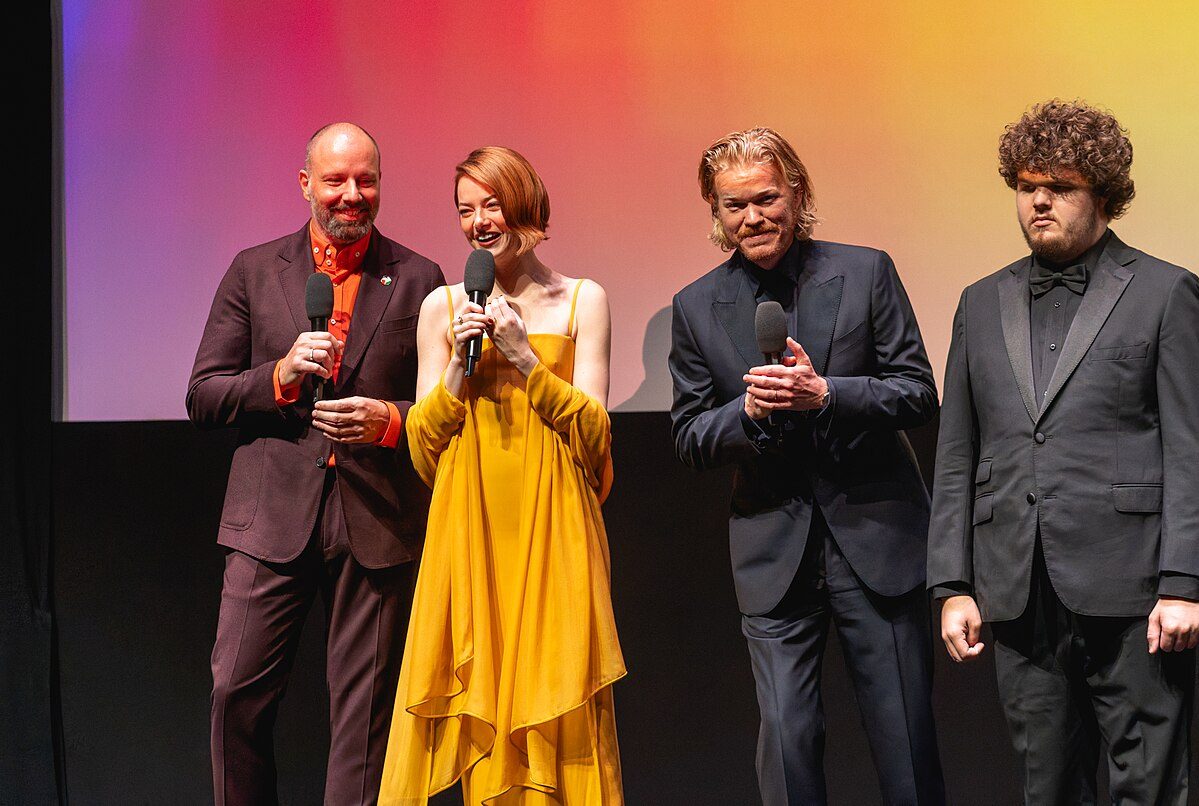
This remake of 2003 South Korean film Save the Green Planet (Dir. Jang Joon-whan) is yet another adventure into the absurd for Lanthimos and marks his fifth collaboration with Oscar-winning actress Emma Stone, who takes on the role of ultra-rich pharmaceuticals CEO Michelle Fuller. Stone’s character is kidnapped by cousins Teddy (Jesse Plemons) and Don (Aidan Delbis). Teddy is a young man possessed by the belief that humanity is not alone in the universe and that Michelle is an alien ‘Andromedon’ and has infiltrated Earth with designs of its destruction. What unfolds is Teddy’s interrogation of Michelle, aided by his cousin, in the hope of convincing her to “beam them up” to her mothership so that he may negotiate for the freedom of earth from extraterrestrial plans. Teddy’s fixation on “the truth” of Michelle’s identity begins as comic but descends into something far more sinister and exposes the extent of his inhumane methods.
These two alumni of Lanthimos’ school of surrealist cinema are nothing short of titanic
For a film so concerned with the otherworldly, Bugonia remains incredibly grounded and nowhere is this more evident than in its characters, with what are arguably career-defining performances from both Jesse Plemons and Emma Stone. These two alumni of Lanthimos’ school of surrealist cinema are nothing short of titanic. Both play characters isolated from wider society, and yet in completely opposite positions: Teddy lives in poverty and Michelle in privilege.
Bugonia’s opening ten minutes skilfully introduces the protagonists as Plemons narrates Teddy’s plan with unnerving conviction, contrasting Stone’s Michelle, whose vacant gazes and robotic morning routine evoke visions of Patrick Bateman. Lanthimos constantly places these characters at odds, both in staging and dialogue, resulting in moments of incomprehensibly uncomfortable tension.
While Michelle’s identity is the focus of the plot, it is the character of Teddy, and Plemons’ performance, that undoubtedly takes centre-stage. Teddy is a deeply unstable man who, after losing his mother to experimental drugs which Michelle’s company supplied, becomes obsessed with the discovery of a “grand design”, believing that “everything will be better” after the fact. Teddy exudes a desperation for something to blame for his trauma, believing that there must be a greater purpose to his suffering and refusing to accept the depressing reality where trauma lacks rhyme or reason.
Despite intending to present himself with an air of professionalism and confidence, Teddy’s façade quickly falls away as soon as he is faced with the potential that he is wrong. With this, we uncover an unfathomable rage cultivated by a lifetime of pain.
He is clawing desperately for an idea which might provide a fleeting sense of control, so, when faced with the fact that even this may not exist, it breaks him
The anger that comes through in Plemons’ performance is almost childlike. From a frenzied screaming and thrashing in his car to launching himself across the dinner table and hurling obscenities at his captive, Teddy is unable to maintain any composure. Such moments of uncontrollable rage reveal the tragedy of Teddy’s character: he is merely a child of Earth who has been irreversibly affected by traumatic events. He is clawing desperately for an idea which might provide a fleeting sense of control, so, when faced with the fact that even this may not exist, it breaks him.
While he may be condemned for his brutality and immoral methods, an impressive sympathy is evoked for Teddy as audiences are forced to examine the history that has shaped him into such a deeply unwell figure. Bugonia is at its best in these moments, encouraging viewers to confront the monstrous aspects of the human condition and to question if anyone can be truly “human”.
Aidan Delbis (Don) is a member of The Miracle Project, an inclusive performing arts programme aimed at fostering opportunities for the neurodiverse and disabled. He impresses as a Hollywood debutant, taking on a pseudo-‘good cop’ role as his cousin’s moral compass. Delbis certainly provides comedic relief but also furthers the film’s exploration of how society exploits the vulnerable. He is manipulated by Teddy into becoming the accomplice to a truly violent scheme under the claim that it will “save him” but the truth is far more melancholic.
Emma Stone is similarly impressive in her role as the out-of-touch billionaire and the focus of Teddy’s obsessions. Michelle is an interesting exploration of the corporatisation of life. In her earliest dialogue she relays her new policy on working hours, asking her PA to tell employees that they should “feel free” to leave at 5:30pm. This isn’t mandatory though, and if they have something left to finish, says Michelle, then they should do that. In this half-hearted attempt at avoiding inquiries about inhumane work conditions and work-life balance, Stone immediately establishes Michelle as being removed from the reality of her employees, not viewing them as functioning people, but as cogs in her well-oiled machine.
While she fulfils the role of the confused and anxious captive in the first half of the film, Stone becomes an intimidating force as the story unfolds. A particular scene positions her staring down the barrel of a gun. She is completely unarmed, and yet she commands an immensely domineering presence, oozing power and confidence. It becomes clear that Michelle knows more than she is letting on, expertly unravelling the psyches of Teddy and Don over the course of her stay in their bespoke basement.
The complexity and darkness of Bugonia’s themes are only elevated by Robbie Ryan’s dynamic cinematography and Jerskin Fendrix’s haunting soundtrack. Ryan’s use of wide-angle lenses in scenes outside of the house remind audiences of their “alien” status as spectators, almost positioning them as extraterrestrial viewers of the events themselves, watching and judging from the comfortable seats of their spaceships – cinemas.
The use of a shallow focus in the scenes of Teddy’s house allow for the close interrogation of characters’ faces, nearly forcing viewers to survey each pore and blemish for indications of the otherworldly. There is a wonderful tension in the scenes of confrontation between the cousins and Michelle, with the framing of the camera capturing a claustrophobia unique to the basement of Bugonia.
Moments of shocking violence in the film are somehow made palpable to audiences through the score, an impactful example of the relationship between music and cinema
Fendrix’s score is just as marvellous, existing in symbiosis with Ryan’s cinematography. The soundtrack is an unsettling mix of harmonies that descend into discordant notes of stings, screeches, and cacophonies. It is both masterful and excruciating and could not be one without the other. Moments of shocking violence in the film are somehow made palpable to audiences through the score, an impactful example of the relationship between music and cinema.
Ultimately, Bugonia is yet another success for Yorgos Lanthimos, offering a bold and introspective look at the human condition. Through its outstanding cinematography, moral complexity, striking performances and unsettling score, the film examines a world where what it means to be “human” is uncertain. While its intensity and unusual narrative might not resonate with all audiences, these very same features are where it triumphs. Lanthimos presents a truly impactful achievement in contemporary cinema, proving his reputation once again as an aficionado of the surreal.
Comments