
An enthusiast’s guide to the interrail pass
Interrailing is a naturally appealing concept for any student in a typical financial situation, offering a huge variety of enticing experiences for comparatively little. There is no shortage of discourse regarding ‘Interrailing’ as a subculture, exploring it as a personal, social and cultural experience. Yet, somewhat ironically, there is minimal discussion about the Interrail pass itself, about its strengths, quirks and limitations. I’m writing this to change that.
If you take away one thing from this article, take away this: An interrail pass is not the same everywhere. When travelling domestically in Germany, you can travel on 99% of trains going from anywhere to anywhere without making a reservation. In Spain, you will struggle to get anywhere during the high season as booking online is difficult (sometimes possible but flaky) and the trains sell out before you could possibly get to a station to book the mandatory seat reservations in person. Even if you do find a train with availability, the pass is only valid on some of the operators, some trains have luggage restrictions, etc. TLDR Spanish train travel is a mess.
Interrail is available to anyone, from anywhere, of any age and for both 1st and 2nd class
I’ve created a map of the usefulness of Interrail in different countries and placed it in the article, bearing in mind the necessity, ease and price of seat reservations, coverage of interrail operators, quality of the trains, relative price of single tickets and the relative quality of alternative means of transport such as buses and boats.
Please account for the restrictions that apply when travelling in your country of residence, with a cap of two travel days imposed regardless of pass type. These are meant for inbound/outbound travel, but using a spare one for a day trip is usually fine if your origin/destination is a believable way in or out of the country.
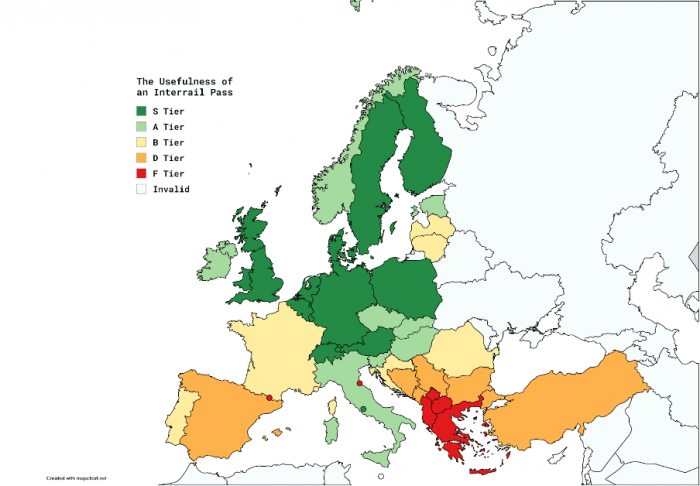
Image: Reuben Goodchild / The Boar
Interrail is available to anyone, from anywhere, of any age and for both 1st and 2nd class. For those without permanent residency in ‘Europe’ (quite a confusing definition, double check for nations on the periphery as it can be illogical) you will need a Eurail pass, which is exactly the same thing for the same price, just with a different name. All advice given is applicable to both Interrail and Eurail.
The best time to buy a pass is during the Black Friday sale (ongoing, ends 17th December). This will give you a 25% discount on all Global Passes and selected Single-Country Passes. This discount is only available on the interrail.eu website rather than the official UK retailer of myinterrail.co.uk, which most people use anyway but is slightly more expensive due to the exchange rates by your purchasing card. Therefore, if purchasing outside of a sale (it is still good value, don’t worry if you miss the sale) always use the second website with a UK bank account.
When deciding what to buy, you ought to base it around your route. As tempting as they might be due to the sticker price, a four or five day pass very rarely makes any sense due to the negatively exponential pricing model. While a 90 day pass is barely more than £5 per day in the current sale, these options are closer to £35 per day, representing significantly poorer value.
Expect at least one of your trains to be either cancelled or heavily delayed. It rarely matters much with an Interrail pass due to the flexibility of the ticket
If you want to do a traditional ‘Interrail’ trip, you should explore the 15 day in two month pass – a continuous pass is rarely needed and you get plenty of flexibility anyway. Some people might prefer the 10 day in one month option, but I think that materially limits your flexibility in a way the 15 day option doesn’t, and being free to experiment with off-the-cuff travel is a core part of the experience.
You should always purchase the mobile pass – the app is vital in assessing validity and the physical ones are so uncommon now there have been reports of people being questioned on whether they are actually a real ticket.
For the ‘Practicalities of Interrail Travel’ I’ll be adopting a bullet point format for this due to the bitty nature of the information:
- Do not assume that your pass will work at any ticket barriers – find a member of staff and they will recognise it and let you through. If a seat reservation has a QR code, this may work.
- All trains must be entered on the rail planner app before you board – this will function as your ticket. You do not need to plan the whole trip in advance – they can be added until the scheduled time of departure.
- Trains must be toggled in the trip section of the app to display on a ticket – do not untoggle them when done, they will naturally go off of the ticket at the end of the day.
- If you are meant to have a seat reservation but weren’t able to get one, go to the buffet car. Unless you are on a high speed train you’ll probably be fine and if caught the punishment will be minor.
- Do not go on a high speed train without a mandatory seat reservation. The fines can be enormous and they check for them more often than not.
- Do not count on getting any sleep on a sleeper train unless you are in a private compartment.
- Ensure that your phone is always charged. If, like the vast majority, you have the mobile pass the moment it runs out you are travelling without a ticket.
- Train internet is notoriously unreliable so ensure you have some entertainment downloaded.
- Expect at least one of your trains to be either cancelled or heavily delayed. It rarely matters much with an Interrail pass due to the flexibility of the ticket.
If you’d like any more detailed information about any of these details, I highly recommend exploring seat61.com – it is the best database of European Railway info and completely free to access. Thank you for reading!
Comments