A guide to Salamanca: An underrated city in the heart of Spain
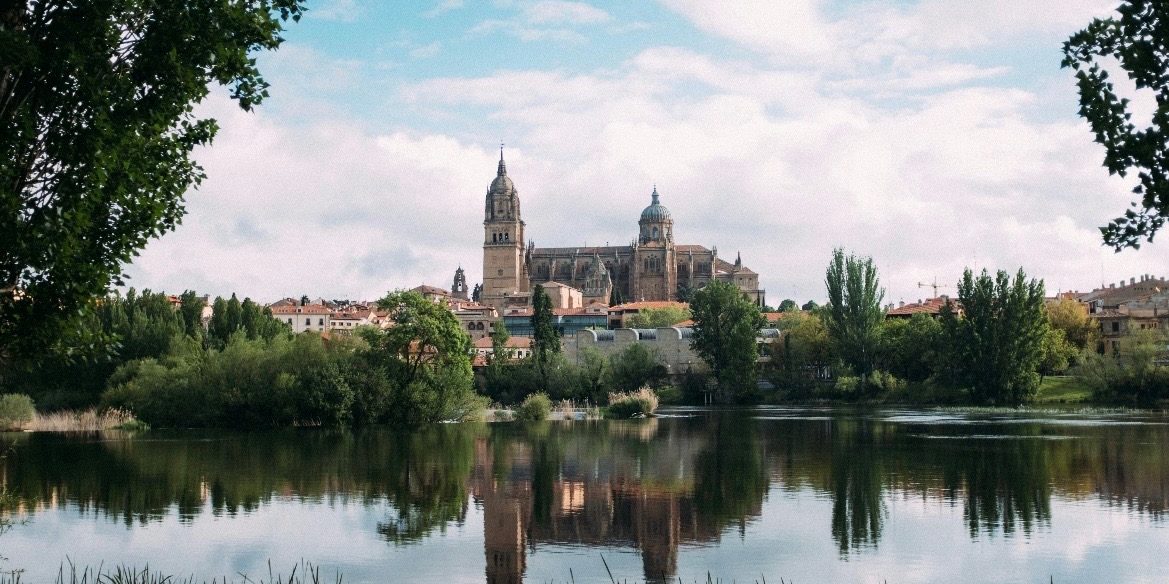
In the 10 or so months since I returned from studying in Salamanca, almost no one who I have talked to about my year abroad has known where it is. Hardly surprising really, tucked away in the bottom corner of Spain’s largest autonomous region, roughly halfway between Madrid and the Portuguese border. Not the sort of destination you’re likely to see in the window of a travel agent, or a TV ad set to a Jess Glynne song. And yet, if you google it, the first picture that will come up is without a doubt one of the most magisterial buildings you’ll ever see. The Plateresque cathedral, rising high above the rest of the city, with the glistening Tormes river on one side and a sea of stone and red-tiled rooves on the other. Needless to say, this sight left quite an impression on me the day I arrived, even from the aisle seat of a crowded coach. That was just one of the things that charmed, fascinated, or confused me about this city; there is much more to see.
Salamanca is the perfect size for me. Not too big, not too small, built long before the invention of the car and as a result beautifully walkable
First, let’s talk getting there. While going by train is an option, by far the easiest way is a flight to Madrid and a coach directly there from the airport. The journey takes you through part of the Sierra de Guadarrama national park, which is a stunning place just to see out of the window, far more rugged and green than most people imagine Spain to be. Salamanca, however, is classic Castilian Spain. Although the cathedral is the most impressive example, the architecture extends far beyond that. The nearby Casa Lis is definitely worth a visit – it’s a museum based in an old art deco house with stained glass windows and exhibits of every type: paintings, sculptures, jewellery, weapons, antique toys, you name it.
The Casa de las Conchas is the most unique, adorned on the outside by over 300 shells carved from sandstone, a symbol of the Camino de Santiago pilgrimage. But the centrepiece, quite literally, is the Plaza Mayor, the main square of the city. A fully enclosed square of Baroque architecture, incorporating the town hall, with arched entrances and home to an enormous tree at Christmas, I never once walked into it without my eyes widening a little, such is its beauty; especially at the golden hour when the lights are turned on all around it. Small wonder that the old town is a UNESCO world heritage site. And the best part is that all of these places are within easy walking distance of each other. Salamanca is the perfect size for me. Not too big, not too small, built long before the invention of the car and as a result beautifully walkable.
If you’re looking for a more budget-friendly and authentically Spanish experience, there’s no shortage of small bars that traditionally serve tapas and coffee during the day and beer and wine in the evenings
One of the things that may worry you, as it did me, is that such an ‘out of the way’ city might be sleepy, with very little to do for those who want more than some nice buildings to look at. This is far from the case in Salamanca. The prestigious university, founded in 1218, is one of the oldest in the world. Often dubbed ‘Spain’s Oxford’, it’s very much a student town, which means it’s livelier than you’d expect, right through the evenings and long into the night. As long as you avoid the restaurants in the Plaza Mayor and on the Calle Rúa Mayor, which leads between it and the cathedral (those are the most touristy spots in the city), it’s difficult to go wrong with eating in central Salamanca. Oslo Gastroteca, who put their own unique spin on tapas, and La Mafia, a brilliant, if somewhat problematically named Italian restaurant, are some personal highlights. If you’re looking for a more budget-friendly and authentically Spanish experience, there’s no shortage of small bars that traditionally serve tapas and coffee during the day and beer and wine in the evenings.
Speaking of drinks, bars are as abundant as you’d expect in a student town. From upmarket cocktails to more reasonable pints, you can get anything. Just make sure to sit outside while it’s still warm enough! I’d be remiss if I didn’t mention some favourites of my friends and I, such as the nautical-themed Capitán Haddock, Gran Café Centenera with its diverse live music, and of course, the Irish Corner Pub. Because an Irish pub in the middle of Spain run by an Italian actually makes perfect sense. To take your night further, there are plenty of clubs to choose from, mostly concentrated around Gran Vía, the main road east of the centre, and Calle de los Bordadores. Everyone has their own tastes of course, but Gatsby, Bender, and (dare I say it) Paniagua are the most popular. The free entry that most of them offer, and the wide selection of “chupitos” (shots) are major advantages.
Where in Oxford can you spend the evening drinking sangría, sat among a UNESCO world heritage site, or wander through an art deco museum with stained glass windows?
Earlier in the article I echoed the comparison between Salamanca and Oxford. There are similarities, but I don’t think that quite does Salamanca justice. Where in Oxford can you spend the evening drinking sangría, sat among a UNESCO world heritage site, or wander through an art deco museum with stained glass windows? The truth is that despite there being similar cities in Spain and beyond, there is no substitute for Salamanca. If I never got bored of it in four months there, you certainly won’t either.
Comments (1)
As a Spaniard in NYC…….. don’t give away our secrets!!! 😬
Salamanca never disappoints!