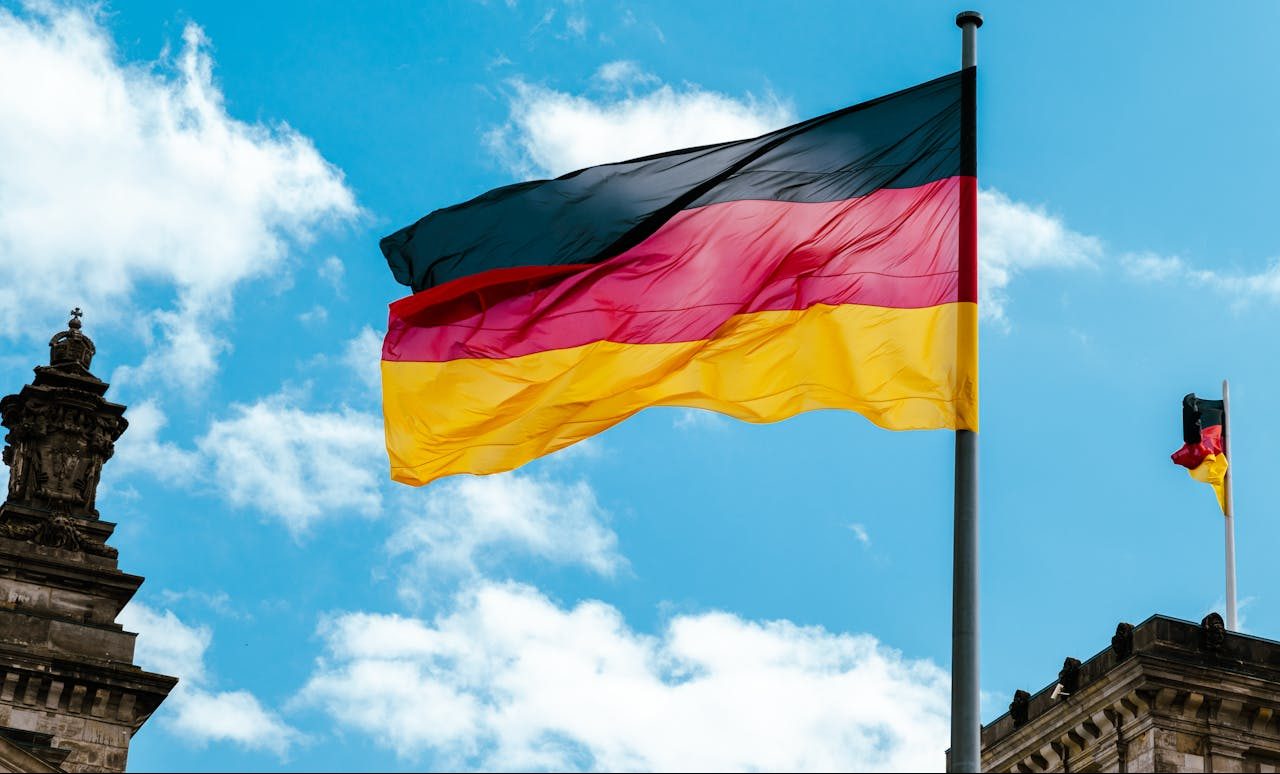
Germany’s 2025 Election: A test for Europe’s unity
Germany’s 2025 federal election, held on Sunday February 23, marked a watershed moment not only for Germany but for Europe as a whole. While the UK media and public have been largely focused on Donald Trump’s second term in the United States, the implications of Germany’s political shift could also prove highly significant. As Europe faces unprecedented security challenges, particularly concerning the defence of Ukraine and Eastern Europe, the outcome of this election sets the stage for pivotal decisions that will resonate far beyond Germany’s borders. Moreover, the results highlight the continued rise of the far right in global politics, a trend that is increasingly shaping the narrative across Europe and the world.
Germany’s parties in review
Germany’s 2025 election showcased a fragmented political landscape. The centre-right Christian Democratic Union (CDU), led by Friedrich Merz, won with 28.6% of the vote. Despite the party’s victory, the result still ranks amongst the party’s lowest post-war performances. Merz has promised to fix Germany’s economy and infrastructure within four years, an ambitious target for Europe’s largest economy.
Contrastingly, Chancellor Olaf Scholz’s centre-left Social Democratic Party (SPD) suffered a historic defeat, securing only 16.4%, its worst performance in over a century. Scholz’s departure from frontline politics symbolises the broader decline of Germany’s centre-left.
The far-right Alternative for Germany (AfD) achieved a major breakthrough, becoming the Bundestag’s second-largest party with 20.8% of the vote. The AfD capitalised on public concerns over immigration and security, with leader Alice Weidel advocating for controversial policies including the “remigration” of criminal migrants.
The Greens maintained a stable 11.6%, while the far-left Die Linke rebounded to 8.8% largely through strong engagement with young voters. However, smaller parties like the pro-business FDP and the new Sahra Wagenknecht Alliance (BSW) failed to cross the 5% parliamentary threshold, underscoring a shift towards polarisation in German politics.
Navigating coalition politics
The election outcome has left Germany in a complex political situation where coalition building is not just a formality but a necessity. With no party securing an outright majority, the CDU must now find a coalition partner to govern. The most viable option is a ‘grand coalition’ with Scholz’s SPD which is a partnership that has a history of providing stability in Germany, most recently under Angela Merkel’s leadership. Together, these parties hold a slim majority with 328 of the 630 Bundestag seats, offering a narrow but potentially effective path forward.
Until a new government is formed, Scholz will continue as a caretaker chancellor, potentially extending a period of political uncertainty at a time when decisive action is needed both domestically and internationally
However, forming this coalition will not be without challenges. Coalition talks in Germany are notoriously long-winded, often involving weeks of negotiations to hammer out detailed policy agreements. Merz has set Easter as the target for establishing a new government, but the SPD’s situation could complicate this timeline. Following their historic defeat, the SPD faces internal upheaval, with outgoing Chancellor Olaf Scholz stepping away from frontline politics and the party needing to elect a new leadership team. These internal changes could lead to delays in coalition negotiations. Until a new government is formed, Scholz will continue as a caretaker chancellor, potentially extending a period of political uncertainty at a time when decisive action is needed both domestically and internationally.
The coalition itself, if achieved, will need to bridge significant ideological divides. Merz’s pro-business stance, advocating tax cuts and deregulation, may clash with the SPD’s focus on social justice, infrastructure investment and support for education. Defence spending is another possible point of contention. While both Merz and SPD heavyweight Defence Minister Boris Pistorius support boosting Germany’s military budget, finding the funds under Germany’s strict debt rules will require careful compromise and innovative financial solutions.
Shaping US and EU dynamics
The outcome of Germany’s 2025 election is set to reshape both domestic policy and the broader geopolitical landscape, particularly Europe’s relationship with the United States. Friedrich Merz’s victory introduced a leadership style focused on redefining Germany’s global role, with a strong push for European independence from American influence.
Merz’s call for “real independence” from the US reflects European concerns over Trump’s unpredictability and fears of weakening NATO solidarity. Trump’s exclusion of European leaders from peace talks with Russia has amplified these anxieties
His sharp criticism of US interference in the German elections, comparing it to Russian meddling, marked a departure from traditionally strong transatlantic ties and hinted at a more sceptical approach to US-German relations under Trump’s second term.
Merz’s call for “real independence” from the US reflects European concerns over Trump’s unpredictability and fears of weakening NATO solidarity. Trump’s exclusion of European leaders from peace talks with Russia has amplified these anxieties. Merz’s suggestion that NATO’s future “in its current form” is uncertain indicates potential shifts towards a more autonomous EU defence strategy, possibly through initiatives such as the Permanent Structured Cooperation (PESCO) and the European Defence Fund to reduce reliance on American military support.
For Ukraine, Merz’s election offers mixed prospects. He has pledged continued support against Russian aggression with Defence Minister Boris Pistorius, a strong advocate for military aid to Ukraine and likely to retain a significant role in shaping policy. Their alignment could boost Germany’s role in supporting Ukraine, enhancing its standing within NATO and Eastern Europe. However, the rise of the far-right AfD, with its pro-Russian stance and opposition to military aid, complicates this scenario. While the AfD remains outside the government due to the ‘firewall’ against far-right collaboration, its position as the largest opposition party allows it to influence debates and potentially disrupt policy initiatives.
The 2025 election results highlight a troubling trend in European politics, this being the continued rise of the far right
The broader European impact is also significant. Merz’s vision of a stronger, more independent Europe aligns with French President Emmanuel Macron’s calls for “strategic autonomy”. However, achieving this will require navigating the diverse interests of EU member states, particularly those who are more fiscally conservative or sceptical of deeper integration. Increased defence spending and robust security policies could become contentious issues within the EU, testing its unity in the face of geopolitical challenges.
The far-right surge
The 2025 election results highlight a troubling trend in European politics – the continued rise of the far right. The AfD party’s success extends beyond its traditional strongholds in the former East Germany, now gaining traction in western industrial regions. This westward expansion signifies a deepening disenchantment with traditional parties and a normalisation of far-right politics among broader demographics, including younger voters. The AfD’s campaign, centred on anti-immigration and security issues, appealed to voters amid a series of deadly attacks allegedly committed by immigrants. The party’s policy of “remigration”, advocating for the deportation of migrant offenders, resonated with segments of the population who felt neglected by the political mainstream.
Beyond Germany, the AfD’s success is part of a broader European trend where far-right parties are gaining ground by exploiting public anxieties about immigration, economic insecurity, and cultural change. Countries such as Italy, France, and Sweden have seen similar shifts, contributing to a more fragmented European Parliament where nationalist and Eurosceptic voices hold increasing sway. The far-right’s influence is not only altering national politics but also shaping EU policy discussions, particularly on migration and climate policies. The European People’s Party (EPP), of which Merz’s CDU is a member, has already moved to adopt tougher stances on immigration, a sign of how mainstream parties are reacting to far-right pressure.
As Europe contends with the geopolitical uncertainties posed by Trump’s US, a resurgent Russia and an increasingly assertive China, the strength of its internal political consensus will be tested
The rise of the far right also presents a strategic challenge for the EU’s external relations. Many far-right parties advocate for closer ties with Russia, oppose sanctions and question the EU’s support for Ukraine. This could lead to more fractious debates within the European Parliament and among EU member states, particularly as the EU negotiates its foreign policy and defence strategies. The international implications of this are profound. As Europe contends with the geopolitical uncertainties posed by Trump’s US, a resurgent Russia and an increasingly assertive China, the strength of its internal political consensus will be tested. If the far right continues to gain momentum, it could hinder Europe’s ability to present a united front on critical issues such as defence, trade, and climate change. This consequently could weaken Europe’s position in negotiations with other global powers and reduce its influence in international institutions.
From election to action
Germany’s 2025 election has exposed deep divisions within the electorate and demonstrated the fragility of Europe’s political landscape. As Friedrich Merz faces the daunting task of forming a stable government, he must balance coalition demands, address domestic concerns, and navigate an increasingly volatile geopolitical environment. His approach to coalition building and governance will set the tone not only for Germany but also for Europe’s response to challenges posed by the US, Russia, and the rising far right.
With the AfD’s rise challenging traditional political norms and Trump’s US creating new geopolitical realities, Germany’s government will need to find a delicate balance between maintaining European unity and asserting independence. Ultimately, how Germany responds to these challenges will influence the continent’s direction for years to come, making this election a critical chapter in both national and European history.
Comments